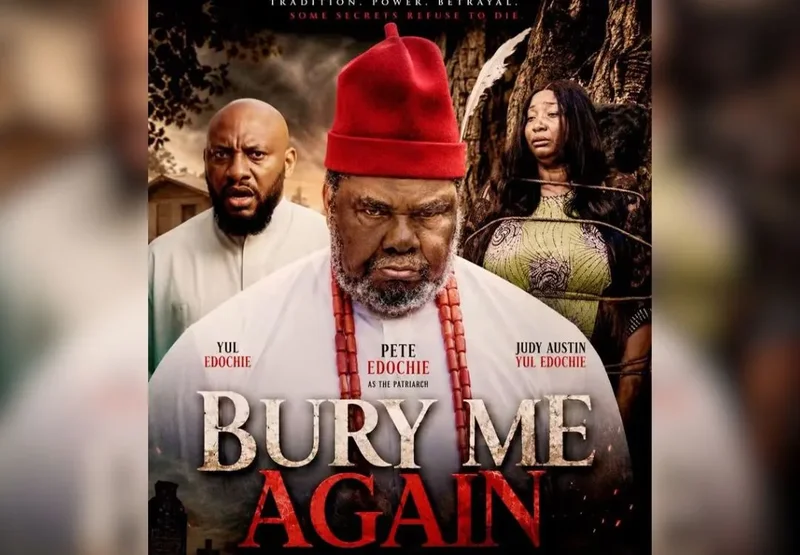
Few themes have endured in Nollywood quite like the consequences of dishonouring the dead, burial rites, and the upholding of traditions. Bury Me Again, directed by actor-filmmaker Yul Edochie and produced by Judy Austin, comfortably sits within that Nollywood legacy.
Released on the YulEdochieTV YouTube channel on 31 July 2026, the film quickly amassed millions of views within days, proof that the Edochie name still commands enormous audience loyalty.
Much of that curiosity stems from the rare on-screen reunion of Nollywood icon Pete Edochie and his son Yul. Their collaboration alone makes the film an event. But beyond its commercial success is the debate on the place of tradition and burial rites.
Plot
Bury Me Again centres on Ikenna (Yul Edochie), a successful businessman whose seemingly stable life descends into chaos after his father, a respected titled elder, dies. Before his father’s passing, Ikenna had promised to accord him a befitting traditional burial, but financial constraints and personal circumstances led him to cut corners, leaving the funeral rites incomplete.
| | |
|---|
Not long after the burial, strange and terrifying events begin to plague his household. Blood-red messages bearing the chilling words “Bury me again” mysteriously appear on the walls, unexplained noises echo through the house, objects shatter without cause, and Ikenna is repeatedly haunted by disturbing visions. His wife, Crystal, watches helplessly as their once-peaceful home becomes a place of fear and uncertainty.
The family’s troubles soon extend beyond the supernatural. Ikenna’s business empire begins to collapse, sea pirates hijack his shipping consignment, his investments fail, and a devastating fire destroys his filling station, pushing him towards financial ruin. As the misfortunes mount, Crystal turns to pastors, prayer warriors and spiritual leaders in search of deliverance, but every attempt to cleanse the home proves futile.
The mystery unravels when Ikenna finally confesses that the torment has nothing to do with murder or foul play but with a broken promise. Consumed by guilt, he admits he failed to perform the elaborate burial rites required for a titled man, believing he could postpone them until he became financially stable.
Fate, however, offers him another chance. A lucrative business deal with Solium Energy unexpectedly restores his fortunes, giving him the means to fulfil his obligation. Determined to make amends, Ikenna organises an elaborate second burial for his father, complete with the traditional rites and the symbolic sacrifice of seven cows befitting the elder’s status.
Performance
If there is one undeniable strength of Bury Me Again, it is its casting. Pete Edochie once again proves why he remains one of Africa’s most commanding screen presences. Whether appearing in flashbacks or as the symbolic patriarch whose absence drives the narrative, he exudes the authority that has defined his decades-long career. His voice alone carries the weight of tradition.
Yul Edochie delivers the emotionally charged performance audiences have come to expect. As both director and leading actor, he embraces the larger-than-life emotional style characteristic of YouTube Nollywood, favouring intensity over restraint.
The chemistry between father and son is less about emotional subtlety. Watching two generations of the Edochie dynasty occupy the same frame provides some of the film’s most memorable moments.
The supporting cast adequately serves the narrative, although few characters evolve beyond the roles required to sustain the supernatural conflict.
Review
The screenplay explores one of southeastern Nigeria’s long-held beliefs: that burial rites are not merely ceremonial but spiritual covenants whose neglect carries consequences that extend beyond death.
It is a concept Nollywood has visited countless times, yet one that continues to resonate because of its cultural familiarity.
The film is thematic, as it raises compelling ideas about the relationship among tradition, Christianity, family responsibility, and cultural identity. Unfortunately, it rarely interrogates these themes beyond surface-level moral lessons.
There is an opportunity to explore how financial hardship, urbanisation and changing social values have altered funeral practices in contemporary Nigeria.
Instead, the screenplay largely reduces the conflict to a simple equation: neglect tradition and suffer spiritual consequences.
The film’s rapid accumulation of millions of YouTube views demonstrates the enduring commercial strength of culturally grounded stories featuring established Nollywood veterans.
It also reinforces YouTube’s growing dominance as a primary distribution platform for Nigerian filmmakers, where audience engagement often outweighs conventional critical reception.
Bury Me Again is less interested in reinventing Nollywood’s supernatural genre than reaffirming its enduring appeal.
It succeeds because it understands its audience. Viewers looking for ancestral mysteries, traditional beliefs, moral instruction, and commanding performances from the Edochie family will likely find exactly what they came for.
Those expecting psychological complexity, nuanced social commentary or innovative filmmaking may leave wanting more.
Ultimately, the film is a reminder that in Nollywood, familiar stories often remain powerful when anchored by iconic performers.
It may not redefine the spiritual-drama genre, but it confidently honours it.
‘Bury Me Again’ is streaming on YulEdochieTV
Verdict: 7/10