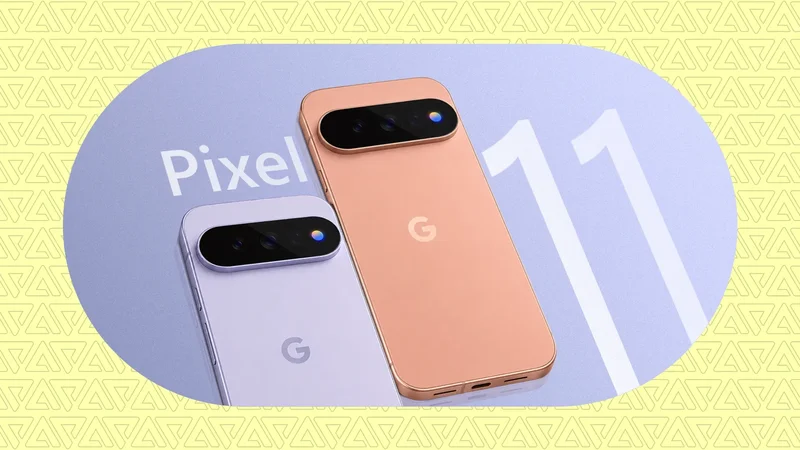
The Pixel 11 is almost here. Google spilled the beans about its upcoming phone range, so we don't have to pretend to be surprised when Google whips the covers off at .
While we're distracted by the upcoming launch, all is not well within the community. The Pixel is not what it once was, and fans are at risk of becoming completely disillusioned with Google's phones.
Worst of all, the . But it might be able to start reversing the course.
Pixel Glow isn't enough to support an entire range refresh
Pretty lights, but there's no weight behind it
Hardware innovation (outside foldable phones) has been lacking where smartphones are concerned, and that's why I broadly like the idea of the bafflingly named "HiLight", formerly known as the much better " ".
this would be more in line with Nothing's Glyph light system, but recent leaks show it's not likely to be much more than an improved notification LED.
And that's fine. I like notification LEDs. But it's nowhere near enough to hang an entire phone range on.
Google used to try crazy stuff with its phones. We've had the squeezable sides, the completely bonkers (and fun) , and a big expansion of Qi2 with the Pixel 10 range's .
But the Pixel 11's big hardware innovation seems to be a pretty light that can tell you when you have an Instagram notification. That's not really enough.
Google is probably expecting new AI features to bridge the gap, but that may not be enough. Because Pixel fans are upset, and many are considering jumping ship.
Fans are losing patience
Google's focus seems to be elsewhere
The humble Pixel hasn't had a great time of it in the last year.
While the was a success, with all models scoring good across the board, it's clear that Google's foundations have become shaky.
Users complain that Pixels aren't as good as they used to be. Animations have slowed down, and interacting with the phone no longer feels as smooth or as immediate.
Keystones of the Pixel experience used to include how fast it was compared to other Android phones, but that's no longer the case.
The instability of the Pixel's software is only adding to this. Crashes have become more frequent, especially in Google's apps.
The is the most notorious of the most recent bunch, and it's seemingly . But it's far from alone, and people are getting sick of it.
Speaking personally for a moment, the accounts of people's meant I held back on updating to Android 17 for as long as I could. When fans are doing that, it's clear something is very wrong.
The problems go further than the software. Take the Tensor processor, for instance. It's well known that the as competing chips, and the trade-off for that is supposed to be better tuning for AI.
Except none of the AI features the Pixel has received in the last few years are exclusive to the Pixel. Samsung and other Android phones either have the same features ported over, or homegrown simulacrums.
So why, exactly, are Pixel owners supposed to be accepting these slower CPUs?
Pixels are midway through a transformation, and it's not a good one. They're slowly becoming the same as every other phone on the market. That's not what Pixel fans signed up for.
All of this comes down to one thing: Google isn't paying enough attention to the details, and it risks alienating its most loyal followers because of it.
It's not too late to fix the situation
Really spend time on what Pixel fans love
The good news is it's not too late to rectify the situation.
Pixel fans are a forgiving sort. They have to be, to have gotten here in the first.
Google dropped the ball a fair amount in its early days. Remember the ? No, me neither. It was a bit rubbish though. But all was forgiven from the onwards.
But quality has skydived, and patience is starting to run out. If Google doesn't take steps to restore what's been allowed to erode, those former faithful are likely to look elsewhere for their upgrades.
A Pixel phone used to feel very different from any other Android phone. It was faster, tighter, smoother — seeing a Pixel in action was supposed to sell you on owning one.
Now, my feels like any other Android device I've used. It's still good, but it's also clear something has been lost. Something important.
It's easy to say Google has been distracted chasing the AI Genie — so I will. AI has delivered some fun and useful toys, but while Google has had its back turned, the Pixel experience has deteriorated.
The camera, once the jewel in the Pixel's crown, is no longer head and shoulders above the competition. Instead, it's all about what AI can do to the image afterward.
Which is great, but a Pixel used to be the ultimate point-and-shoot device. The competition has caught up, and the Pixel is no longer special.
, a problem made worse by the aforementioned battery drain bug.
Speaking of bugs, software updates are now riddled with them, making updating a nail-biting experience. There have been so many reports of bricked Pixels that holding back on updates is recommended by many users.
The Pixel 11 won't fix these problems. At least, not immediately.
But Google can take steps after the Pixel 11 releases. It can lock in, get the software experience tied down tight, and redefine what it means to use a Pixel.
The Pixel needs to look backwards to go forward
Don't leave your faithful behind
The Pixel 3a XL is still one of my favorite phones of all time, so I say all of this with nothing but love. But recent phones have lost the magic that made the Pixel such a great phone.
Google needs to focus on recapturing that magic before it can move forward.
This isn't a problem Google can fix overnight. But if it starts making obvious moves to reverse the decay, fans will stick around to see if it could deliver.
The Pixel 11 certainly won't fix this problem and win back fans. But it might be a start.