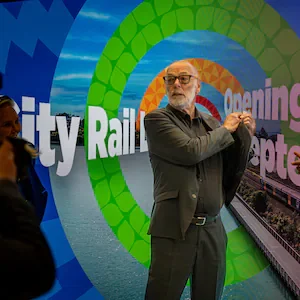
Last week’s announcement of an opening date of September 13 for the City Rail Link showed how difficult it is working on big projects with government involvement. As a developer of complex projects like multiplex cinemas, I’m not big on announcements of openings and would have preferred just to have
The cost to complete it was $1.66 billion, which is not much above the original estimate of $1.5b. The increase was due to extending the pipe to Point Erin to increase the population served. The project took seven years to build, as was expected when it was first planned 10 years ago.
This project, which protects our harbours from the dreadful inflows of effluent during heavy rainfall that have come from old pipes originally designed for effluent and stormwater, has been a great success. It’s come in on time and close to budget and is paid for solely by the council and its ratepayers, with no government money or, more importantly, interference. The work was supervised by Watercare and built by experienced Italian tunnellers Gell and Abergeldie.
This compares with the City Rail Link (CRL), a tunnel project of a pair of only 3.45km-long tunnels that is years late and, at $5.5b, costing around $2b over budget. In contrast, the CRL project was jointly paid for by the Government and the council, with the Government heavily involved at the outset when the then Mayor Len Brown had his enthusiasm more than tempered by the then Government taking a controlling interest in contract signing and contractor selection.
In addition to Auckland Council, Auckland Transport (AT) and NZ Transport Agency Waka Kotahi (NZTA), there was strong input from Kiwirail and the operator Rail One, who had to work with City Rail Link Ltd (CRLL) and they all attempted to manage a group of contractors, predominantly Downer and French Company Vinci plus four others, Soletanche Bachy, WSP Opus, AECOM NZ and Tonkin and Taylor.
Anybody heard of too many cooks spoiling the broth?
There is no question that this will be of great benefit to Auckland – but it still cost too much and took too long.
These two projects reinforce my belief that projects don’t go wrong, they start wrong. The CRL started with way too much emotion and excitement and calls for the railway stations to be major architectural statements were catastrophic for any chance of this being built to a sensible economically viable price.
Early decision-makers seemed to forget that a station is there for people to catch a train at a price of around $5 per trip, given the $50 weekly price cap. Expensive and completely unnecessary ceilings and wall linings not only drove up the cost but will continue to drive up the operating costs. Travellers are not going there to buy expensive items like fashion or jewellery, nor are they going there to get married – yet these stations are in the style and cost of a cathedral.
On top of that foolish scope creep, the CRL fell under the spell of future-proofing, an idiotic mantra that somehow justified stations designed for nine-carriage trains when we only use six-carriage trains. Apparently, these trains will be 50% short in a few decades, the answer to which should just have been to shove more trains through faster and more often.
Does this cost increase matter? Well, given the howls of outrage at the council having to lift rates by 7.9% solely to pay for the CRL, it clearly does. Had it been less expensive and simpler, that increase would have been around 4.9%, with little outrage, nor accompanied by the Government’s shallow call for a rates cap.
It now falls to the council to get as many folk to regularly catch the trains that now will run more regularly to better destinations. To do that, the council will be encouraging more people to live near the CRL stations. This entirely sensible approach has met its own noisy opponents, among whom are some who pushed for the elaborate stations.
It is our job to make this a success but being cheaper would have made this task simpler. There is also a massive cost still coming for better rail crossings, which don’t seem to have been in the original budgets.
Those original decision-makers have disappeared from any chance of being held responsible and, in too many cases, they are now in even more powerful positions. This has to stop.
My biggest worry for the city we love is some government decision to build a cross-harbour tunnel of any sort, especially in the idiotic site where NZTA has been drilling holes. Our grandparents knew that tunnels cost way more than bridges but NZTA missed that message and might want to extend its perfect record of every project being way over budget with this possible cross-harbour tunnel shocker.
Fortunately, we now have a city deal that will require governments of whatever sort to consult and work with Auckland Council, which remains very budget-orientated.
Catch up on the debates that dominated the week by signing up to our Opinion newsletter – a weekly round-up of our best commentary.