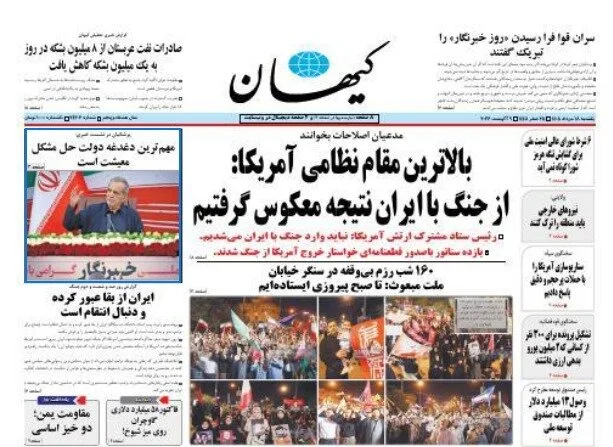
A new order in West Asia
Kayhan, in a commentary, has pointed out when the war will end. The reality is that the Islamic Republic of Iran has shown it can close the Strait of Hormuz in a way that even the world's strongest army has been unable to reopen this vital waterway to ships.
But Iran’s sovereignty over the Strait of Hormuz is not achieved merely by closing it. Now is the time to show that we can open the Strait of Hormuz only for vessels that have not cooperated with the United States and Israel and that comply with the order desired by Iran, and to guarantee their safe passage until they exit the conflict zone. Completing Iran’s sovereignty over the Strait of Hormuz is the basis of the new regional order in West Asia. As long as this order is not established in West Asia, the war has not ended. The United States will not accept this order through negotiation, understanding, or signing a few pieces of paper, and of course Iran also does not need negotiation or agreement to exercise its sovereignty over the Strait of Hormuz and implement the new regional order.
**Etemad: Iran, the architect of the new Hormuz order **
Etemad, aiming to examine the dimensions of the Iran–US agreement and developments in the Persian Gulf, spoke with Gholamreza Karimi, an international affairs expert. Karimi considers this agreement, from a geopolitical perspective, an unprecedented turning point, because now Washington has practically accepted a plan in which Iran’s dominant role over the entrance to the world’s most important energy corridor is recognized. America’s strategic deadlock, reduced missile stockpiles, energy‑market sensitivity to continuation of the war, and the vulnerability of allies such as Saudi Arabia are all factors that have pushed the US toward accepting the realities and trying to restore the flow of oil to the market. For this reason, Israel and hardline factions in the US are worried about this agreement, because it can turn into a lasting pressure lever for Iran.
**Sobh‑e‑No: Efforts to stabilize the new route **
Sobh‑e‑No reviewed details of Iran–Oman negotiations over the Strait of Hormuz. In the ongoing talks between Iran and Oman, Iran is determined to replace the middle route with the pre‑war pattern so that the deterrent role of the Strait is preserved for the country. The main reason for Iran’s insistence on placing the entry route within its own waters is security considerations arising from recent regional tensions and wars. Exclusive control of the entry route within Iranian waters practically obstructs the entry of military equipment and warships into the Strait and gives Iran strategic superiority. The Iran–Oman agreement complements the Islamabad memorandum, because even if an agreement with Oman is reached, the Strait of Hormuz will not automatically reopen. If the US does not adhere to the Iran–Oman agreement and returns to the southern route, then the southern route becomes a legitimate target for Iranian military action.
**Iran: Hormuz, the path back to the memorandum **
The Iran newspaper analyzed the alignment between Tehran–Muscat consultations and revival of the Iran–US understanding. Tehran–Muscat consultations on the mechanism of passage through the Strait of Hormuz can become one of the key links in efforts to revive the Iran–US understanding, because any reduction of tension in this strategic waterway can remove part of the obstacles that have hindered the return of Tehran and Washington to the framework of the understanding. The importance of this issue increases when Tehran–Muscat talks coincide with diplomatic efforts to contain regional tensions. Observers believe any agreement between Iran and Oman on creating a temporary corridor and then reaching a fixed route can provide grounds for redefining security arrangements in Hormuz and ultimately create conditions necessary for resuming the Iran–US understanding.
**Arman‑e‑Melli: The Mecca Pact and Iran–US relations **
In negotiations with Oman, Iran seeks indirectly to ensure that the goal the Americans have for reopening the Strait of Hormuz is achieved through Iran’s own management and in coordination with Oman. Although these talks are indirect, the Americans say they are participating in the negotiations. But this fulfills Trump and the US administration’s aim of being able to announce that the Strait of Hormuz was reopened through diplomacy and by Iran’s own hand. Meanwhile, a pact has also been formed among Saudi Arabia, Turkey, and Pakistan. These countries have very close ties with the US and its policies. They can pressure the US to soften its positions so that negotiations and understanding can proceed; thus, they can also be good intermediaries. Although the Mecca Pact among Saudi Arabia, Turkey, and Pakistan is a defensive pact, one can see traces of potential connection with negotiations and understanding between Iran and the US.