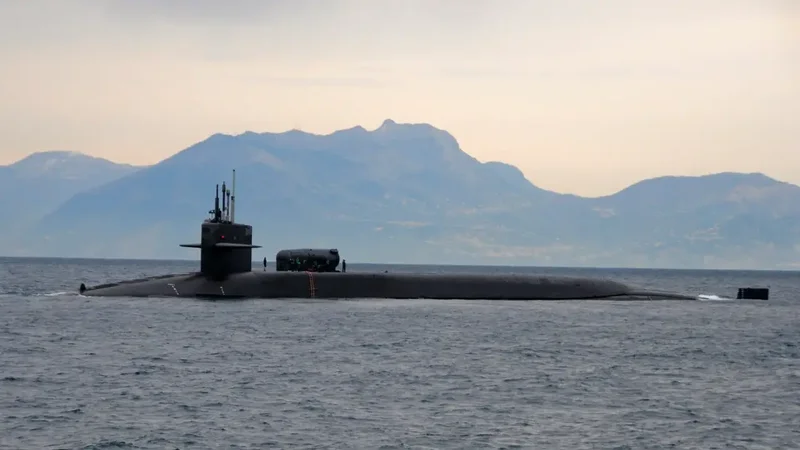
The US Navy decommissioned the nuclear-powered attack submarine USS San Juan (SSN-751) on Thursday, ending the 38-year service of the first Improved Los Angeles-class, or 688i, submarine.
The decommissioning ceremony was held at the US Naval Undersea Museum in Keyport, Washington. San Juan was commissioned on August 6, 1988, as the first of 23 Improved Los Angeles-class submarines.
Its retirement comes as the US Navy faces a widening gap between ageing attack submarines leaving service and Virginia-class replacements entering the fleet.
The Navy's long-term requirement is about 66 nuclear-powered attack submarines, while the force is projected to fall from roughly 49-50 boats in 2025 to about 46-47 around 2030, according to figures cited in the supplied material.
The problem is not only the number of submarines. Ageing Los Angeles-class boats require increasingly extensive maintenance, while the same nuclear-qualified workforce and shipyard capacity are needed for Virginia-class attack submarines and Columbia-class ballistic-missile submarines.
San Juan was a technological bridge to Virginia
Built by General Dynamics Electric Boat, USS San Juan had a submerged displacement of 6,197 long tons and was powered by an S6G nuclear reactor.
It carried four 533-mm torpedo tubes and 12 dedicated vertical launch tubes for Tomahawk cruise missiles.
As the first 688i submarine, San Juan introduced several improvements over earlier Los Angeles-class boats, including retractable bow diving planes, a reinforced sail for Arctic operations, additional noise-reduction measures and the AN/BSY-1 combat system.
The changes were aimed at improving the Navy's ability to detect increasingly capable Soviet submarines and operate beneath Arctic ice.
San Juan demonstrated the capability in 1993 when it conducted the first through-ice surfacing by a 688i submarine, according to the supplied material.
The submarine also reflected the changing role of US attack submarines. Originally focused heavily on anti-submarine warfare, the Los Angeles class evolved into a multi-mission platform combining submarine hunting, intelligence gathering, anti-surface warfare and land attack.
San Juan launched Tomahawk missiles from the Red Sea during Operation Iraqi Freedom in March 2003.
Its final operational deployment began in December 2022 and ended on June 6, 2023, after covering nearly 37,600 nautical miles and operating in the Mediterranean, North Atlantic and High North.
It entered Reserve, Stand Down status in August 2024 before its decommissioning.
Why the retirement matters
The retirement of one submarine does not by itself create a major change in US military capability. The wider concern is the pace at which Los Angeles-class submarines are retiring compared with Virginia-class deliveries.
The US built 62 Los Angeles-class submarines between 1972 and 1996. Most surviving boats are now more than three decades old, making their continued operation increasingly expensive and maintenance-intensive.
Extending their service can require major work on reactor systems, propulsion, piping, electrical equipment, sonar and structural components. Those overhauls also occupy shipyard capacity and require specialised nuclear workers.
A separate analysis by Defence Security Asia estimates that around 37-40 per cent of the attack-submarine fleet can be unavailable at a given time because of maintenance, modernisation and other readiness constraints. That should be treated as an estimate rather than a fixed fleet-wide rate.
Similarly, the attack-submarine fleet could fall to roughly 45-47 boats around 2030-31 before gradually recovering.
Virginia deliveries lag behind retirements
Virginia-class submarines are intended to replace the Los Angeles class, but production has not consistently reached the pace required to prevent the fleet from shrinking.
Although Virginia-class boats have generally been procured at two a year since fiscal 2011, the supplied material says actual deliveries have averaged only around 1.1-1.3 submarines annually since about 2022.
The challenge is compounded by the Columbia-class programme, which is the Navy's priority for maintaining the US sea-based nuclear deterrent.
One Columbia submarine can consume an industrial workload comparable to roughly 2.5 Virginia-class submarines.
A July 2026 contract worth $76.6 billion covered nine Block VI Virginia-class submarines, five Columbia-class submarines, material for a tenth Virginia and additional industrial support.
But funding alone cannot immediately solve the problem. Shipyards require trained workers, suppliers, facilities and specialised nuclear expertise, all of which take years to expand.
AUKUS adds pressure
The US submarine industrial base also faces additional demands from AUKUS. Australia is expected eventually to acquire three to five Virginia-class submarines from the United States.
The supplied material estimates that the requirement could rise to about 2.33 Virginia-class submarines annually when planned AUKUS transfers are taken into account.
This comes while the Navy is trying to establish a sustained production rate of two Virginia submarines and one Columbia submarine annually.
The next-generation SSN(X) is not expected to provide a near-term solution, with production not anticipated until the early-to-mid 2040s. That leaves Virginia production and the remaining Los Angeles-class boats as the main factors shaping US attack-submarine numbers through the 2030s.
Another gap: Ohio-class SSGNs
The Navy is also retiring its four converted Ohio-class guided-missile submarines, or SSGNs, which can carry large numbers of Tomahawk cruise missiles.
Their retirement will reduce concentrated undersea strike capacity. The Navy plans to partly replace the capability with Virginia-class submarines equipped with the Virginia Payload Module (VPM).
Nineteen Virginia-class boats are planned to receive VPM, which adds a large hull section containing 28 additional launch cells.
The first VPM-equipped Virginia is expected around fiscal 2029, while completion of the planned fleet could extend into the late 2030s, according to the supplied material.
The SSN and SSGN retirements are separate issues, but both increase pressure on the Virginia programme.
China and Russia raise the stakes
The fleet gap comes as the US Navy faces growing submarine requirements in multiple theatres.
China is expanding its nuclear and conventional submarine forces, increasing pressure on the US Navy in the Indo-Pacific, where attack submarines are expected to conduct surveillance, anti-submarine warfare, sea denial and strike missions.
Russia's continued submarine modernisation creates additional requirements in the North Atlantic, Arctic and surrounding waters.
This means the US Navy must distribute a limited number of deployable attack submarines across geographically distant theatres while also accounting for maintenance, training and crew preparation.
What San Juan's retirement shows
USS San Juan's decommissioning marks the end of a 38-year career and the retirement of a submarine that introduced capabilities that became important to subsequent US attack-submarine development, including improved acoustic performance, Arctic operations, digital combat systems and dedicated land-attack capability.
But its retirement is significant mainly because it comes during a broader transition in the US undersea fleet.
Ageing Los Angeles-class submarines are leaving service faster than Virginia-class boats are being delivered, while the Navy must simultaneously manage maintenance backlogs, Columbia-class construction, AUKUS commitments and the retirement of Ohio-class SSGNs.
The Navy's long-term requirement is about 66 nuclear-powered attack submarines, but projections supplied in the material show the fleet remaining well below that level through the 2030s.
The central challenge, therefore, is not simply replacing USS San Juan. It is maintaining enough operational submarines while the US Navy balances ageing hulls, shipyard capacity, workforce shortages, new construction and rising demands from China and Russia.
San Juan's retirement is one visible sign of that larger undersea force transition.