Here is SpacePolicyOnline.com’s list of space policy events for the two weeks August 9-22, 2026 and any insight we can offer about them. The House and Senate are in recess except for pro forma sessions.
During the Weeks
The Senate did indeed leave for summer break, though they stayed in session through the night Friday into Saturday to pass some of the more critical legislation and nominations — more on that below. With both the House and Senate gone, the dog days of summer are here meaning fewer events than usual, so we’re combining the next two weeks. Enjoy the brief respite. Things get busy again after that.
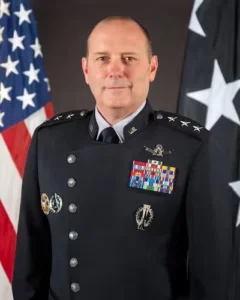
First, to recap two especially important Senate actions before they left: Lt. Gen. Douglas Schiess was promoted to General and confirmed as the next U.S. Space Force Chief of Space Operations, and they passed their version of a Continuing Resolution (CR).
Schiess is currently the Space Force’s Deputy Chief of Space Operations for Operations, developing and implementing policy for global operations, sustainment, training and readiness. He’ll be the third Chief of Space Operations, succeeding Gen B. Chance Saltzman who is retiring this month. Saltzman posted on X: “Congratulations to my teammate, Lt Gen Doug Schiess, on being confirmed as the next Chief of Space Operations. The future of our @USSpaceForce is in great hands!” We’ll let you know when they announce details of the change-in-command ceremony, which probably will be soon.
As for the CR, the Senate-passed version is very different from what the House approved. For example, the Senate version prevents the Administration from implementing a proposed rule that changes how federal grants are awarded. Critics say the changes would mean awards are granted on political grounds, not merit. The effect would be very broad, but the American Astronomical Society and the Planetary Society have useful overviews of the impact on science and space. It’s not a permanent fix. The CR only prevents implementation until the CR expires on December 11.
The House bill was narrowly crafted and did not address that or many of the other issues in the Senate version. It would expire on December 4. The two chambers have a lot of work to do to reach common ground if they want to avoid a government shutdown on October 1, just a few weeks before the November 3 mid-term elections. The House returns on August 31, the Senate on September 14 (after the Labor Day holiday). Both chambers will hold only pro forma sessions until then.
This week, the big event is the total solar eclipse that will cover parts of Greenland, Iceland, Portugal, and Spain among other countries on Wednesday. A partial eclipse will be visible in many other places. Don’t forget to wear eclipse glasses! ESA will hold an in-person event in León, Spain. ESA and NASA will both provide live coverage on YouTube and other platforms for everyone who can’t see it in person. As awesome as it undoubtedly will be, it’ll be tough to beat this one from the Artemis II mission.
One other event we’ll highlight is NASA’s next spacewalk, number 97. It was scheduled for this Thursday, but NASA has postponed it several days, to August 18. An anomaly occurred in astronaut Anil Menon’s spacesuit during last week’s EVA and NASA needs time to check it out. Toward the end of his 6 hour 27 minute spacewalk with Jessica Meir, a carbon dioxide sensor gave an unexpected data reading. Menon reported no issues and the sensor returned to normal after he was back inside and took off the suit, but NASA is evaluating whether they should use a different suit.
Before we go, we want to congratulate Brian Weeden for his appointment as the new Editor-in-Chief of the quarterly journal Space Policy, published by Elsevier. He posted on X (@brianweeden): “A long time ago as a young researcher getting started in this field, my goal was to one day be published in Space Policy Journal, the top in our (small) field. Today, I am very pleased to announce I’ve assumed the role of Editor in Chief.”
Brian is very well known in the space policy community and is currently Director of Civil and Commercial Policy at the Aerospace Corporation’s Center for Space Policy and Strategy. Before that he spent 16 years at the Secure World Foundation (where he also was the founding Executive Director of CONFERS) and nine years in the Air Force. He’s the fifth EIC since the journal was founded in 1985, succeeding Frances Brown, Jill Stuart, Laura Delgado López, and most recently Dimitrios Stroikos. [Full disclosure: your SpacePolicyOnline.com editor has been on Space Policy’s editorial board since the early days and is currently the North American Editor. Many of you may also know Xavier Pasco, the European Editor.] Congrats, Brian!
The events we know about as of Sunday morning, August 9, are shown below. Check back throughout the weeks for others we learn about later and add to our Calendar or changes to these.
Sunday-Thursday, August 9-13
- 2026 Taiwan Lunar Symposium, Sun Moon Lake, Taiwan (local time)
Monday, August 10
- JAXA Launch of QZS-7, Tanegashima, Japan, 3:23 pm EDT (August 11, 4:23 am Japan Standard Time)
- Rocket Lab Second Quarter 2026 Financial Results, virtual, 5:00 pm EDT
Tuesday-Wednesday, August 11-12
- 2026 Southern Space Conference, Canberra, Australia (local time)
Wednesday, August 12
- Coverage of Total Solar Eclipse in Greenland, Iceland, Portugal, Spain
- NASA livestream coverage begins 1:15 pm EDT
-
ESA livestream coverage begins 19:30 pm CEST (1:30 pm EDT)
-
Virgin Galactic Second Quarter 2026 Financial Results, virtual, 5:00 pm EDT
Friday, August 14
- NASA News Conference to Preview Event on U.S. Leadership in Aviation and Space, KSC/online, 2:30 pm EDT
Tuesday, August 18
- NASA Spacewalk 97 (2nd of 3), Earth orbit, details TBA
Thursday-Friday, August 20-21
- Texas Area Planetary Science (TAPS) Meeting, Austin, TX