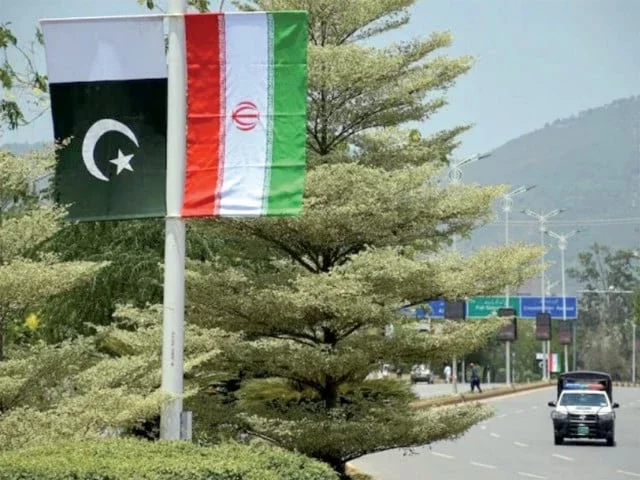
Is $10b Pak-Iran trade a pipe dream?
Sanctions, barter and geopolitics stand between promise and reality
ISLAMABAD:
Recently, the joint commitment by the leadership of Iran and Pakistan to raise bilateral trade to $10 billion has attracted considerable attention. This article provides a historical overview of bilateral trade and argues that achieving this target will require credible solutions for payments, sanctions compliance and transit connectivity.
In 2006, exactly 20 years ago, Iran and Pakistan signed a "Preferential Trade Agreement" under which Pakistan offered concessions to Iran on 338 tariff lines and Iran gave concessions on 309 tariff lines, covering roughly 18% of mutual MFN tariffs. In that year, according to SBP data, total bilateral trade was $638 million, of which $450 million represented exports from Iran to Pakistan. Primary exports from Iran to Pakistan included petroleum gas, refined petroleum, electricity and dried legumes. Primary exports from Pakistan to Iran consisted of rice, meat, fruits, vegetables and textiles.
Bilateral trade between Iran and Pakistan reached $1,321 million in 2009, after which it began to decline. By 2020, it had fallen to $438 million; subsequently, according to formal recorded trade data, it fell to zero and has remained there. US sanctions and the absence of viable payment channels became major barriers to the expansion of formal trade.
To overcome payment-channel challenges, since 2023 Iran and Pakistan have been implementing a barter trade system under the "Business to Business Barter Trade Mechanism". Although no public data is available because of the complexity of these transactions, current barter trade is estimated at around $3 billion – more than double the last recorded level of formal bilateral trade.
Pakistani public and private entities can trade 26 approved commodity categories, ranging from food products like milk, cream, eggs, cereals and rice to manufactured goods, textiles and metals.
It shows one thing: sanctions have only converted the direction of trade – they have not necessarily stopped it. They may have encouraged smuggling and barter trade.
However, one should remember that barter trade can only serve as a stop-gap measure for formal trade. The basic requirement of barter is mutual dependence: Pakistan must have rice, for example, of equal value if it wants to purchase oil of the same value, or it must offer an equivalent basket of goods.
This is quite different from a situation in which Pakistan runs a trade surplus with some countries – mainly the US and EU – and a trade deficit with others – mainly China – before arriving at an overall trade balance. In a way, barter trade belongs to the past, before the idea of comparative advantage prevailed and reshaped the direction of global trade.
Recent regional developments may again alter this trajectory. On February 28, 2026, the region plunged into crisis after the US-Israel attack on Iran decapitated its leadership. As the crisis deepened, Pakistan emerged as one of the most significant mediators and interlocutors for peace. Leveraging this, in April 2026, Pakistan notified six routes for the transportation of goods to Iran against an encashable bank guarantee through "Transit of Goods through Territory of Pakistan Order 2026".
In August 2026, both countries, through high-level ministerial dialogue, expressed a commitment to raise bilateral trade to $10 billion. This is one of the positive outcomes of the Iran-US war, which has forced both Pakistan and Iran to deepen trade and connectivity through formal routes.
Iran has opened doors for Pakistan to Central Asia which were closed by Afghanistan. Pakistan has opened its ports for re-exporting Iran's goods to third countries, under the new transit arrangements.
This can provide a lifeline to Iran's economy as the Strait of Hormuz continues to face blockages. According to US sources, Iran was losing an estimated $500 million per day because of the naval blockade.
The next steps are more challenging. The immediate challenge is to develop a roadmap for converting the target of $10 billion trade into concrete milestones and a credible pathway.
If only formal trade is counted, the target implies moving from zero to $10 billion. If barter trade is included, the current base is closer to an estimated $3 billion. However, if the past is any guide, a sharp increase from this base is unlikely without concrete policy measures.
Such export targets may generate newspaper headlines, but they will have limited practical meaning unless supported by credible payment, compliance and logistics mechanisms.
A more practical step for Pakistan would be to request a US waiver for the purchase of petroleum products from Iran. Several countries, including China, Turkiye and India, have obtained similar arrangements that allow them to purchase petroleum products from Iran.
Pakistan, as Iran's neighbour, can secure a credible source of cheaper diesel and petrol. To make this viable, it must also close smuggling routes that are undermining both the formal market and government revenue. A second practical step is to explore a currency swap between Iran and Pakistan. A proposal already exists, and Pakistan should move to operationalise it through the Asian Clearing Union.
THE WRITER IS CHIEF EXECUTIVE OFFICER OF PRIME, AN INDEPENDENT ECONOMIC POLICY THINK TANK