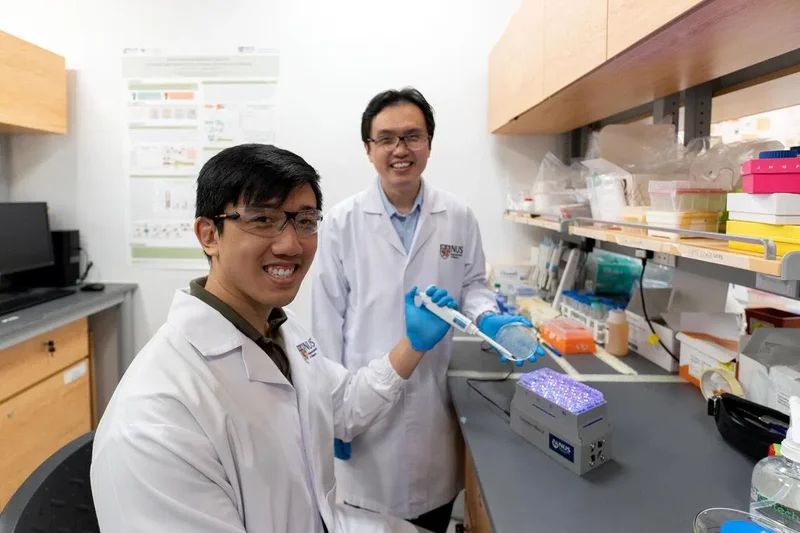
NUS researchers brandish light beams for biotechnology breakthrough
AI generated
SINGAPORE – Used for thousands of years in leavening bread and alcohol fermentation, yeast has in recent years become a key ingredient in biotechnology, with engineered versions of the microorganisms used to convert sugar into products ranging from medicines to fuels.
However, because it is a living organism, even well-engineered yeast can be difficult to control with precision.
To get around this, researchers from the National University of Singapore (NUS) employed optogenetics – the use of light to control cell activity.
“Achieving precise, dynamic control over cellular machinery has been a goal in synthetic biology,” said Poh Chueh Loo, an associate professor from NUS Synthetic Biology for Clinical and Technological Innovation, who led the research. “By using different colours of light to dictate complex, multi-step processes, we are paving the way to make biological manufacturing more predictable and programmable.”
Cells can be rewired to turn on or off selected genes in response to light, and biological instructions can be delivered by exposing yeast to different colours and patterns of light, without the need to repeatedly add chemical inducers.
While the use of light has been shown to control biological processes in yeast, the researchers for the new study found that one key challenge was making yeast respond reliably to red light.
Red light is often used in optogenetics as it is able to penetrate deep into biological tissues without significant cellular damage.
Existing red light-responsive optogenetic systems in yeast require several introduced genes, additional cofactors – otherwise known as “helper” molecules, which bind to enzymes to speed up chemical changes – or careful handling to avoid unintended activation.
These limitations made it difficult to combine them with other light-controlled systems, the researchers said.
To get around this, the team adapted iLight, a light-sensitive genetic tool that had previously been used to control gene expression – the process by which instructions in DNA are used to produce proteins – in bacteria and mammalian cells.
This was used to develop a protein for yeast which responds to red light, which they dubbed y-iLight. When exposed to red light, y-iLight attaches to certain DNA sequences in the yeast, activating specific genes.
The protein also works without the need for additional chemicals beyond those naturally found in yeast.
This makes it more cost-effective and reliable, as well as more environment-friendly, said Linus Tan, lead author of the study.
One limitation was that the molecule used to detect red light was also sensitive to blue light, said Tan, a PhD student with the NUS College of Design and Engineering.
The researchers came up with a solution where y-iLight was fused to protein modules designed to block its activity specifically under blue light.
Different combinations of the two were developed to identify variants that preserved red light responsiveness while suppressing unwanted blue light activation.
The improved system for red light was then combined with an established blue light-responsive system called EL222 – a light-sensitive protein derived from marine bacteria.
The researchers noted this was a major step towards multiplexed optogenetics in yeast – where different coloured light can be used to control multiple biological processes.
Different coloured lights can be used to deliver more complex instructions to the yeast, the team noted.
For example, by exposing yeast to different amounts of red and blue light, the researchers could adjust how the yeast made luteolin – a natural compound found in fruits and vegetables with antioxidant and anti-inflammatory benefits.
And by connecting FLO1, a gene for flocculation – a process where small particles in a liquid clump together – to a red light-activated genetic switch, the team found that red light could trigger yeast cells to clump together and sink.
In an experiment, the researchers were able to show that the yeast could produce luteolin under blue light and then clump together under red light.
This demonstrated how light could control production and separation, which could be used to derive cleaner and more programmable biomanufacturing methods, they said.
The team was also able to use optogenetics to engineer yeast to produce different coloured compounds in response to red or blue light, spread the cells as a thin layer on agar and projected light through masks.
This was able to produce multi-colour “living images” grown by yeast.
Their findings were published in the scientific journal Nature Communications in May.
The team is now working on boosting the strength and sensitivity of the light-sensitive proteins, and also hopes to be able to introduce more colours of light, which could allow for even greater control of such processes, Poh said.
In the longer term, the team wants to be able to bring the technology to market, by spinning off a start-up or working with others who wish to license the technology.