The balance of power is a security philosophy that reflects the post-Cold War security paradigm and was proposed by Hans J. Morgenthau, the father of classical realism. This concept describes the practice in which states with limited capabilities form a bloc to counter shared threats. States that cannot fend for themselves pool their capabilities, guided by the beliefs that “unity brings strength” and “the enemy of my enemy is my friend.”
In contrast to the balance of power, “bandwagoning” involves capitalizing on and benefiting from the power of a strong and threatening state rather than challenging it. Thus, a state seeks to gain privileges while entrusting its own survival to the initiative of a more powerful state. During the Cold War, this trend also fueled polarization. Weaker states that sought to ensure their security by aligning with one of the hegemonic powers, the United States or the Soviet Union, were simultaneously forced to accept the rules dictated by that hegemonic power.
In the aftermath of the Cold War, however, these two main conceptual debates did not disappear but instead took on a new form. As the U.S., the sole hegemonic power, came to dominate the international system, discussions also began to focus on regional systems and regional hegemonic powers. More recently, the focus has shifted to “middle powers.” While these concepts have traditionally centered on the dynamics of great power competition, new concepts such as strategic autonomy have come to challenge the boundaries of middle powers.
The new phenomena can be scrutinized by very fundamental questions: Under what circumstances does a state remain within the framework of “bandwagoning,” to whom does it remain subordinate, and under what conditions does it shift toward strategic autonomy? As the hegemonic power, unable to accept the claim of strategic autonomy, voices criticism of an “axis shift,” it begins to calculate how to keep “middle powers” under control and when it must use force.
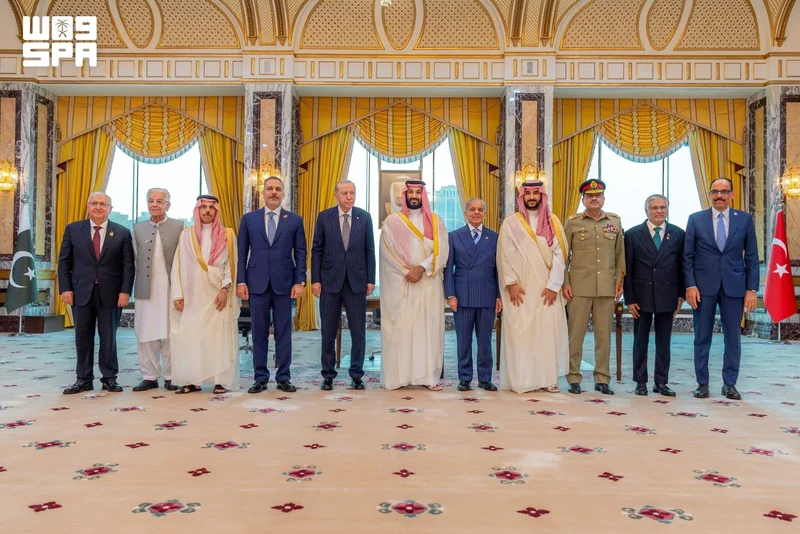
Following the Mecca Alliance Treaty, signed on Aug. 7 in Mecca by Türkiye, Saudi Arabia and Pakistan, the relevant concepts in international politics have taken on new meaning. Raising these questions first and then answering them might spark a new debate:
Does the Mecca Treaty challenge the international system under U.S. hegemony, or is it a response to new realities?
Can this treaty be explained in terms of the “Islamic Civilization” in Huntington’s “Clash of Civilizations” thesis, or is it a state-centered phenomenon of realpolitik?
How should the treaty's aftershocks be analyzed?
In the context of the first question, it should be noted that the treaty amounts to a repetition of history. Such alliance relationships have frequently been established, primarily on the European continent, in response to common threats. With the establishment of NATO, a generalized defense architecture has taken shape in Europe, replacing the regional alliances. On the other hand, NATO member states still maintain alliance arrangements such as the U.S.-Greece, the U.S.-Japan, and the U.S.-Singapore. For this reason, the Mecca Treaty is not a phenomenon that runs counter to the normal course of international politics.
Once the Middle East, particularly the Gulf, is revisited, a rentier-based political-economic system is in place. The continuity of these states, in the context of internal security, depends on the continuity of energy revenues, while external security has been outsourced to the U.S. in exchange for energy concessions. However, the realization that these countries’ sensitivity toward Iran is real and that U.S. security guarantees are illusory marked a significant turning point. When Israel’s strike on Qatar is also taken into account, it became clear that the U.S.’s “America First” motto has led it to neglect the Gulf countries in favor of Israel. Such an environment of distrust naturally brings the “self-help” mechanism and new avenues of exploration to the forefront.
As tensions in the region persist, the Gulf states have sought to maintain relations with the U.S. on the one hand while pursuing security solutions independent of the U.S. on the other. The Mecca Treaty is the most significant pillar of this trend. Consequently, an additional layer of security has been established over the past five months to counter Iran’s attacks on the Gulf states. From Pakistan’s perspective, Saudi and Turkish support against India serves as a significant deterrent, while Türkiye has created important room for maneuver against Israel’s threatening rhetoric and the policy of encircling Türkiye via Greece.
Thus, the Mecca Treaty can be understood not as a challenge to the international system but as a measure taken against clusters of threats emerging within intertwined regional systems. These three countries, standing shoulder to shoulder, are developing measures to counter threats emerging from three different directions, that is, against realities that are already making themselves felt.
Although Huntington’s famous “Clash of Civilizations” focuses on the ethnic conflicts of the 1990s, it contains its own biases. Indeed, while the work’s subtitle focuses on the “remaking of the world order,” it offers recommendations for American policy. When describing civilizations, he lists races and nationalities, with one exception: the Islamic civilization. Huntington’s bias has led to Muslim countries being perceived in the security sector as a single entity.
The anti-Islam sentiment that emerged in the U.S. and Europe following the Sept.11 attacks, in turn, triggered an approach steeped in prejudice against the entire Muslim world. Nevertheless, the Muslim world was far from solidarity and consciousness of how American, European, Russian, Indian or Chinese perceptions interpret them.
This mindset, which alienated the Muslim world, naturally bolstered claims that the “Muslim NATO” had been established by the Mecca Pact. Although the Mecca Treaty declared the alliance open to third parties, the emphasis on Muslim solidarity lent credibility to those claims. Indeed, Gulf countries such as Qatar, Kuwait and Bahrain, as well as Muslim countries like Indonesia and Malaysia, are not opposed to such an alliance, despite the United Arab Emirates' (UAE) silence. But it is too early to assess this agreement as a NATO-like entity because of its lack of institutionalization.
However, because the treaty was signed by three sovereign states, it establishes a unique balance of power without aligning with a hegemonic power, in other words, without being subject to “bandwagoning.” No religious or sectarian prerequisites have been imposed for membership in this alliance. All three countries have decided to form this alliance based on their own security and threat assessments. Given that Türkiye and Saudi Arabia have had an up-and-down relationship in the past, “circumstances” dictated such an alliance. Thus, its formation is a result of realpolitik.
This agreement will primarily enhance cooperation among the three countries not only in defense but also across all sectors of state and societal life, in keeping with the spirit of the alliance. In other words, the alliance agreement could create a spillover effect, leading to “integration” in financial, commercial, legal or other areas. However, such an agreement will have an “impact” on other states and may provoke both positive and negative reactions.
From the U.S. perspective, this agreement is a positive development regarding Iran. The U.S. is likely to support this alliance to maintain the regional balance. Israel, on the other hand, will begin a complex analysis of the situation. While Israel is expected to remain silent about this alliance, which aims to keep Iran at a distance from Israel, it is causing concern due to Türkiye’s perception of the matter. For this reason, Israel is expected to pursue new initiatives through Greece and the Greek Cypriots, attempting to encircle Türkiye.
Meanwhile, Iran is gripped by panic over losing control in the Gulf rather than by the perception that the agreement was made against it. As Iran pretends to be more powerful than it is, it can be expected to carry out asymmetric tests against the alliance. In this context, the three new allies must be prepared for the Houthis’ test attacks targeting the Red Sea and Saudi Arabia. Iran, which seeks to impose a toll on the Gulf via the Strait of Hormuz, may perceive this alliance as a threat and attempt to stir up Shiite identity.
Another country that will be displeased with the scope of the agreement is India. India, which blamed Tükiye for the tensions it experienced with Pakistan last year, may seek to cooperate with Israel, Greece, and the Greek Cypriots against Türkiye and Saudi Arabia, which have provided defense guarantees to Pakistan.
In conclusion, the Mecca Treaty is a step taken toward a regional balance of power. It aims to produce solutions that address the security needs and defense expectations of states rather than fostering religious unity. However, the goal is to establish stability in the region through collective effort, drawing lessons from past experiences and cooperating with the U.S., the global hegemon.