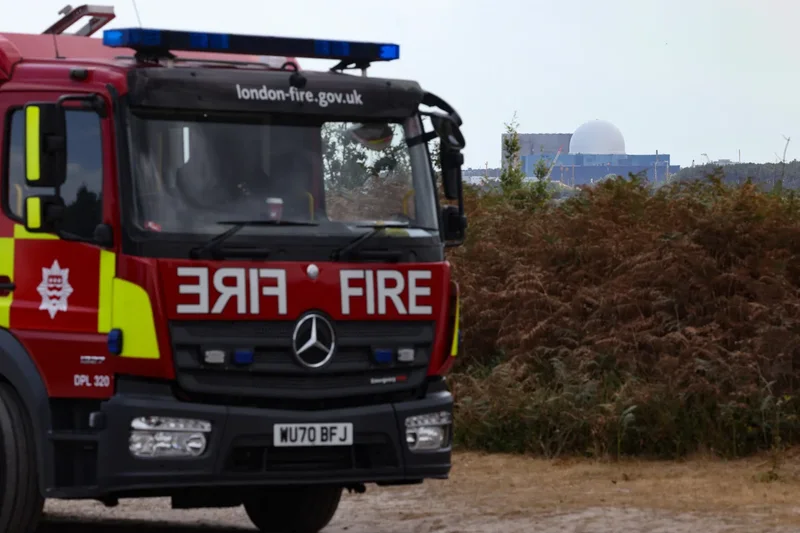
A significant blaze involving over 20 fire engines is currently being tackled near the A31 in Hampshire, after a vehicle fire rapidly spread to adjacent heathland, emergency services have confirmed.
Hampshire and Isle of Wight Fire and Rescue Service reported receiving more than 160 emergency calls regarding a vehicle ablaze on the eastbound A31 at approximately 5.24pm on Sunday.
A substantial response has been mounted, with twenty-six fire engines, four water carriers, six off-road vehicles and multiple command units deployed to the scene near Ringwood.
The fire service detailed the incident, stating: "The fire spread from the vehicle to the central reservation before progressing into nearby heathland.
“Crews from across Hampshire, supported by colleagues from Dorset and Wiltshire Fire and Rescue Service, are currently attending the incident."
The A31 is closed between Picket Post and junction two of the M27.
Motorists have been urged to avoid the area and use alternative routes whenever possible.
The fire service added: “Please follow diversion signs, allow extra time for your journey and avoid the area to allow emergency crews to work safely.”
Meanwhile, Nottinghamshire Fire and Rescue Service declared a major incident on Sunday as two large fires in woodland put a strain on resources.
Several wildfires have broken out in the UK over recent weeks, including large blazes at Dunwich Heath in Suffolk, Headon Warren on the Isle of Wight, Llanwonno in the Rhondda Valleys, South Wales, and the Cairngorms National Park in Scotland.
Hot weather continued to build on Sunday, with the south and south-eastern parts of England expected to have the highest temperatures.
According to the Fire Severity Index, any wildfires are likely to be exceptionally severe on Sunday in almost all of the east and south-east of England.
“Exceptional” severity is its highest ranking.
The Met Office data includes rainfall, temperature and humidity, and agencies use the index to assess the severity of fire if it starts.
It does not cover the chances of wildfires occurring.
Heatwave conditions will likely return next week, with a high of 36C expected in parts of East Anglia and south-east England by Thursday, according to the Met Office.
So far the extreme weather of summer 2026 has included two record-breaking heatwaves in May and June that led to more than 2,800 excess deaths.
Two more heatwaves in July, the driest July in England and Wales since records began in 1836, have fuelled drought and wildfires.