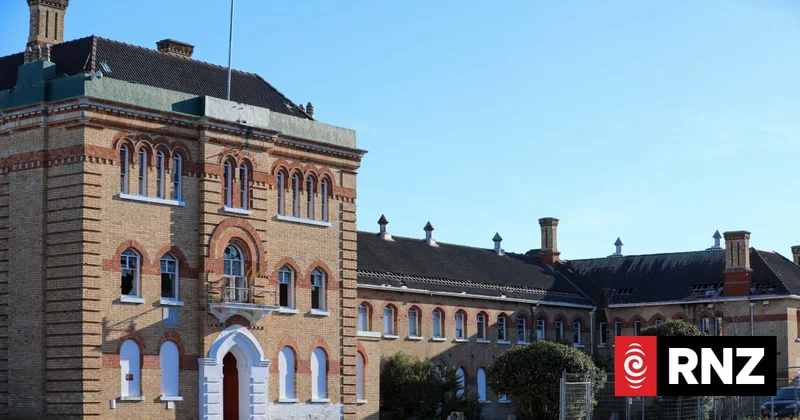
'Stop the rot': Protesters fear Auckland's Carrington Hospital facing 'demo by neglect'
What happened to Auckland's former Carrington Hospital?
The vast brick exterior of the former Carrington Hospital in the Auckland suburb of Mt Albert is an impressive sight - from a distance.
But up close, windows are smashed or boarded up, graffiti is strewn across the building's facade, and whole rows of roof tiles are missing.
Built in 1865, the Category 1 historic place opened as the Whau Lunatic Asylum, and was used for psychiatric and mental heathcare for more than 120 years, and then was part of tertiary institute, Unitec, until 2021.
For the past five years, it's sat empty, and deteriorating.
Tired of watching the heritage building's decline, a group has gathered in front of the building on Saturday mornings through the winter.
"We hold our little placards that say 'Stop the rot', and 'Fix the bloody roof' and 'Shame this' and 'Shame that'," said Chris Casey, a trustee of The Cachet Foundation, a charity which aims to support artists and protect heritage buildings.
"We protest weekly just to highlight the fact that we think it's shameful that government and the managers are not protecting the building."
He told RNZ the group was prepared to fundraise to weatherproof the building, and in particular, to fix the roof where rows of tiles have been removed, exposing interior timber.
"If it's a case of money, well then speak to the community. We're good fundraisers, we know where we can get money from. I don't think it's a huge amount of money to weatherproof it," Casey said.
The Crown acquired the site in 2018, as part of a 40-hectare parcel that is part of Treaty of Waitangi redress, and where 4000 homes are planned to be built in coming decades.
As part of development preparations, Heritage New Zealand Pouhere Taonga recommended four buildings across the wider site, including the former Carrington Hospital main building, be protected with heritage covenants.
Only one building, the Pumphouse, now has that. Another, Penman House, was demolished last year.
Once Unitec moved out of the building, the former Ministry for Housing and Urban Development (now part of the Ministry of Cities, Environment, Roads and Transport, MCERT) took over responsibility for its maintenance.
An MCERT spokesperson said the ministry did reactive maintenance while it held the building, including boarding up broken windows, but it wasn't responsible for decisions about the building's future.
"We initially boarded up only broken windows, to avoid fully concealing a heritage building, but later boarded up all ground-level doors and windows, to improve security.
"We also employed CCTV and fulltime security guards 24/7, 365 days a year. Unfortunately, the building was a constant target for theft, vandalism, and other criminal activity, as vacant properties often are. The initiatives above did not prevent people from breaking into the building."
In October, responsibility transferred to Marutūāhu Rōpū, the iwi group that has development rights for the site - and their partner, Ockham Residential.
"As part of the transfer of the building to Marutūāhu Ockham No 6 Limited Partnership, the developer advised they could improve the boarding up of the building and we provided them funding for this," the ministry spokesperson said.
The hospital building's Category A heritage status in the Auckland Unitary Plan means it needs to comply with Auckland Council planning rules.
In recent months, Auckland Council has issued two bylaw notices, under the Property Maintenance and Nuisance Bylaw 2015, demanding the developers secure entry points.
They complied with the first notice in July, and must comply with the second by 10 August.
Council compliance manager Adrian Wilson said the developers had "gone to considerable lengths" to comply with the first notice.
"In response to recent break-ins, we have issued an additional bylaw notice to secure several additional windows, doors and a grate that we identified as allowing reasonably easy access into the building," Wilson said.
"Ultimately, if people are both reckless and determined enough to bring a large ladder to the site and access the building via holes in the roof, that is criminal behaviour and not something the council can reasonably require the property owners to prevent."
Meanwhile, Casey's group continues to protest.
"Our main thing at the moment is we're really wanting to stand up and protect Carrington heritage from degrading, and what would formerly be called demo by neglect."
Also concerned about the building's deterioration is Allan Matson, president of the Civic Trust Auckland, which has focused on protecting heritage buildings for decades.
Matson said the community shouldn't bear the cost of fixing the roof, when the developers would profit from the associated housing project on adjacent sites.
"They've got a job to do to look after it in the meantime. Clearly the job's not being done and the asset is degrading, and they'll all just point the finger at the other party and say, 'oh no, it's not our responsibility'."
Marutūāhu director Paul Majurey has not responded to RNZ's questions about the building, and Ockham Residential chief executive William Deihl declined to comment.
Heritage New Zealand Pouhere Taonga said it had encouraged proactive maintenance at the site, and more broadly, had advocated for measures to address demolition by neglect, as well as incentives for owners to conserve heritage places.
HNZTP director northern Bev Parslow said the organisation had raised the possibility of a heritage covenant for the building with the iwi developers "who expressed openness to the idea at that time".
"We would welcome further discussion with them about that possibility, however we have no ability to require this," Parslow said.