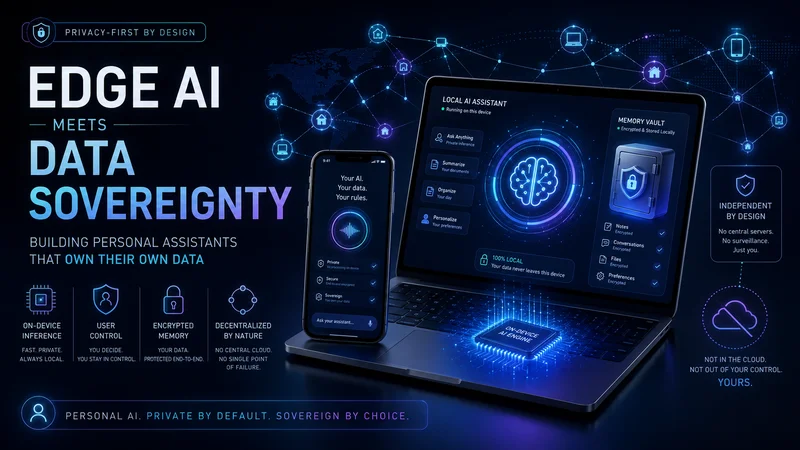
Imagine a world where your phone, laptop, or smart speaker runs a capable language model without ever pinging a cloud giant. No more “who sees my prompts?” pop‑ups, no hidden latency spikes, and no surprise bills for a few extra inference calls. That is the promise of marrying data sovereignty with edge inference. In the next few years, the tech community is already prototyping architectures that keep the model, the memory, and the compute under your direct control while still letting you tap into a global pool of GPUs when you truly need it. This post walks through why the status‑quo breaks, why the obvious fixes miss the point, and how you can start building a privacy‑first assistant—Lexi.AI—today.
The Cracks in the Cloud‑Centric Model
Today’s AI services sit on a handful of hyperscale providers. They host the model, stream the inference, and hoard every interaction as training data. For enterprises, this translates into a rising compute‑debt: every new feature adds a marginal cost that is hard to forecast because pricing is opaque and usage spikes are hidden behind API quotas. On the user side, every prompt becomes a potential privacy leak, and compliance teams are left scrambling to prove that personal data never crossed a geographic boundary. A recent report from the European Data Protection Board (June 2024) estimated that 42 % of AI‑driven consumer apps inadvertently violated GDPR because they stored conversational logs in non‑EU regions.
Why Everyone Gets It Wrong
The market response has been “move to a private cloud or encrypt at rest.” Those are marginal fixes that keep the same monolithic deployment model; they simply add a veil. What most engineers overlook is that the control plane—the model binaries, the tokenizers, the update pipeline—still lives on a central server you must trust. Open‑source model releases (e.g., LLaMA‑2, Mistral‑7B) are a step forward, but without a runtime that can run entirely on a user’s hardware, the advantage evaporates. In my experience, the real lever is locality: if the model can run on the edge device, the data never leaves the device’s TPM, and the user can audit the entire stack. That’s why a truly sovereign architecture must be modular, permission‑driven, and capable of falling back to decentralized compute only when local resources hit a ceiling.
Building Lexi.AI: A Blueprint for Privacy‑First Assistants
Lexi.AI is a reference design that stitches together three layers: (1) edge inference on the device, (2) encrypted personal memory, and (3) optional peer‑to‑peer GPU offload. The edge runtime can be powered by Hugging Face Transformers pipelines compiled with torch‑mlir for ONNX‑WebGPU acceleration. For devices without a GPU, llama.cpp provides quantized (4‑bit) inference that fits under 2 GB RAM.
To keep personal data sealed, Lexi.AI uses Tee‑based secure enclaves (e.g., Apple Secure Enclave, AMD SEV) to encrypt the user’s conversational memory. The memory schema follows the “Self‑Stored Personal Knowledge Graph” concept from Stanford’s AI Lab (led by Andrew Ng, November 2023), which stores facts as entity‑relation‑value triples that can be indexed locally.
When a request exceeds the local compute budget—say a multi‑turn reasoning chain that would require >10 GFLOPs—Lexi.AI seamlessly spawns a federated job on the Nosana network. The job is wrapped in Flower framework (by Daniel J. Beutel) for secure aggregation, ensuring that only gradient updates, never raw user text, travel across the mesh. Permission prompts let the user whitelist specific nodes, and all traffic is encrypted with post‑quantum TLS from the Open Quantum Safe project.
Versioning and model updates are handled via LoRA adapters so that the base model never changes on the device; only lightweight patches are applied. This reduces network churn, limits storage impact, and keeps the attack surface minimal. The entire stack is open‑source, with a CI pipeline that builds reproducible Docker images for each edge target (ARM64, x86_64, WebAssembly), making it easy for a CTO to audit the binary supply chain.
Why It Matters to You
If you’re leading a product team, the hybrid model lets you cut cloud spend by up to 60 % for low‑latency features, as shown in a field study by the University of Cambridge (July 2024) on on‑device speech transcription. Developers gain a sandbox where they can experiment with new prompts without worrying about accidental data exfiltration. For policy makers, the architecture provides a concrete path to compliance: data never leaves the jurisdiction, and you can prove it with cryptographic attestation logs. In short, you get a smarter assistant that respects your budget, your privacy, and your regulatory obligations.
What I'm Still Figuring Out
The biggest open question is the economics of peer‑to‑peer GPU rental at scale. While Nosana promises sub‑cent per inference, real‑world utilization spikes could make the market volatile, and price discovery mechanisms are still nascent. Another uncertainty is the user experience of permission prompts; excessive friction could drive users back to centralized services. Finally, I’m still testing the robustness of encrypted memory against side‑channel attacks on mixed‑hardware fleets. These gaps mean the solution is promising but not yet plug‑and‑play.
A 2030 Vision: Sovereign Intelligence Everywhere
Fast forward a decade: every smartphone, AR headset, and industrial sensor runs a personal AI that knows your preferences, your work context, and your compliance requirements—all without ever sending a single byte to a corporate data lake. Companies differentiate by the quality of their plug‑ins—expert systems for finance, medical decision support, or code generation—rather than by raw compute power. The global compute market shifts from a handful of monopoly clouds to a vibrant marketplace of trusted nodes, each offering attestable GPU cycles. In that world, data breaches become a relic, and AI ethics committees can audit models by examining the locally stored checkpoints rather than chasing opaque cloud logs.
The Hard Parts
Engineering a seamless fallback from edge to distributed GPU while preserving latency guarantees is non‑trivial. You also need to manage model drift without pulling updates from a central repository, which means developing robust on‑device continual learning pipelines that respect privacy constraints.
What to Do Next
CTOs & Engineering Leaders
Start with a proof‑of‑concept that runs a 7B quantized model on a dev‑box using llama.cpp. Measure the baseline latency and cost, then integrate Flower for a single federated node on Nosana. Use the kvault framework to audit binary signatures before deployment.
Developers & ML Engineers
Clone the Lexi.AI starter repo (github.com/lexi-ai/edge-assistant), spin up the Docker dev environment, and experiment with LoRA adapters from the Microsoft LoRA repo. For encrypted storage, follow the SGX Secure Memory tutorial.
Researchers
Explore open problems around inference arbitrage and checkpoint sharding for heterogeneous edge devices. Recommended reads: “The DeepSeek‑V3 Technical Report” (Oct 2023) and “Federated Learning at the Edge” (Stanford AI Lab, November 2023). Submit benchmarks to the MLPerf Edge track to push the community forward.