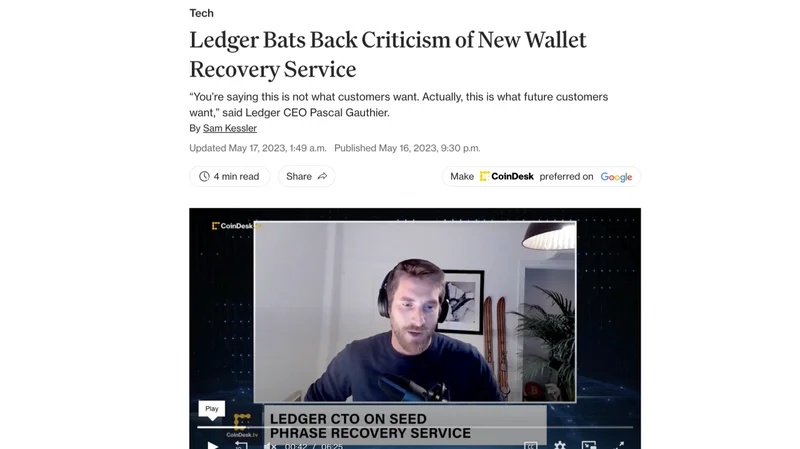
Launching a new Web3 product without proper communication to the media and public can quickly turn into a nightmare. The PR failure during the launch of Ledger Recovery is a perfect example.
A bit of context.
In the crypto community, there's a well-known saying: "Not your keys, not your coins" — this is the golden rule of security in the world of digital assets, meaning that without full control over your seed phrase (private keys, password, or recovery phrase), you are not the true owner of your coins. The ColdCard hack once again confirmed this.
Ledger Recovery is a service that allows storing a seed phrase in a special way. It's split into three parts, each stored "in the cloud" by a different company, and in case of loss, it can be recovered like a forgotten password.
It was precisely to solve this problem that Ledger Recovery was proposed as a solution, but users grew alarmed — since enabling such a service could mean access to the password being opened up to a third party in the form of the three companies storing it, meaning there would exist a technical possibility for accessing cryptocurrency without the user's knowledge, without their desire, and without their permission. This is where the story of one of the most epic PR disasters begins.
Ledger's PR&Comms Mistake
You’re saying this is not what customers want. Actually, this is what future customers want
Pascal Gauthier, CEO Ledger
After announcing the new service, the company received negative feedback from the community. In response, the company’s director decided to clarify (what he considered) the key points during a Twitter Space. During the broadcast, he essentially accused the community of being ignorant, shortsighted, and lacking understanding of the technology — which only made the PR disaster worse.
To try and put out the fire, the former CEO attempted to fix the situation by posting a message on Reddit.
This post is more constructive, but it breaks an important logical sequence. It begins with a description of personal feelings and emotions, followed by accusations of inciting hatred, then an apology, and only after that — a clear explanation of what actually happened.
A more appropriate order would be as follows:
First and foremost: emphasize that the issue concerns a failure in communication with the media and the public.
Second: offer an apology for the negative emotions caused, express understanding, and promise that such a situation will not happen again.
Causes of the PR Disaster and Key Mistakes:
- The company’s spokesperson lacks charisma.
- The company ignores the media, relying solely on its own social media channels.
- The spokesperson entered into an open confrontation with the community.
- A second spokesperson failed to properly shape their message.
Commercial Impact
How a product or service is presented in the media is more important than its technical specifications. In 2023, Ledger was the leading cold wallet provider, with a market share of 70–80%, compared to 10% for its closest competitor, Trezor.
In the first week after the Ledger Recovery announcement, Trezor’s sales surged by 900%, and by the end of 2023, Trezor had tripled its total sales. Its market share rose to 30%, while Ledger’s share dropped to 60%.
Trezor’s Response
Trezor took the opposite approach, publicly expressing full support for its users. Company representatives emphasized that their devices are completely open-source and cannot — under any circumstances — be used to extract a seed phrase remotely. Trezor’s CEO stated that 100% control must remain with the user and that such a backup recovery service will never be implemented in Trezor devices.
What Actually Happened:
- The company announces the service.
- It receives a wave of backlash.
- Postpones the launch for 6 months — but does not revise the PR strategy.
- Launches the service without any changes to its communication approach, repeating the same mistake as in step 1.
- Faces an even stronger negative reaction.
- The CEO enters into a confrontation with users.
- A co-founder acknowledges the PR failure.
- The company publishes technical documentation and offers detailed explanations.
The community accepts the explanations, and the crisis slowly dies down. The commercial damage, however, is already done.
What Should Have Happened:
- The company announces the service.
- After receiving backlash, it reassesses the situation, adjusts its strategy, and works to minimize the damage.
- Publicly acknowledges the PR failure and announces that those responsible have been let go.
- Postpones the launch — giving time for the new team to properly prepare a media strategy.
- Publishes detailed technical information and provides transparent explanations.
- The community accepts the explanation, and the crisis begins to resolve.
- The company launches the service.
A dismissive attitude toward media relations and communications, combined with the founder's desire to personally represent the product, led to losses of millions of dollars. I'm confident that having a professional Head of PR & Comms on staff would have prevented these entirely avoidable losses.
Crisis communications isn't just about what to do when a problem occurs — it's about knowing what kinds of problems can happen and when. Was it really so hard to imagine that issues might arise when launching an innovative product in the high-tech segment? Wasn't the risk of an ambiguous reaction obvious?
At the height of the crisis, Ledger refused for a long time to demonstrate the source code that would confirm the full security of the service and put all questions to rest — but after the failed launch, the company finally did so, and users and the community became convinced that the new feature posed no threat to security. Today, in one form or another, "password" recovery services operate at both Ledger and Trezor. It's an important and useful feature for a segment of users.
Professional Opinion
From a professional standpoint, I cannot agree with Eric Larchevêque's assessment that this was a PR disaster. No — a PR disaster is when a team of highly qualified PR & Comms specialists develops and implements a set of activities to cover the launch of a new product, which not only turn out to be useless but also cause irreparable damage to the company's brand. It's obvious that in the story of Ledger Recovery's failure, there was no PR at all — no one was working in that direction.
A dismissive attitude toward media relations and communications, combined with the founder's desire to personally represent the product, led to losses of millions of dollars. This is a logical outcome of personal decisions and purely personal responsibility for the decision to launch the product while completely ignoring modern PR and communications practices. There's no PR disaster here, because there was no PR here at all.
The story of Ledger's PR failure has something in common with the story of the arrest of Gotbit's head: a young and successful entrepreneur gave an interview to a journalist that later became the basis for a criminal case. He prophetically said in an interview with Coindesk: "Yes, we work with US citizens without a license. This is illegal, we'll get shut down, and accounts will be frozen." Prophetic words — the guy was detained in Portugal and extradited to the US. If the guy had had a great PR person who prepared the poor fellow for the interview — or at least warned him that he was about to be interviewed by a professional investigative journalist who specializes in economic crimes...
Is it really safe to go chat, working under high risk in conditions of uncertain regulation, with someone like Ian Allison, whose investigation buried FTX and sent SBF to prison?
Work with PR people — it's safer that way.