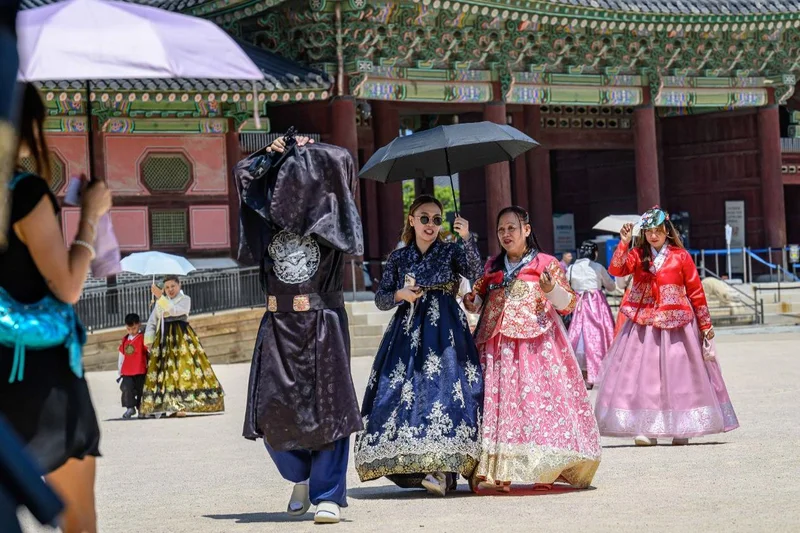
Giosue, a 29-year-old Italian tourist, felt the fabric of his rented hanbok, Korea's traditional dress, clinging to his skin on a Sunday afternoon. Even with the temperature close to 30 degrees Celsius, the long top and bottom could not deter him from wearing it.
“It sticks to you and it's getting more hot,” Giosue told The Korea Times. “But I think it's worth it. It's fun and kind of a special experience.”
The weekend brought cooler weather after Seoul's heat wave peaked Friday, with temperatures topping 40 degrees. But the day's highest perceived temperature in Seoul still reached 32.4 degrees Celsius by 3 p.m. Sunday, too warm for hanbok, which are typically both long and layered.
On Sunday, nearly all Koreans around Gyeongbok Palace wore short sleeves and shorts. But the palace and the streets around it still filled with hanbok-clad foreign tourists, drawn by the chance to experience something distinctly Korean.
Wearing hanbok was high on the list for Liz, 29, from Monterrey, Mexico, who arrived in Korea a day earlier.
“It's very interesting how Koreans wear hanbok because of the culture. It's symbolic and amazing, so I wanted to try it,” Liz said. “It's not that hot since Monterrey is a little bit hotter than Seoul. I'm getting used to hanbok. It's long, but it's comfortable.”
Elena, 20, from Spain, said she wore hanbok out of respect for Korean culture and didn't mind the weather. “I think it's really amazing that everyone else around Gyeongbok Palace is wearing hanbok too,” she said.
But the tourists' enthusiasm was not enough to offset the toll the extreme heat has taken on hanbok rental shops.
Lee, a hanbok rental shop employee in his 30s, said the past two weeks have brought less than a quarter of the customers he'd normally see in pleasant spring or fall weather.
“I'm not sure about today, but yesterday there was no one outside at all. Summer feels like a break before we get ready for fall. It's always been that way,” Lee said, adding that the shop used to rent out traditional fans, but stopped after too many got broken.
Seok, a hanbok rental shop owner in her 60s, said customer numbers drop by about 20 to 30 percent in summer. “But under the current administration, more Chinese tourists have kept overall customer numbers rising.”
Kim, 42, a manager at a rental shop, also said sales have dropped sharply in recent weeks.
“During the cherry blossom season in March and April, when we get the most customers, we make about 4 million won ($2,834) a day. Now it's more like 400,000 to 500,000 won.”
That drop, however, hasn't pushed her shop to prepare lighter fabrics for summer. “We stock hanbok that fit an average that works across all seasons. If we made separate ones for each season, there'd be nothing left over.”
Kim added that summer losses likely vary by a shop's location and size, but that every rental shop probably struggled in recent weeks.
“A large hanbok shop on the first floor with high accessibility might see it differently, but this week there really was no one. Other shops probably didn't have anyone either. It does seem like things have dropped more this year because it's been hotter.”