Tough waters, strong winds fail to stop IRONMAN 70.3 Lapu-Lapu
CEBU CITY, Philippines — The IRONMAN 70.3 Lapu-Lapu Cebu was once again successfully staged on Sunday, August 9, but not without putting its participants and organizers to one of their toughest tests in recent years.
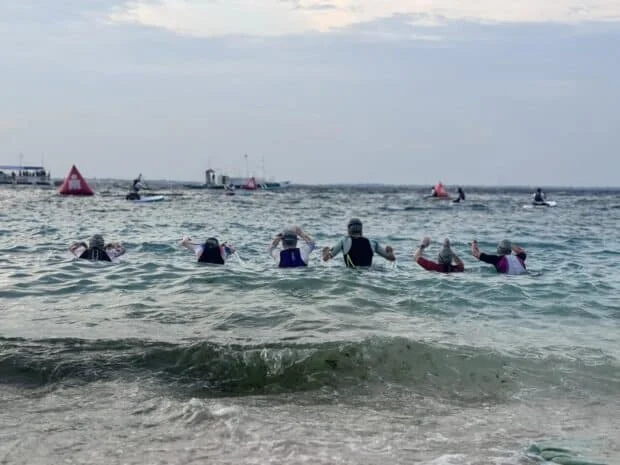
Strong currents and waves along the Hilutungan Channel, followed by powerful winds on the bike course, forced organizers to make crucial adjustments and resulted in an estimated 10 percent of the 1,412 registered triathletes from 48 countries being declared Did Not Finish (DNF).
IRONMAN Philippines and Sunrise Events Inc. (SEI) general manager Princess Galura told CDN Digital that roughly one in every 10 participants failed to complete the race, with the swim proving to be the biggest obstacle.
The challenging conditions were brought by the Southwest Monsoon, which produced strong winds, waves and currents in the Hilutungan Channel.
For safety reasons, organizers made an early decision to shorten the 1.9-kilometer swim course for age-groupers to just 1 kilometer.
READ: IRONMAN 70.3: How Schoeman defended title on a Cebuano’s bike
Hard race
But even with the shortened swim, the conditions remained difficult.
Rescue personnel and jetskis equipped with sleds were frequently seen navigating the choppy waters to assist triathletes who could no longer continue swimming and needed to be brought out of the course.
The strong winds also carried over to the 90-kilometer bike leg, particularly along the Cebu-Cordova Link Expressway, where some triathletes reportedly struggled to maintain their aerodynamic position while others were knocked off their bikes by the gusts.
Despite the difficult conditions, Galura said the organizers’ protocols and quick decisions helped prevent the race from becoming a more serious safety situation.
“We really have to remember that our sport is really outdoor. There are really many things that are out of our control,” Galura said.
“The good thing is there is a protocol to face these challenges. Nag-isip na kami kung ano ang gagawin, and nung umaga ready na kami. Overall, the main thing is everyone is safe in the swim and bike courses.”
(We thought of what to do, and in the morning we were ready.)
Galura said the swim was particularly challenging, but organizers immediately shifted their attention to managing the bike leg once the participants reached the road.
“The swim was very challenging, we have to move on and do our best. Then next was the bike, ang lakas ng hangin (the wind was so strong). A lot of people could not maintain the aero position the whole time,” she said.
Despite the treacherous conditions, Galura said only two bike-related accidents were recorded, with both athletes suffering minor injuries and being discharged from the hospital on the same day.
The race eventually concluded successfully, with Japanese triathlete Kiko Hashikawa, the final finisher, receiving one of the loudest cheers from spectators along the course.
‘If it’s not hard, it’s not Ironman’
For Galura, the difficult conditions were part of what makes an IRONMAN race what it is.
She said the sport is designed to test athletes not only physically but also mentally, while exposing them to conditions that organizers cannot always control.
“After all sa lahat ng nangyari… successful ang race. Those who finished this hard race must celebrate [given] the things [that were] thrown at them,” Galura said.
(After everything that happened, the race was a success.)
“Those who didn’t have a good race, it’s okay. If it’s not hard, it’s not an IRONMAN race.”
Galura also compared this year’s edition with the infamous 2016 IRONMAN 70.3 Lapu-Lapu Cebu, when around 300 triathletes were declared DNF because of strong underwater currents in the swim course.
More severe but safer
While this year’s conditions were severe, she considered the 2026 edition a much better outcome in terms of safety and race management.
The successful staging, she said, was made possible by the collective efforts of the Lapu-Lapu City government led by Mayor Cindi King Chan and her husband, Congressman Junard “Ahong” Chan, as well as thousands of volunteers and personnel.
These included members of the Philippine National Police, the Philippine Coast Guard, rescue teams, force multipliers, barangay tanods and medical personnel who were deployed throughout the course.
Galura also credited the thousands of students and residents who lined the streets to cheer for the athletes, a scene that has become one of the defining features of the Cebu race.
“This race remains the biggest and most loved IRONMAN 70.3 race out there. It’s also one of the longest-running, for 12 years already,” Galura said.
Cebu: Attractive venue
She added that the Cebu race continues to attract foreign triathletes because of the destination’s accessibility and the many activities available to participants and their families outside the competition.
“Dito sa Cebu, pag pumunta ka, alam mo na may magagawa ka pa after. Sobrang accessible lang ng lahat, mapa-mall, beaches, hotels and the airport,” she said.
(If you come to Cebu, you know you still have things to do after the race. Everything is extremely within reach from the malls to the airport.)
Galura also highlighted the record-setting IRONKIDS 2026, which drew 674 entries, saying its participation figure would be difficult to replicate or surpass in another Philippine venue.
For organizers, however, the biggest victory of Sunday’s race was not simply the number of finishers.
It was getting thousands of athletes through one of the year’s most challenging IRONMAN 70.3 courses while ensuring that the safety protocols were in place when nature presented conditions beyond their control.
Disclaimer: The comments uploaded on this site do not necessarily represent or reflect the views of management and owner of Cebudailynews. We reserve the right to exclude comments that we deem to be inconsistent with our editorial standards.