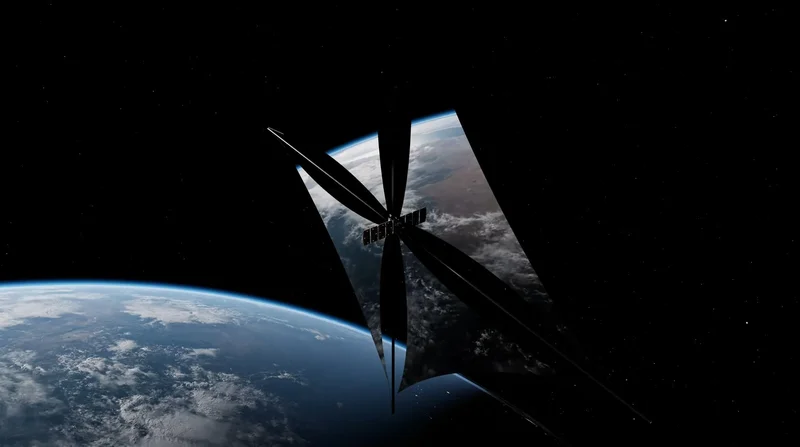
Solar energy, at any time of day or night — that’s the dream of space mirror projects. Futurists have been imagining satellite mirrors that could reflect the sun’s light onto the Earth’s surface for over a century. Russian scientists experimented with the concept in the ’90s with the Znamya project. The idea is to put a large mirror in orbit and angle it such that sunlight can be reflected onto a specific geographical area for illumination or the generation of solar power.
Space mirrors could ruin astronomy — and your eyes
Astronomers warn that a recent FCC decision about mirror-equipped satellites could hinder their ability to observe the cosmos, as well as lead to permanent eye damage.
Space mirrors could ruin astronomy — and your eyes
Astronomers warn that a recent FCC decision about mirror-equipped satellites could hinder their ability to observe the cosmos, as well as lead to permanent eye damage.
Now, the California-based company Reflect Orbital wants to try this idea again, launching a test satellite named Eärendil-1 as a precursor to a fleet of up to 50,000 space mirrors that would provide sunlight on demand as a service. The 18-square-meter mirror satellite has recently been approved for launch by the Federal Communications Commission (FCC) and will create what the company has said will be a 5-kilometer-wide beam of light that could be used for capturing solar energy in so-called solar farms, for boosting agricultural yields, or assisting in search and rescue operations during nighttime emergencies.
The consequences range from disrupting scientific observations to concerns over the safety of the public.
The goal is to benefit companies and municipalities as well, with Reflect Orbital aiming to provide a service to cities to illuminate streets at night, or to provide construction and industrial projects with lighting so that work can be completed faster and more safely.
More clean, renewable energy and help during a crisis — what’s not to like?
If you ask astronomers, there are plenty of concerns. The satellite will be strikingly bright, with estimates placing the illumination as being as bright as Venus from outside the beam and four times as bright as the Moon within the beam. The consequences range from disrupting scientific observations to concerns over the safety of the public, including the potential for permanent eye damage for anyone unlucky enough to be using a telescope in the wrong place at the wrong time.
Experts like Roohi Dalal, deputy director for public policy of the American Astronomical Society (AAS), and Robert Massey, deputy executive director of the Royal Astronomical Society (RAS), have warned that the plan could have disastrous effects on astronomy as a whole, as well as directly harming humans and wildlife in affected areas.
Light pollution has been proven to be a genuine threat to human well-being by disrupting circadian rhythms, and can be devastating to local ecosystems and migratory species in particular. But in the case of Reflect Orbital, the concern is not just the increasing brightness of our skies, but the particular dangers to both people and astronomy that space mirrors can cause.
If you’ve seen reports of streaks of white light trails ruining images from the Hubble Space Telescope, then you already know the kind of damage that can be done to astronomical observations from bright satellites. Reflect Orbital says it will work to avoid shining light on astronomical facilities, but hasn’t stated which facilities will be part of its exclusion zones.
Even with the best intentions to avoid individual facilities, the overall brightness of the sky from the planned tens of thousands of reflective objects in orbit would be an existential threat to astronomy. Not only would the many reflective objects create light trails that could disrupt astronomical images, but the background illumination of the night sky would also rise due to atmospheric scattering. The resultant glow from this scattering would “make the night sky three to four times brighter” in affected areas, according to the RAS.
It could become impossible to observe distant objects like galaxies or even to spot Earth-threatening asteroids using telescopes on the ground. The planned 50,000-mirror satellite project “is likely the end of ground-based optical astronomy,” according to Dalal.
It’s not just professional astronomers who could be affected. One major concern is the potential harm to amateur astronomers who use their own backyard telescopes to observe the night sky. Reflect Orbital has acknowledged in its own filing to the FCC that accidentally observing a single satellite through a 12-inch telescope could cause permanent eye damage. That size telescope is “pretty common for amateur astronomers,” according to Dalal, and Massey described it as “quite shocking” that the company admitted to this risk and “extraordinary” that the FCC approved the launch.
The danger of eye damage from mirror satellites has been a known concern for decades, as experts warned as early as 2000 that the Russian Znamya experiment would carry a danger to observers “similar to that involved in looking at the Sun just before or after a total eclipse.”
Concerns over eye damage from the new satellite were raised to the FCC, including by the AAS, but the FCC stated that these issues “are far removed from the space station’s radiofrequency operations and are too attenuated from the Commission’s authority to license communications in the public interest,” essentially declaring them outside of its authority and washing its hands of the problem.
The planned 50,000-mirror satellite project “is likely the end of ground-based optical astronomy.”
— Roohi Dalal, deputy director for public policy of the American Astronomical SocietyThe FCC further states that the “small risk” that an amateur astronomer is subject to permanent eye damage from simply using a telescope at the wrong time in the wrong place must be weighed up “against the benefits of permitting American companies to test innovative technology in space,” a calculation that is not likely to inspire confidence in the estimated 100,000 amateur astronomers in the US.
Worse still, Reflect Orbital has not shared any plans to warn the public of when and where its service will be in use, meaning amateur astronomers will not even know that there is a potential danger they should be careful to avoid. Further concerns have also been raised that the satellite could inadvertently cause flash blindness to drivers or pilots during slewing, when the beam is moved.
Questioned on the potential dangers of its satellite, Reflect Orbital spokesperson Christopher Buscombe first highlighted the potential benefits of the technology, then said that the company has “engaged in substantive discussions with scientists, astronomers, environmental researchers and other stakeholders - and their feedback has already meaningfully informed the design of our spacecraft and operational plans.”
However, the company did not respond to a detailed list of questions including how it has modified its designs or operational plans, nor as to whether the public would be warned of potential dangers, nor how its acceptable brightness thresholds were calculated.
Buscombe did state that “Importantly, our approach is incremental and test-and-learn. Our first milestone is this single demonstration satellite. The mission will enable Reflect Orbital to test our technology, including the built-in safeguards governing precisely how, where and when our service is delivered.”
The argument seems to be that this single satellite will be used to develop the technology — including figuring out how safeguards will operate — and that astronomers, environmentalists, and others who are concerned should simply put up with any worries while the details are figured out.
However, DarkSky International, an advocacy group protecting dark skies, has described Reflect Orbital’s statements on these concerns as “cavalier” and the approval of the test satellite by a House committee as “unlawful,” while the Air Line Pilots Association has criticized the company’s approach to air safety issues as insufficient and “extremely vague.” The general tenor of the criticisms is that “move fast and break things” is not a compelling approach when the thing that could be broken is the night sky itself, or the eyeballs of innocent bystanders.
“Our main concern is that we feel Reflect Orbital hasn’t done their due diligence,” said AAS’s Dalal. “And due diligence is necessary when launching a satellite that is designed to impact the human and Earth environment.”
There are open questions around the actual size of the beam of light that will be produced by the satellite. “Our service will be targeted, time-limited and bounded by brightness thresholds calibrated to levels humans and animals already tolerate,” Buscombe said. Reflect Orbital CEO Ben Nowack has previously stated that the illuminated area will be 24 square kilometers. However, experts have questioned his accuracy, given that light scatters in the Earth’s atmosphere in complex ways, and also from hitting the ground and from interacting with clouds.
“Our main concern is that we feel Reflect Orbital hasn’t done their due diligence.”
— Roohi DalalAstronomers are currently performing independent research that attempts to model the size of the light beam due to atmospheric scattering and have found that it could be significantly larger than the company claims. (The research, by Gaspar Bakos of Princeton and colleagues, has been submitted for publication but not yet peer reviewed, and we have reached out to Bakos for comment and confirmation but did not receive a response in time for publication.) This adds to the concerns over whether the company will be able to accurately avoid astronomical facilities and other ecologically sensitive areas, Dalal said: “If they don’t know the accurate size of their beam, then is that avoidance really going to be sufficient?”
Reflect Orbital has argued that it will be able to dim its service or turn it off if necessary, but it isn’t clear what would trigger that decision. If the light reflected by the satellite does start to cause problems for people, animals, plants, or scientific facilities on the ground, those who are affected may have to rely on the company’s goodwill to turn it off.
The problem here is not just one company launching one satellite, but the lack of regulation around satellite technologies that could be potentially damaging to humans, the environment, and astronomical observations. With the FCC effectively declaring astronomical concerns as beyond its purview, there is no government body regulating satellite brightness — a concern that will only become more pressing as more and more satellites are launched.
Although NASA oversees the government’s actions in space like building, launching, and operating spacecraft, it is not a regulatory agency and does not oversee commercial satellite operations. There is the Office of Space Commerce, which has recently announced a certification program for novel in-space activities as an alternative to traditional FCC approval, but this certification is voluntary and does not cover astronomical concerns.
Reflect Orbital has stated that it is working with the National Science Foundation (NSF) to develop a coordination agreement over the use of its satellite. Miriam Kleiman, spokesperson for the NSF, confirmed this and stated that the NSF was working with the company on “potential collaborative mitigation strategies,” which could help to identify areas where the satellite might interfere with astronomical observations and lessen its impact.
Reflect Orbital has argued that it will be able to dim its service or turn it off if necessary, but it isn’t clear what would trigger that decision.
While this would be a welcome step, it is not the same as regulation. There are no federal laws limiting light pollution, and a large number of US states have no laws regarding light pollution either. In practice, protection of astronomical observations from commercial satellites rests largely on the good intentions of private companies, who have little financial incentive to prioritize environmental or scientific concerns over making money.
In a recent RAS meeting on the issue of dark skies, Lily Beesley of the University of Birmingham pointed out that some companies have been active in working with astronomers to minimize their satellites’ brightness, such as SpaceX with its Starlink satellites, while others have shown “no visible effort” on the issue, such as China’s Qianfan satellite constellation.
This is not just a scientific issue but one of taxpayer funding. In quantifying the effect of light pollution on wide-field surveys like those using the upcoming Vera C. Rubin Observatory, “they can lose up to 40% of their long exposure images, costing us millions and millions of dollars,” Astha Chaturvedi of the University of Surrey pointed out at the meeting. “For Vera Rubin, the cost amounted to at least 22 million additional dollars, adding to the project cost.”
The scale of this problem is growing. Not only are there more satellites being launched than ever — from having around 1,400 satellites in low Earth orbit 10 years ago to around 16,000 today, according to Jim Verner of the International Astronomical Union (IAU) Centre for the Protection of the Dark and Quiet Sky, and proposed launches taking us to more than 1.7 million potential satellites in total — but these satellites are getting brighter, partly due to the number of satellites being launched into lower altitudes closer to Earth. Further, proposed orbital data centers are expected to be even brighter still due to their size, according to those presenting at the meeting.
Even within this broader picture, space mirror satellites are an extreme outlier in terms of brightness regulation. That’s because the brightness of these satellites is not incidental, as it is with telecommunications satellites, but rather fundamental to their business. Reflect Orbital is in the business of trying to sell light, and so the purpose of the satellite is to be as bright as possible.
The IAU, along with Slovakia, recently proposed that if strong oversight measures to protect eye safety and astronomical research can’t be put in place, space mirrors should be banned altogether.
The need for renewable energy is obvious, with increasing global demand for energy, rising fuel prices, and a national security-related push for energy independence working together to turn renewable energy into big business. But astronomers question whether the tradeoff of tens of thousands of extremely bright satellites in the night sky would be worth the potential benefits Reflect Orbital is offering. “The stars above us are a valued part of human heritage – deploying more than one million exceptionally bright satellites would utterly destroy this and permanently scar the natural landscape,” Massey of the RAS said in a statement.
There are plenty of alternative avenues for generating more solar power on Earth, from developing better battery solutions to simply building more solar panels. And these options don’t require damaging the night sky or potentially harming people or ecosystems in the vicinity.
“What’s sad to me is that probably most people have not ever seen the Milky Way in the night sky, or seen a truly starry sky,” Dalal said. “That, to me, was one of the best experiences of my life, being able to go out to a dark sky site and see the Milky Way. And so I think without having seen that, being in cities where light pollution is just so common, it’s hard to know what we are losing and what we are missing.”
Follow topics and authorsfrom this story to see more like this in your personalized homepage feed and to receive email updates.