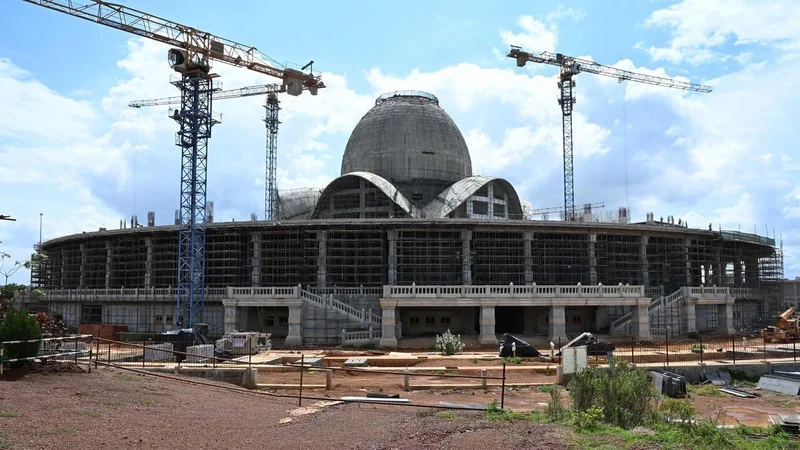
The colossal Anubhava Mantapa — under construction at Basavakalyan in Bidar district and conceived as a tribute to the eponymous 12th-century concept of philosopher, poet, and religious leader Basaveshwara — seeks to recreate the spirit of what is widely regarded as the world’s earliest “spiritual and socio-philosophical Parliament”.
The edifice is envisioned as a centre for preserving and promoting the egalitarian ideals, reformist philosophy, and the literary legacy of the Sharanas, or followers of Basaveshwara, in the Veerashaiva-Lingayat tradition.
The Mantapa, conceived in 2017 and under construction since June 2022, is expected to be inaugurated in May 2027. Chief Minister D.K. Shivakumar recently reviewed the progress of the project, said P.K. Sharma, Project Manager of B.G. Shirke Construction Technology Pvt. Ltd. It will be named ‘Anubhava Mantapa — Monument of Democracy’.
Scholarship and tourism
Together with the nearby 108-foot Basaveshwara statue, the historic Akkanagamma Cave and the Allama Prabhu Math, the monument is expected to establish Basavakalyan as a major destination for pilgrimage, scholarship, and cultural tourism, while reinforcing its place as the cradle of the 12th-century Sharana movement of Karnataka, which played a key role in shaking the caste and gender hierarchies of the time. It also reshaped Kannada literature.
Spread over nearly five acres and being built at a cost of more than ₹800 crore, the six-storeyed Anubhava Mantapa structure is crowned by an 183-ft. Shivalinga-shaped dome. The monument features 770 columns (pillars), each engraved with one of the Vachanas of the 770 Sharanas of the 12th century, symbolising the movement’s enduring literary and spiritual heritage, according to Babasaheb Gadde, chairman of Nurture and Nature Enterprises and the project’s consultant. The names of 12,944 martyrs of India’s freedom struggle have also been inscribed on its walls as a tribute to their sacrifice.
The structure has been designed around the Ashtavarna principles of Sharana philosophy — Guru, Linga, Jangama, Vibhuti, Rudrakshi, Padodaka, Prasada, and Mantra. The names of 74 democratic countries will be inscribed on monolithic stone pillars outside the monument, with each pillar highlighting the distinctive features and democratic traditions of the respective country.
The monument itself symbolically represents the Sharana philosophy. Its six floors correspond to the six stages of spiritual evolution — Bhaktasthala, Maheshasthala, Prasadisthala, Pranalingisthala, Sharanasthala, and Aikyasthala. The inner circular structure, representing the soul, rises through all six floors and is surrounded by a water body at the ground level. A middle ring, symbolising the body, contains three interconnected floors, while the outer ring will be developed with landscaped gardens and public spaces.
Digital classrooms
The ground floor will house 16 digital classrooms dedicated to teaching Basavanna’s Kayaka (dignity of labour) philosophy alongside modern skill development programmes, including technology-oriented courses aimed at preparing students and the youth for an AI-driven economy.
The first floor, Bhaktasthala, will feature 12 theatres, each spread over about 3,500 sq. ft., showcasing the philosophy, history, and social reforms of the Sharanas through immersive multimedia presentations.
The second floor will house a Kayaka Museum, where aptitude assessments and interactive exhibits will help students identify their strengths and aptitudes while encouraging skill-based learning.
The third floor will include a Kayaka Village, meditation facilities, and a robotics centre equipped with a 7-D theatre. The meditation centre is intended to demonstrate the transformative effects of meditation and support awareness campaigns against drug abuse, alcoholism, and smoking. Visitors will also be able to interact with AI-enabled systems and seek information on a range of subjects in Kannada and other languages.
The fourth floor is to be designed as a Parliament hall, where sessions of the Karnataka Legislature could be held on special occasions. It will also house a 400-seat auditorium for lectures, seminars, and public discussions. One of its proposed features is a “truth test” facility intended to encourage ethical reflection among elected representatives and public officials.
A whispering gallery will occupy the fifth floor, while the sixth floor, Aikyasthala, will house what is proposed to be one of the world’s largest Shivalingas, sculpted from nearly 4,000 slabs of black stone.
Blending history, philosophy, spirituality and modern technology, the monument seeks not merely to commemorate Basavanna’s legacy but to create a living institution dedicated to dialogue, ethical governance, knowledge, and social transformation, said Dr. Gadde.
Published - August 09, 2026 06:00 am IST