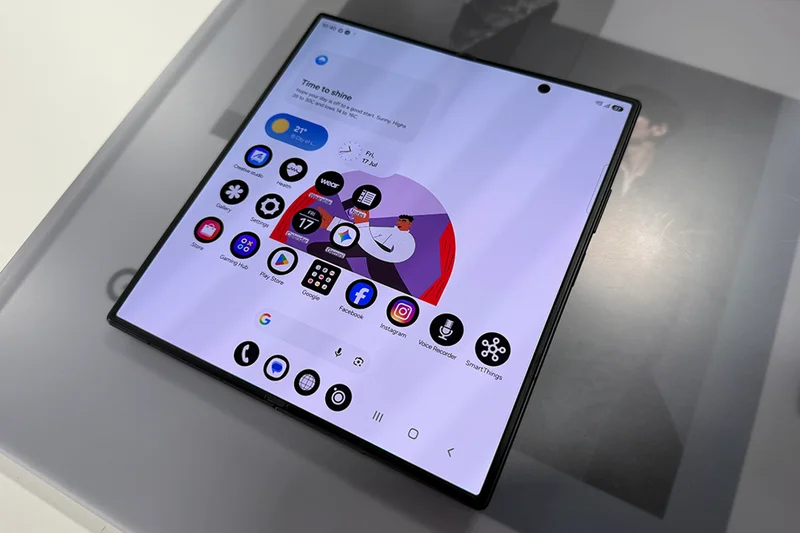
Samsung has just unveiled three new folding phones and all are on sale right now. The first two are the Galaxy Z Flip 8, which folds down from regular smartphone size to something that fits easily in the pocket, and the Galaxy Z Fold 8, which is a bigger phone in an eye-catching format, the same shape as a passport. The top-of-the-range is the Galaxy Z Fold 8 Ultra, which is a direct upgrade from the Galaxy Z Fold 7.
The Z Fold 8 Ultra looks like last year’s model (but for the colour finishes), which means it is narrow and tall, with a highly usable 6.5in cover screen, folding out to reveal an 8in inner display. It has three rear cameras (unlike the other phones in the series, which have two each).
What’s more, one of the cameras is much higher resolution than on the others, at 200MP. While it looks like last year’s Z Fold 7, there are significant changes under the hood, including something called Flex Titanium, which aims to hide the crease that runs down the centre of the internal display.
It’s also slightly thinner than last year’s Z Fold 7 – which had already boasted a much slimmer profile than the year before – and is the slimmest folding phone Samsung has produced. I’ve put the latest Samsung Galaxy Z Fold 8 Ultra through its paces.
Read more: **Samsung Galaxy Z Fold 8 review **
Read more: Best Samsung discount codes
- Why we love it- Design remains outstanding
- Improved battery life
-
Crease issue reduced
-
Take note- Expensive
Samsung Galaxy Z Fold 8 Ultra: Design
Last year’s Galaxy Z Fold 7 was a big step forward in terms of design refinement. It shrank the thickness from front to back considerably, to 4.2mm, making it breathtakingly slim. The thickness is now marginally thinner at 4.1mm (though in the hand, there’s no discernible difference). This means there’s currently no thinner folding phone available from any brand. That matters because when it’s in your pocket, the phone will be folded, so it’s important it’s not thicker than a regular smartphone. Folded, it is 8.9mm thick. That’s more than double the unfolded measurement because the two halves have slightly different thicknesses, though you don’t notice this when you use it.
Also, please note that neither of those measurements include the camera panel protruding from the back. The three lenses sit in a vertical line, something of a Samsung speciality, on a raised oval plinth.
The first major design change from last year’s model is one you feel rather than see. By changing the edges of the phone and introducing a more relaxed hinge, the phone opens to your touch much more easily. Earlier foldables took a bit of persuasion to open. This is much better, and it’s still secure – it won’t fly open of its own accord.
Open it up and the second change becomes apparent. A new material called Flex Titanium, a titanium alloy film and a titanium plate, work to improve the strength of the fold and offer a notable reduction in the visibility of the crease between the two halves.
The crease is something that all foldables have, and its prominence has turned many off using folding phones. Here, it’s much less evident, though you can still see it if you look for it, or feel it when your run your finger across the middle of the screen. Specifically, from an angle you can still see it, but viewed straight on with the display on it’s pretty much gone. Whether the crease becomes more pronounced with extended use will become apparent in time, but in my experience, I quickly stopped noticing it anyway.
The new colours range from gorgeous to demure. Cream is sumptuous and eye-catching while graphite (which is near-black), violet shadow and green shadow are quiet but attractive. Green shadow is exclusive to purchases from samsung.com.
Samsung Galaxy Z Fold 8 Ultra: Displays
The cover screen measures 6.5 inches, so you will likely find much of your usage happens with the phone folded. Watching a movie is arguably better than on the internal screen, where there are inevitable wide black borders either side of the content.
Both the internal and external displays have an anti-reflective coating, which is useful in bright sunlight – the inner screen is also brighter than its predecessor.
The internal display has a slightly higher resolution than on last year’s model, and means the pixel density is now the same on both inner and outer screens. There is HDR in the form of HDR10+ but no Dolby Vision support.
Samsung Galaxy Z Fold 8 Ultra: Cameras
The three rear cameras are essentially similar to the Galaxy Z Fold 7, though the ultrawide snapper has been improved and is now a 50MP model. The main camera is the 200MP sensor which performs extremely well, even in low light situations. Telephoto is just 10MP, but its 3x zoom equivalent makes it highly usable. The front-facing cameras (there are two, one on each of the displays) are also just 10MP but deliver decent selfies.
Photography has been really good on Samsung’s phones for years and this continues the tradition. Sharp, fast general shots, a portrait mode that’s nicely done and strong results in low light stand out.
One new feature using the latest software is My FanCam. Maybe the name isn’t that great, but the idea is. It uses AI to automatically and dynamically frame and zoom so the person you select is always front-and-centre in your videos. Not everyone will need this, but it’s a fun addition, nicely done.
Samsung Galaxy Z Fold 8 Ultra: Performance
Qualcomm’s Snapdragon 8 Elite Gen 5 for Galaxy is the name of the processor on board, a bespoke version of the latest top-flight Qualcomm processor. It’s the same chip as in the Galaxy S26 Ultra.
It’s really fast, with the phone never dawdling or keeping you waiting. It rarely gets warm, and gaming performance is fast and effective.
For everything else, from the super-fast camera shutter to everyday usage, it just works.
Samsung Galaxy Z Fold 8 Ultra: Battery life
Despite the slightly slimmer profile and otherwise similar dimensions to the Galaxy Z Fold 7, the new phone has a bigger battery, up from 4,400mAh to 5,000mAh. Whatever other innovations a manufacturer brings, the truth is that longer battery life is always a crowd-pleaser. It delivers here, with full-day battery and more. As ever, even though you’ll likely find enough juice left at the end of the day to banish battery anxiety, nightly recharges are recommended.
There are two batteries inside and the operating system controls how the two are charged efficiently enough.
Recharging is also faster: wired charging, previously 25W, is now up to 45W, while wireless charging has also improved, from 15W to 25W. Note that there is no Qi2 circle of magnets, the Android equivalent of Apple’s MagSafe, so you’ll need a case with Qi2 compatibility for that satisfying snap-into-place feeling when you’re charging wirelessly.
Key specifications
- Processor:Qualcomm Snapdragon 8 Elite 5 For Galaxy
- Display:Cover display 6.5in OLED, 120Hz, 1,080 x 2,520 pixels, 422ppi, internal display 8in OLED120Hz, 2,256 x 2,504 pixels, 422ppi
- Storage:256GB / 512GB /1TB
- Size:Folded: 158.4 x 72.8 x 8.9mm; unfolded: 158.4 x 143.2 x 4.1mm
- Weight:215g
- Rear cameras:200MP main, 50MP ultra wide, 10MP telephoto
- Cover display camera:10MP
- Internal display camera:10MP
- Colours:Graphite, cream, violet shadow, green shadow