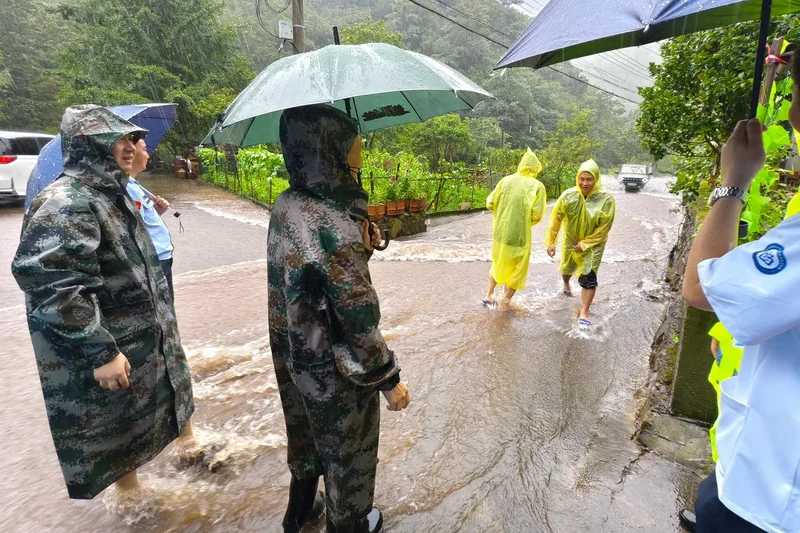
More than one million people have been evacuated after Typhoon Dolphin made landfall in China, bringing with it heavy rain and strong winds.
The typhoon landed on the coast near the city of Yuhuan in Zhejiang province at around 5.30pm local time on Sunday, bringing winds of up to 50km/h – equivalent to a category one hurricane.
Areas of the province were forecast to receive rainfall close to the amount London gets in a particularly heavy year, with predictions of between 250mm and 500mm of rain on Monday.
Dolphin made a second landfall at Wenzhou around an hour later, China’s meteorological centre reported.
Transport has been thrown into chaos, with over a thousand flights cancelled and train and passenger ferry services suspended, while flooded roads stall vehicles in the water.
What is happening in China and Japan?
Authorities have now downgraded Dolphin to a tropical storm, but warnings of torrential rain, severe flooding and risks of landslides remain in place.
The typhoon previously caused authorities to issue the highest-level red alert as it made landfall.
Over the next three days, heavy rain or torrential rain is expected in northern and eastern Zhejiang, Jiangsu, Anhui, Hubei, northern Hunan, Henan, western Shandong, central and southern Hebei, southeastern Shanxi, central and southern Beijing, and central and western Inner Mongolia, with some areas experiencing extremely heavy rain and thunderstorms.
Ahead of landfall, China suspended ferries in eastern and southern areas of the country, as well as ordering fishing boats back to port.
Dolphin is now forecast to head westward before slowing over central and southwestern China and gradually losing strength.
Typhoon Dolphin had already swept across Japan over the weekend, causing 50,000 buildings to have their power cut in the Okinawa prefecture on Saturday.
Hundreds of thousands of people were also ordered to evacuate their homes in Japan, particularly in the Kagoshima and Okinawa prefectures where winds were forecast to be at their strongest, up to 198km/h.
What does the UK government say?
The UK’s Foreign Office (FCDO) said, “The typhoon season in China normally runs from May to November, affecting southern and eastern coastal regions.
“Air travel and other forms of transport can be affected. Monitor the progress of approaching storms on the Japan Meteorological Agency and the China Meteorological Administration websites.”
It added that travellers can also view their guidance on tropical cyclones for advice about what to do if you are caught in a typhoon.
Have flights been cancelled?
Nearly 1,000 flights have been cancelled in Shanghai airports on Monday, around 40 per cent of the usual daily itinerary. More had been cancelled over the weekend.
A notice from the Shanghai government on Monday morning said there were 642 cancellations at Pudong airport and 301 at Hongqiao, the South China Morning Post reports. Passengers have been urged to check their airlines for updates.
Trains and metro lines in Shanghai were also halted due to heavy rain.
Ningbo Lishe International Airport in Zhejiang suspended all flights on Sunday, but by Monday, some services had started to operate while a large proportion remains cancelled.
Okinawa’s Naha airport closed on Friday too, while domestic airlines ANA and Japan Airlines had cancelled flights to and from Okinawa over the weekend. Naha airport is now running flights again.
Can I cancel my holiday to Japan or China and what are my flight rights?
As the FCDO has not warned against non-essential travel to Japan or China, there will be no special circumstances in place to be able to cancel a trip for a full refund under UK law.
The conditions for cancelling your trip will be dependent on your holiday provider, so it’s best to contact them if you’re looking to postpone.
There is no obligation for companies to refund bookings if you want to cancel, and you will not be able to claim on your travel insurance due to safety concerns unless government advice changes.
However, some travel insurance policies include natural disaster cover for an event that prevents you from reaching your holiday destination. Check your insurance policies and speak to your insurer to see where you stand.
Contact your airline for any refund or compensation requests. As a passenger, you are covered by UK law if you are departing from an airport in the UK on any airline, arriving at an airport in the UK on an EU or UK airline, or arriving at an airport in the EU on a UK airline.
Airlines must provide you with care and assistance if your flight is cancelled, and also offer an alternative flight or a refund.