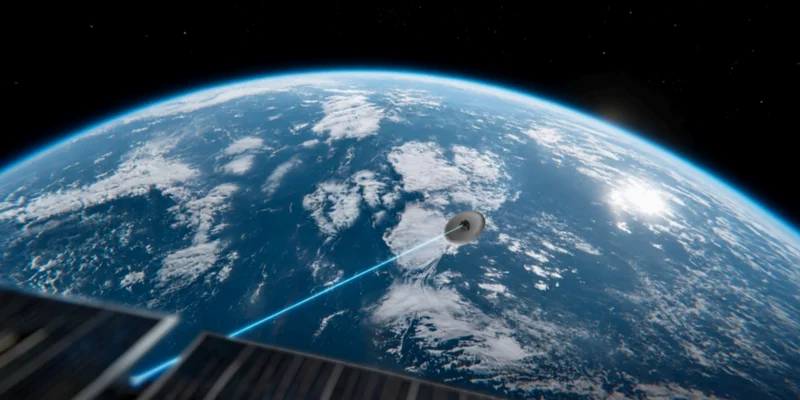
WARSAW, Poland — The Lithuanian space laser communications company Astrolight has signed a memorandum of understanding with ATMOS Space Cargo, to demonstrate in-flight optical communications link between a reentry spacecraft and an orbiting satellite.
The demonstration is expected to take place in 2027 and would be the first of its kind, the companies said.
During the mission, Astrolight’s ATLAS-X laser communication terminals would fly onboard ATMOS’ PHOENIX reentry vehicle and the satellite employed for the test to demonstrate a spacecraft-to-satellite optical link. This will allow for real-time transfer of system and mission data during in-orbit operations and re-entry at a rate of up to 2.5 Gbps, Astrolight told SpaceNews.
Laurynas Mačiulis, CEO of Astrolight, said that testing a laser link between PHOENIX and an orbiting satellite could mark an important first for reentry communications. To date, this capability has only been explored in ground-based laboratory conditions, and Astrolight’s ambition is to bring it into space in partnership with its German partner, he said.
“Our goal is to help reentry vehicles connect directly with satellites and, in the future, satellite constellations, so operators can access as much data as possible in real time and make missions more controlled and scalable. Laser links also make communications harder to interfere with or intercept – a major advantage for both commercial and defense missions,” Mačiulis said.
Sebastian Klaus, the CEO of ATMOS Space Cargo, said that, as cargo-return missions become increasingly autonomous and data-intensive, there is a growing need for real-time connectivity across the mission cycle.
Astrolight leaders said that laser communication is well-suited to provide cargo reentry missions with the real-time and reliable connectivity that they necessitate. This is because its narrow, focused beams are able to transmit data at rates of up to 100 times higher than traditional radio frequency communications. They are also significantly more difficult to jam, intercept or detect, according to the company.
Astrolight says that Europe currently depends on international partners to transport cargo to and from low Earth orbit, with local players contributing technology and services in exchange for access.
“As the space sector becomes more commercialized, Europe is working to build its own cargo-return capabilities, including through ESA’s LEO Cargo Return Services Initiative, which aims to reduce reliance on international partners for bringing payloads back from orbit,” Astrolight said.