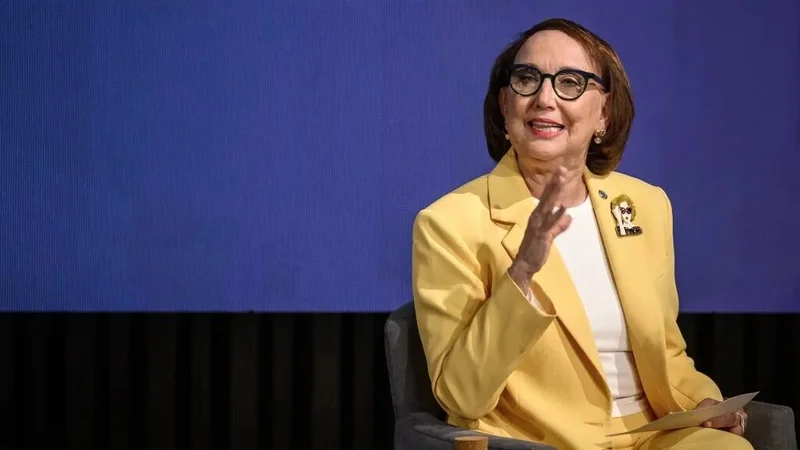
Israeli media eye Rebeca Grynspan's Jewish identity as she emerges as UN chief frontrunner
Israeli media have highlighted the Jewish background and family ties of Rebeca Grynspan to the country as she emerges as the early frontrunner to become the next United Nations secretary-general.
If selected, the Costa Rican economist and diplomat would become the first woman, first Central American and first Jewish person to lead the organisation.
Grynspan secured 10 "encourage" votes, four "no opinion" votes and one "discourage" vote in the Security Council's first secret straw poll held on 30 July.
The five permanent and 10 elected members assessed seven candidates, without publicly revealing how individual countries voted. Although further rounds could reshuffle the contest, receiving only one objection places Grynspan in a strong opening position.
The Security Council is expected to settle on a candidate by October. Any of its five permanent members can effectively end her campaign with a veto.
Antonio Guterres, the current secretary-general, will complete his second term on 31 December. Under the UN's informal regional rotation, his successor is widely expected to come from Latin America.
Israeli family ties
Grynspan, who leads the UN Conference on Trade and Development (UNCTAD), was born into a Jewish family in Costa Rica in 1955.
Her parents were European Jewish refugees who fled persecution in the lead-up to the Second World War, while members of her extended family were killed in the Nazi Holocaust.
Israeli coverage has focused heavily on that history and her relatives in Israel.
Her sister, Frida Greenspan, moved to Israel at 17 and lives in Mevaseret Zion, near Jerusalem. Her children served in the Israeli military, including as officers.
"We are Zionists by birth," her sister told Ynet.
The Israeli newspaper described Rebeca Grynspan as "one of the distinctly pro-Israel candidates" and reported that she has relatives living in the occupied West Bank.
Ynet added that "she herself is proud of her Jewish heritage, and has maintained close ties with officials in Jerusalem over the years".
Those family connections do not, however, establish how Grynspan would handle Israel and Palestine as secretary-general.
She has rarely placed Israel at the centre of her public political identity, leaving her approach to longstanding UN positions on Palestine largely untested.
Ynet acknowledged that her perceived closeness to Israel could also become a liability in a contest requiring support from governments with sharply differing positions on Israel's occupation and war on Gaza.
Record at the UN
Under Grynspan, UNCTAD has continued producing some of the UN system's strongest assessments of the damage Israel has inflicted on the Palestinian economy.
Its reports have examined the costs of occupation, Israeli restrictions across the occupied West Bank and the destruction of Gaza's economy, linking the collapse of Palestinian economic life to Israeli policies and military operations.
In January, Israel's foreign ministry cut ties with several UN agencies and international organisations over their reporting on Israel's genocidal war on Gaza. Israel included UNCTAD on the list and accused the bodies of publishing "dozens of virulent anti-Israel reports".
Yet Israeli officials have not publicly targeted Grynspan in the way they have repeatedly attacked Guterres and other senior UN figures.
Israel Hayom, a newspaper widely regarded as supportive of Israeli Prime Minister Benjamin Netanyahu, paid closer attention to her public position on Gaza. Grynspan has called for "humanitarian agencies to have unrestricted access to Gaza" and said aid must not become politicised or weaponised.
The newspaper concluded that, "despite the candidate's identity", she continued to represent the UN system's traditional position.
An Israel Hayom opinion piece went further, arguing that "Grynspan's candidacy is quietly being sold to select member states, especially the US and Israel, wrapped in a carefully crafted personal narrative: daughter of Holocaust survivors, familiar with Hebrew, with close family living in Israel".
Ynet suggested that Israel could influence the contest indirectly because "what Israel thinks of a particular candidate seeps into the place where decisions are really made - with the US, Britain and France".
It also reported that "several of the candidates have already sent envoys and courtship messages to Israeli Ambassador to the UN Danny Danon".