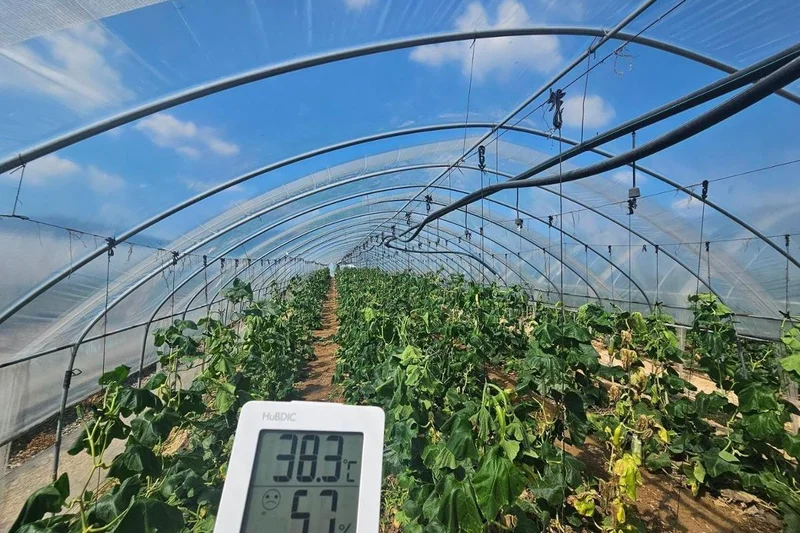
The temperature inside the greenhouse was surpassing 38 degrees Celsius as a Nepali migrant worker, in his 30s and asked to be identified only as A, bent at the waist to pull weeds among the chives, Thursday.
"It's hot," he said, his face and blue cotton T-shirt soaked in sweat. It was 2:10 p.m., the hottest part of the day. When asked whether he could take a break, A replied, “My employer says I need to keep working.”
A severe heat wave was issued that day across Pocheon, Gyeonggi Province, where the farm was located. Yet no cooling measures, let alone a fan, could be seen inside the greenhouse. A, who came to Korea three years ago, said he works 10 hours a day starting at 6:30 a.m.
"When it comes too unbearable, I go to a workstation next to the greenhouse for water," A said.
Government-issued guidelines recommend suspending all nonessential outdoor work and giving workers a break every two hours when a severe heat wave warning is in effect. That day at the farm, however, the guidelines appeared to be largely disregarded. Other immigrant workers encountered in twos and threes during the two-hour field reporting period recounted similar experiences.
"There is no such thing," said a Malaysian worker in his 20s working in a young napa cabbage field when asked whether he was aware of heat wave safety guidelines including break times.
He lamented that he could not even rest on weekends because there was so much work to do. Asked how he copes with the heat, the worker said he simply endures it by drinking water.
At another greenhouse about a 10-minute drive away, three female migrant workers in their 20s and 30s were picking zucchini and placing them in baskets. "It's hot," "It's hard," they repeatedly said while sweating heavily.
They pointed to the cooling vests fitted with small fans that they were wearing. "Still, this makes it better," the workers said, but declined to say whether the farm owner had provided the vests or whether they had purchased them themselves.
The daytime temperature in Pocheon soared to 39 degrees Celsius that day. The Rules on Occupational Safety and Health Standards require employers to give workers at least a 20-minute break every two hours at worksites where the apparent temperature reaches 33 degrees or higher.
The labor ministry also recommends suspending outdoor work between 2 p.m. and 5 p.m. when the apparent temperature reaches 35 degrees or higher. At 38 degrees or above, it recommends halting all outdoor work except emergency operations.
Yet it was difficult to find workers being given the legally mandated breaks. The work-stoppage thresholds are also merely recommendations, making it difficult to penalize farm owners who fail to follow them.
“Stopping work for just one day would cost us millions of won," one farm owner said when asked why the work was continuing despite the heat wave. "How can they tell us simply to stop working without offering any support?"
As work continued in the sweltering heat, the number of heat-related illnesses continued to rise as well. According to the Korea Disease Control and Prevention Agency, 2,665 cases of heat-related illness were reported nationwide between May 15 and Aug. 5, with 23 people estimated to have died. Gyeonggi Province recorded 612 cases, including two deaths, the highest number among the 16 cities and provinces tallied.
Migrant worker deaths have also occurred one after another. On July 4, a Vietnamese worker in his 20s collapsed and died while cutting grass in Goesan, North Chungcheong Province. On July 25, a Thai worker in his 30s died after complaining of dizziness while working in a field in Haenam, South Jeolla Province. A migrant worker was found dead in Yeoju, Gyeonggi Province, on Saturday, a day after she left work complaining of feeling unwell.
“The government has drawn up heat wave safety guidelines, but at migrant labor sites, they might as well be talking about another world,” said Kim Dal-sung, head of the Pocheon Migrant Workers Center, who accompanied the reporting team that day. “Workers are being forced to work even under heat wave warnings, sometimes at the cost of their lives. Safety regulations to protect workers must be made enforceable."
This article from the Hankook Ilbo, the sister publication of The Korea Times, is translated by a generative AI system and edited by The Korea Times.