Among experts focused on China and the Indo-Pacific, TaiwanPlus is a familiar name. Beyond those circles, though, the English-language broadcaster that serves as Taiwan’s main international messaging outlet remains relatively obscure.
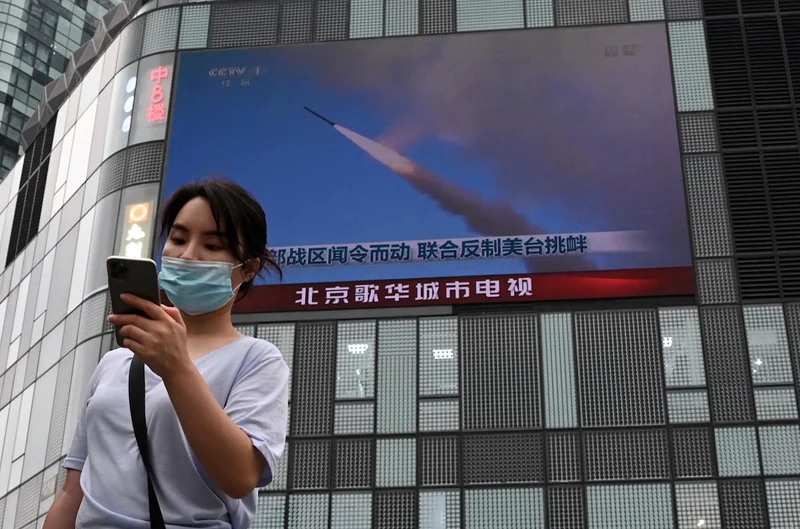
It shouldn’t be. Over the past several years, the platform has become the island’s principal vehicle for presenting an authoritative Taiwanese perspective on history and current events – subjects Beijing is increasingly seeking to shape to its own ends.
That mission has become progressively more important as China's informational capabilities have expanded in their scope and sophistication. The PRC hasn’t developed those in isolation; it has drawn lessons from the influence operations of its strategic partner, Russia, while increasingly coordinating narratives with Moscow as well as Tehran on a range of geopolitical issues. The result is an emerging authoritarian information ecosystem in which all three amplify one another's messaging, reinforce shared strategic objectives, and work collectively to erode confidence in the West.
Taiwan has become one of the principal testing grounds for that strategy. During a visit to Taipei last autumn, senior government officials described to me an information environment that is growing steadily more hostile, as Beijing moves beyond traditional propaganda toward increasingly sophisticated efforts to shape public opinion both on and about the island.
The takeaway was unmistakable: China's campaign against Taiwan is no longer confined to military coercion or economic pressure. It has increasingly become a contest over narrative as well.
That is precisely where TaiwanPlus has a role to play. Though vastly outspent by the Chinese Communist Party's sprawling global media apparatus (the budget of which has been estimated to be at least $10 billion annually), the broadcaster has nevertheless established itself as a credible international platform capable of presenting Taiwan's perspective to audiences that might otherwise only encounter Beijing's version of events.
But that capability is now at risk. Last week, opposition lawmakers in Taiwan's Legislative Yuan proposed sweeping cuts to the budget of the Public Television Service (PTS), the state broadcaster that oversees TaiwanPlus. If fully enacted, the cuts would amount to as much as 30% of PTS’s budget, and strip almost all operational funding from TaiwanPlus, thereby neutering the broadcaster.
The battle is about much more than a single media outlet. It represents a proxy fight over Taiwan's larger strategic orientation.
For years, legislators from the opposition Kuomintang (KMT) have leveled criticism at Taiwan's public broadcasting system and sought to disrupt its funding. Their objections are hard to reconcile with the service’s public standing, since according to the Reuters Institute 2026 Digital News Report the PTS ranks among Taiwan’s most trusted news organizations. Rather, the dispute reflects a broader political disagreement over Taiwan's identity, its relationship with Beijing, and the role that publicly-funded media should play in shaping domestic and international perceptions of the island.
That debate has acquired new urgency as the KMT gains momentum after a decade of political control by the Democratic Progressive Party (DPP). Under the leadership of its chairwoman, the U.S.- and UK-educated former parliamentarian Cheng Li-wun, the KMT has of late advanced a considerably more accommodating approach to Beijing than the one embraced by the government of current President Lai Ching-te.
Seen from that perspective, an influential broadcaster that consistently highlights Chinese coercion, and which emphasizes the island’s democratic resilience and the distinctness of Taiwanese identity, is not merely a budgetary expense. It also represents a significant political impediment.
That matters a great deal, because the contest between Taipei and Beijing has never been solely about military capabilities or diplomatic recognition. It is a struggle over legitimacy, perception, and narrative. Beijing understands this very well, which is why it continues to devote enormous resources to information operations that are designed to isolate Taiwan internationally and sow discord on the island itself.
All of which makes the current fight over TaiwanPlus deeply consequential. It represents a bellwether for how Taiwan will fare in the larger battle for international opinion – a contest that has become almost as vital as the military balance in the Taiwan Strait itself.