Dogs may be even more attuned to people’s feelings than we think.
Man’s best friend has a knack for knowing what humans are thinking, reading signs as subtle as jangling keys or a dangling leash. But a new brain-imaging study suggests that dogs may even be able to distinguish between certain negative emotions without using clues like our body language, odor or words. Just looking at people’s faces may be enough, scientists report August 10 in iScience.
The results offer a new peek at what’s going on in canine brains. That could help scientists better understand how dogs’ emotion-sensing abilities evolved, says Laura Cuaya, a neuroscientist at the University of Vienna in Austria. In the meantime, the work provides yet another reason to smile at any pup that crosses your path, she says — perhaps they’ll understand.
Previous studies have revealed much about dogs’ perception of emotion. They can tell whether a human face is displaying positive or negative emotions, for example. And such emotions seem to arouse different areas of the brain. But many questions remained. Can dogs’ brains differentiate between two negative emotions, such as anger versus fear? Do the faces need to be familiar?
Who’s a good boy?
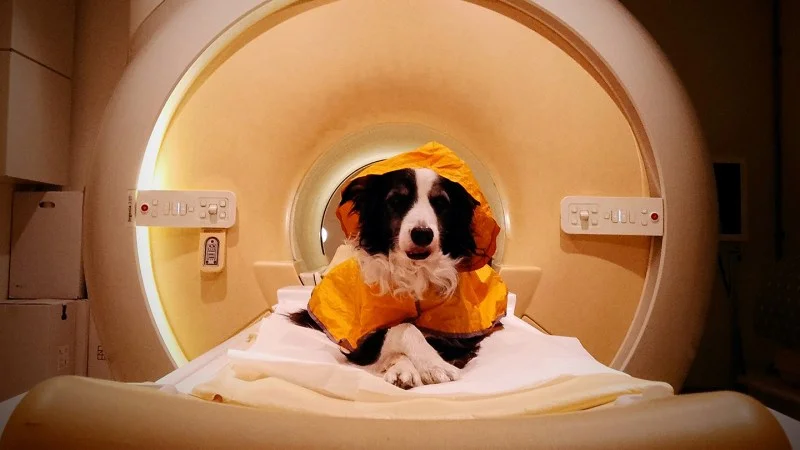
Odin and Kun-Kun (right) are two canine participants in a project that examined dogs’ brain activity. Researchers trained the pups to sit still inside an MRI machine while looking at images of human faces. The dogs’ brains lit up in different patterns depending on what emotions people’s faces displayed. Scroll through to see just how good a boy Kun-Kun is.
Cuaya and her colleagues trained 14 family dogs, including border collies and golden retrievers, to stay still inside an MRI scanner while the researchers tracked brain activity. “They are very, very good at the task,” she says. In one experiment, dogs looked at images of unfamiliar human faces with happy or neutral expressions. Happy faces lit up a reward region in the animals’ brain more strongly than neutral faces did, the team found.
In another experiment, the dogs’ brains registered different activity patterns when looking at angry or sad faces versus fearful ones. It’s the first evidence that the animals can differentiate between negative emotions on people’s faces, Cuaya says. That suggests dog brains have more detailed processing capabilities than scientists once thought, though she acknowledges that the findings might not be the same in all dogs.
The team is now investigating a sound dogs make that’s believed to be the equivalent of human laughter. The researchers want to see how the animals’ brains respond to hearing the sound. They are not, however, planning any imaging studies in cats, says neuroscientist Raúl Hernández-Pérez, also at the University of Vienna. That,he says, would be “nearly impossible.”