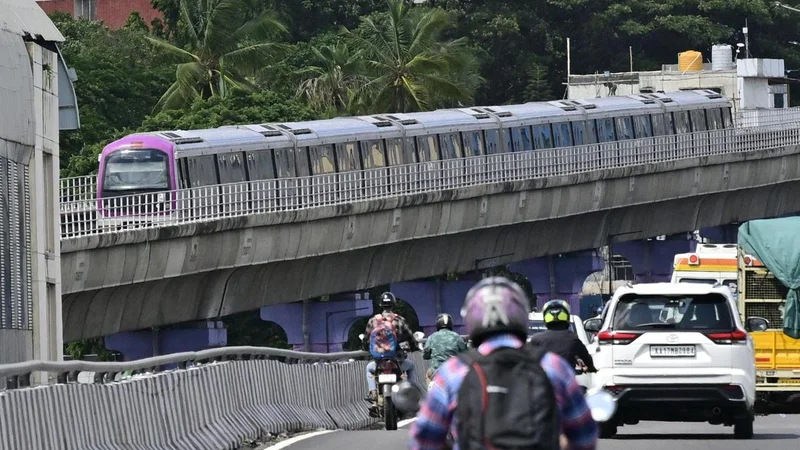
The implementation of Phase 1 and 2 of the Bengaluru Metro project by the Bangalore Metro Rail Corporation Limited (BMRCL) faced significant shortcomings in planning, land acquisition, project execution, financial management and operations, according to a performance audit by the Comptroller and Auditor General of India (CAG).
The CAG Performance Audit Report No. 7 of 2026, covering the implementation of Phase 1 and 2 of the Bengaluru Metro project, was tabled in Parliament on Monday (August 10). The audit examined planning, implementation, monitoring and operations of the two phases since their inception up to March 2021, while the physical and financial progress of selected contracts was reviewed up to March 2023. Phase 2A and 2B were excluded from the audit.
BMRCL is a 50:50 joint venture between the Centre and the Karnataka government. Phase 1, covering 42.3 km, began commercial operations in phases from October 2011 and became fully operational in June 2017. Phase 2 operations began in stages between January 2021 and March 2023 over 27.36 km, with the remaining portion is planned for completion by December 2026.
One of the major concerns raised by the CAG was the planning of Phase 2 without a Comprehensive Mobility Plan, Transit Oriented Development or Land Use Policy.
Low ridership
The audit noted that the actual Peak Hour Peak Direction Traffic (PHPDT) achieved during Phase 1 in 2021 was substantially below projections, ranging between 6,429 and 8,852, against projected levels above 15,000. Despite the low ridership, no study was undertaken to establish how ridership could be improved to justify investment in a heavy metro system.
The audit also questioned the ridership assumptions used for calculating the Financial Internal Rate of Return and Economic Internal Rate of Return for both phases. According to the report, the projected ridership could not be achieved and BMRCL had not conducted a detailed study into the reasons for the low ridership.
The audit noted that feeder services were poorly organised and did not adequately connect Metro stations with interior residential areas. It also pointed to a decline in BMTC bus footfall from 51.3 lakh passengers per day in 2014-15 to 27.49 lakh in 2022-23, a year after the pandemic. Even the combined ridership of BMTC and Metro remained lower than BMTC’s earlier ridership, indicating that the Metro had not attracted enough private vehicle users to significantly increase overall public transport ridership in Bengaluru.
Land acquisition
Land acquisition emerged as another major area of concern. The CAG said land requirements were not properly assessed in the Detailed Project Reports. For Phase 1, BMRCL acquired 62.67 hectares against a projected requirement of 45.24 hectares, while for Phase 2, it acquired 145.16 hectares against a projection of 165.09 hectares. The audit estimated that improper land assessment and delays in acquisition increased land acquisition costs by ₹6,603.39 crore as of March 2023.
Cost escalation
The report also found excess compensation payments. Adoption of inappropriate land rates resulted in excess compensation of ₹294.72 crore, while delays in issuing final acquisition notifications led to an additional ₹186.86 crore being paid as interest. Another ₹31.35 crore was paid in excess compensation in Phase 2 due to the adoption of higher percentages for certain property attributes.
On project execution, the CAG noted that BMRCL did not have a procurement manual and lacked uniform guidelines for cost estimates, project duration, package sizes, tender document periods and contractor advances. Taxes included in estimates for nine civil contracts increased project costs by ₹1,222.4 crore. Land handover delays in 13 contracts ranged from 12 to 1,305 days, well beyond the permissible 90 days.
The audit further highlighted BMRCL’s financial dependence on the Karnataka government. Continuous cash losses between 2013-14 and 2021-22 left the corporation dependent on the State government to service project debt.
Non-fare revenue
Non-farebox revenue also remained below projections. Property development, which was expected to generate additional revenue, also remained underutilised. Of the 2.46 lakh sq. ft. of built-up space developed at Metro stations, 2.23 lakh sq. ft. remained vacant for years, resulting in an estimated loss of ₹38.53 crore in lease-rental revenue between 2019 and 2022.
The CAG also found a substantial gap between projected and actual farebox revenue. Between 2016-17 and 2022-23, BMRCL earned ₹1,758.13 crore in farebox revenue against the projected ₹7,736.7 crore. The report attributed the failure to achieve projected ridership to factors including inadequate integration with BMTC, poor last-mile connectivity and insufficient parking facilities.
Published - August 10, 2026 08:43 pm IST