- Lightning Beneath The Sea by James M. Tabor (W. W. Norton £24, 368pp) is available now from the Mail Bookshop
The Atlantic Ocean,’ proclaimed Harper’s monthly magazine in 1858, ‘has been abolished.’ Who had achieved this remarkable feat and how? As we learn from James M. Tabor’s absorbing book, it was a wealthy American paper merchant named Cyrus Field and he had done so by laying the first telegraph cable across the ocean floor. Communication between the Old World and the New could now take minutes rather than weeks. Harper’s metaphor seemed appropriate.
Field had apparently succeeded in his self-appointed mission, despite previously knowing nothing of telegraphy. Or the electricity that powered it. (Few people did at the time. Many, including the chief electrician in Field’s Atlantic Telegraph Company, thought electricity was a kind of fluid.)
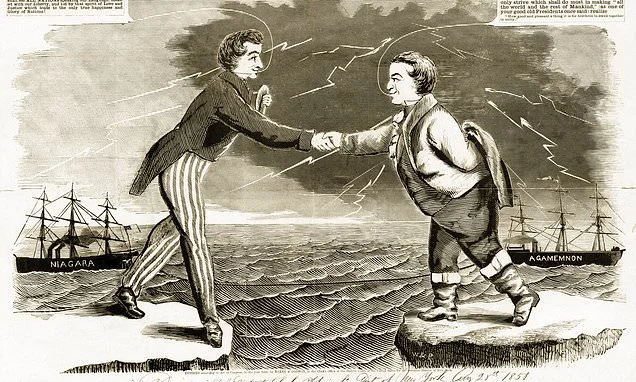
Contemporary cartoon showing the closeness that would be created with the laying of the cable
Field’s first attempt to join the continents, in 1855, was an ‘abject failure’. His cable snapped. He tried again three years later but was thwarted by a monstrous storm in which one of the ships laying out the cable was nearly swamped by ‘walls of water on both sides as high as five-storey buildings’.
A second attempt later that same year was seemingly successful. Field became the man of the hour. In the words of his brother, ‘his name was on millions of tongues’. Hundreds of thousands of people turned out for a grand four-mile parade in his honour in New York.
The celebrations were premature. Messages faltered and then failed. In Tabor’s words, ‘Cyrus Field’s Atlantic cable uttered its dying words the same day New York City held its grand celebration to honour him as the new Columbus.’
Acclaim turned to vilification. Former friends crossed the street to avoid him. He was assailed by money difficulties. Rivals threatened to steal his thunder. During the American Civil War, he was even accused of treason against the Union, though the charges were dropped.
However, Field was not a man to be easily discouraged. In 1865, he took up the challenge again. His cable-laying vessel this time was the largest ship of its era – Isambard Kingdom Brunel’s Great Eastern. Years earlier, Brunel had said to Field, ‘There, sir, is the ship to lay your cable.’ Now, the great engineer was dead and the Great Eastern was for sale.
Field bought it and fitted it out for his purposes.
An initial expedition across the Atlantic ended once again in failure, amidst rumours of sabotage by Field’s enemies. A second journey, in 1866, finally succeeded in laying the cable. And this time, the telegraph continued to work. Field had achieved his goal after 12 years of stress and struggle.
His is an extraordinary story of alternating disaster and triumph, often forgotten today. Tabor brings it to life in a widely researched and lively narrative.