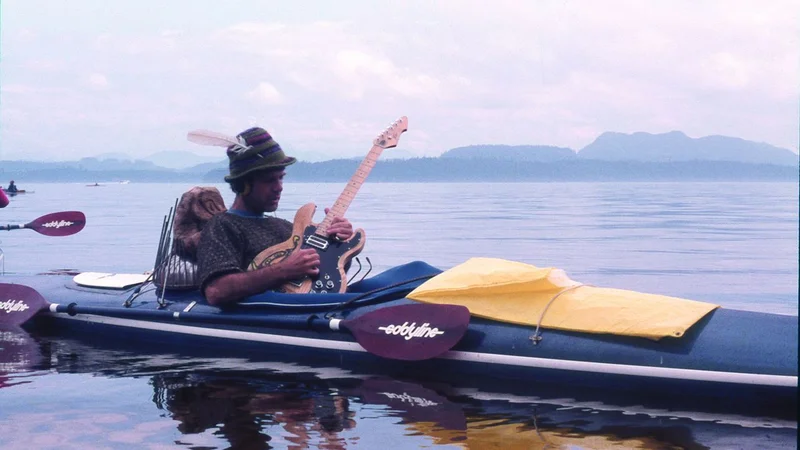
Throughout his career as a composer, Jim Nollman has worked with unorthodox partners to create music. Instead of collaborating solely with human musicians, the artist has expanded his cast to include animal bandmates, and they've been making melodies together for more than 50 years.
Nollman's new album, "Orcas' Greatest Hits," will be released Aug. 14 by the music label Smithsonian Folkways Recordings. As the title suggests, the album is a collection of songs centered around orca (Orcinus orca) vocalizations.
Nollman now lives in Friday Harbor, Washington, but he recorded these sounds off the coast of British Columbia between 1985 and 2002, using underwater microphones called hydrophones. The vocalizations weren't random calls that Nollman overheard; rather, he prompted the orcas to "sing" by broadcasting his and fellow musicians' music into the water via underwater speakers. The artists kept the volume at a reasonable level to protect the orcas and performed after dark to avoid motorboat sounds.
However, orcas weren't Nollman's first animal bandmates. Fresh out of Tufts University in the 1970s, he made music with various animals, including turkeys, wolves and dolphins. To learn more, we spoke with Nollman about his career, including several years he spent consulting with the U.S. Navy, and the extraordinary interactions he's had with whales and other creatures.
Jim Nollman is a Washington state-based musician, sound artist and author interested in interspecies communication. He has released several music albums, including "Playing Music with Animals" in 1982 (Folkways Records), "What the Dolphin Said" in 1997 (Beluga Records) and "Music for Swimming and Flying" in 2021 (Other Minds Records).
Sascha Pare: How did you first start making music with animals?
Jim Nollman: In my latter year at university, I got involved in the theater, doing all the music for all their plays. I soon got into John Cage [an American composer known for his innovative approaches to sound] — first in Boston, and then in the San Francisco Bay Area when I moved there. I got to know some of the avant-garde music people, especially in Berkeley, because there was a big movement there [centered around California's KPFA Radio].
I'd been in Mexico, playing flute, and the turkeys next door would always gobble on a certain high note and at a certain volume. I said [to an editor at KPFA], "Why don't you send me to a turkey farm? I'd like to do a Thanksgiving Day piece." He gave me a sound man and a Nagra tape recorder. I remember vividly, because having a Nagra after just getting out of college was a big deal for me. I was into technology. [Editor's note: Nagra is a Swiss brand of portable audio recorders.]
The turkey farm had 300 turkeys, and I immediately learned from the owner that it's really only the males that gobble. He kept the males and the females separate, so he put me into the fenced-in area where the males were. I started singing, and I could control them. The turkeys closest to me would start, and the gobble would go out to the edge of the 300 birds. And then it would come back, and then they would all stop. I was singing "Froggie Went A-Courtin'," which is an old American folk song [originally from Scotland] about animals. I sang 30 or 40 verses of this song and controlled the turkeys.
I was around 24 years old, and I had a hit. I knew I wanted to be a musician, but I had some major flaws to be a performer, because I didn't like being the center of attention. I'm kind of an introvert. That's a loser if you're trying to be a singer-songwriter. I loved writing tunes and playing them, but not in front of a big audience. This [recording tunes in nature with animals] was a way to get into music.
After the turkeys, I wondered if I should try making music with animals again. I tried it with kangaroo rats [Dipodomys deserti], which build these burrows like Trinidad steel drums. Kangaroo rats only come out at night, and they thump to each other in their burrow systems, which are tuned — it seemed to me, anyway, that each place in the burrow had a different tone — and they communicate with one another.
Then, I went to a wolf preserve. I realized that the wolves did two or three howl sessions in the morning around dawn and two or three at night. The wolves wouldn't play with me if I was out of their key. If I played a flat note, they would stop and basically tell me, "We don't mind if you're playing in our pack, but you've got to do it right." That was a big lesson for me, and that's how I got into it.
SP: Your new album features orcas. Did you always have a sweet spot for orcas, or is there another animal you preferred working with?
JN: No, I don't have a sweet spot for orcas. I recorded orcas for 15 years, and I had lots of recordings, most of which I never really listened to, because I didn't know what to do with them. At some point, I decided that "I can't do anything more with the orcas, and I don't like going to whale conferences and being this authority," because it wasn't about that for me.
[After years of recording orcas], I started going to the Arctic — because I wanted to go to the Arctic and because beluga whales [Delphinapterus leucas] were there, and they seemed like the opposites of orcas. The orcas were very much in tight families traveling together and making very simple calls that had deep meaning. To have their echolocation against a speaker at midnight could be like being in a war zone. It was so loud; we had speakers blow out sometimes.
The beluga whales were the antithesis of that. It seemed like they all were talking at the same time, and they all seemed to know what everybody else was saying. This is my speculation. They used sound as their family anchor, and I had no idea if they all understood each other talking. But it was very much more animated than what the orcas were doing. I would say 50% of the orca calls were just two notes; they were D to C, and back to D. And they would do that all day long, some of them. Beluga whales sometimes sounded like belly laughs. They made the weirdest sounds, and I loved it.
I went everywhere in the Arctic. I started out in the first year going to Nome [Alaska] in the Bering Strait, and then I went east to the Mackenzie River delta in northern Canada on the Beaufort Sea. Then, I went to Baffin Island in the Canadian High Arctic. In every place I went, limited beluga populations were crashing. At some point, I realized this was a complete loser. I pretty much gave it up until I met some people from Finland who said, "You should try it in Russia." The Soviet Union had recently crashed, and they were opening up all the places where they had their gulags [forced labor camps] and their nuclear fleet. The Solovetsky Islands were loaded with beluga whales that hadn't seen people in 70 years. I went there, and I had a great time with the beluga whales.
SP: What is your favorite memory of working with orcas or beluga whales?
JN: Six or eight years ago, somebody brought me and a bunch of other artists up to Hudson Bay [in Canada], basically to emulate what I'd done for so many years [artistic residencies to experiment with whale sounds]. I was the mentor for everybody. I liked that role. We were confronted with beluga whales, and I said, "I don't really want to play the guitar or the mandolin with the beluga whales, because I've tried that all over the Arctic and I've never had much success. I'm going to put my head in the water and blow bubbles."
The beluga whale came up, and it wrapped its mouth around my face. It did the same thing to the woman who was blowing bubbles on the other side of the kayak we were on. That was maybe the most fun thing I ever did with cetaceans. I wasn't worried at all. I've had the same thing happen with giraffes. I was in Texas at this game farm, and this giraffe came and licked my whole face with its giant tongue. It was really quite wonderful.
SP: The oldest recordings in the new album are 40 years old, and you said you hadn't listened to all of them before making the album. What was it like hearing them after all these years?
JN: I had 65 hours of tapes, and I listened to them over three or four months. Ninety percent of it was rubbish; it was just repetitive, and the whales would get into their D-to-C-to-D call routine. I wanted something where there was a groove, or some kind of magic going on that was inexplicable.
I started choosing some sequences. I thought it was only a certain level of connection that we'd created, but a couple of the things that I listened to when I was in that process blew me away. The one where I was playing James Brown riffs into the water — that was very strong for me. I'd never heard that before. I was discovering new stuff by giving it a close listen.
There's one where I was being filmed by National Geographic, and it was just me and a guy on a big boat cruising the waters. I started playing a country blues bottleneck on the guitar. [Editor's note: A bottleneck in country blues is a guitar-playing technique where a hard object is placed on a finger and glided along the strings.] The whales only did this a couple of times, but they would come in with a chord change. Say I'm playing in a key of D; they would come up and play the G in perfect time. I was impressed by that.
SP: Did you ever play the recordings of you and the orcas back to the orcas?
JN: No, because the recording can't answer the whales. I was trying to make a telephone connection, so it has to be two things talking to each other. To play a recording would be like me saying, "Let's stop this interview now, and I'm going to put on something of me giving an interview to somebody I spoke to yesterday." You wouldn't like that, and I don't think the whales would have liked that either if I did it to them. It had to be direct. I had many people who were very ardent or passionate about singing or reciting poetry — one guy wanted to sing Jewish death prayers to the whales. But the whales didn't come.
SP: Is part of why you've been so successful at making music with animals that they particularly like you?
JN: Some animals like me. I definitely got through to the orcas. I could tell that, because I had an interim of eight years between doing it with the big communities [of artists] and going out alone with the orcas. They were the same orcas, and they definitely knew who I was the first time I put sound in the water again. That's when that country blues episode happened. We were all much more relaxed with each other. The second time was great. It was also a tragedy, because the whales had lost their residence to the loss of salmon [in the northeast Pacific Ocean], and they were way out of their range.
SP: Your work with orcas and other whales landed you a job with the U.S. Navy in 2011. How did that happen, and what was your role?
JN: I was doing underwater concerts in the 1990s. I was invited to Kodiak Island, which is a large island off the coast of southern Alaska. They wanted me to do an underwater concert. At the time of this festival, in which I was performing, the U.S. Navy was sending ballistic missiles from Southern California to the waters off Kodiak Island for testing. This was destroying the halibut [Hippoglossus stenolepis] fishery on Kodiak Island, because the fishermen couldn't go into this area, suddenly.
The Navy sent a guy who was part of this ballistic missile thing but also had a PR background. He said, "Can I speak before your concert?" I said, "You can speak about whatever you want, but you've got to get in the water. That's the payment you have to give me: Get in the water and hear all this music that I've created."
He was blown away. I had a fan. He took me out for dinner and asked me if I had any ideas about solving this great scandal that was enveloping the Navy at the time, which was the killing of mostly beaked whales during mid-frequency sonar exercises, mostly in the Bahamas, in this hole in the ocean that's there. Nobody had a solution, so he wanted me to be on the team. I said, "Sure, I'll be on the team." It was like somebody asking me to play for the New York Yankees or something — completely odd, but I thought, "OK, I'll try that."
He called me back two years later, saying, "We have our money, and we want you to come to the Groton submarine base [in Connecticut], where we'll have our first meeting with submarine captains, Ph.D. sonar engineers and a few whale biologists." That went on for seven years. I took the job seriously. I told them that I thought we could solve it in five minutes. I said, "All you need to do is take care. If you see whales in the vicinity, don't exercise on that day." This sounds so totally obvious, but the fact was that he [the PR man] was contending with a Navy establishment that believed that the Navy could do anything to save the American people from being bombed or wrecked. They didn't see whales as anything but collateral damage.
SP: Do you have a favorite song on the new album?
JN: I like "The Three Jimmies." I never knew that James Brown's guitar player was named Jimmy Nolen — I mean, that's really outrageous. So, it's the three Jimmies, right? I really like the music, and I like the piano player [Jonathan Churcher], who plays one note every three or four bars. The response of the whales is also brilliant, I think. There's one part where the whale starts to echolocate, which is the way they see the world; it's their perceptional tool. The whale starts clicking in time with the beat that I'm playing on the guitar. That only happened once in 65 hours of recordings, and I thought that was pretty unusual.
Related stories
- 'They reliably chose the statistically more favorable option': A crow researcher explains how these winged geniuses process numbers, and what it could reveal about human math smarts
- 'We were genuinely surprised': 'Superworms' can clean extremely delicate skeletons lickety-split, and that's a game changer for museums
- 'I've seen the movies. What a horrible way to die': What it's like to be sucked into a tornado and survive
SP: What's next for you after "Orcas' Greatest Hits"?
JN: I'm composing new music, and I'm hoping I'm at least breaking even [with the new album] so that they [Smithsonian Folkways Recordings] can do the next one, which is called the "Cowbird Variations." The cowbirds are basically the bottom voice, maybe the part that's played by bass in pop music. Everything else is other birds and insects called treehoppers. It has this very primitive sound to it.
I love doing this music with cowbirds, because cowbirds have a horrible reputation. They lay their eggs in other birds' nests, and when the eggs hatch, the baby cowbirds knock all the birds in the nest out and kill them. Then, the parents — juncos, where I live — end up raising the cowbirds. These birds have a terrible reputation, but they make one of the strangest sounds in nature — so that's why I chose them.
This interview has been condensed and edited lightly for clarity.
Sascha is a U.K.-based staff writer at Live Science. She holds a bachelor’s degree in biology from the University of Southampton in England and a master’s degree in science communication from Imperial College London. Her work has appeared in The Guardian and the health website Zoe. Besides writing, she enjoys playing tennis, bread-making and browsing second-hand shops for hidden gems.