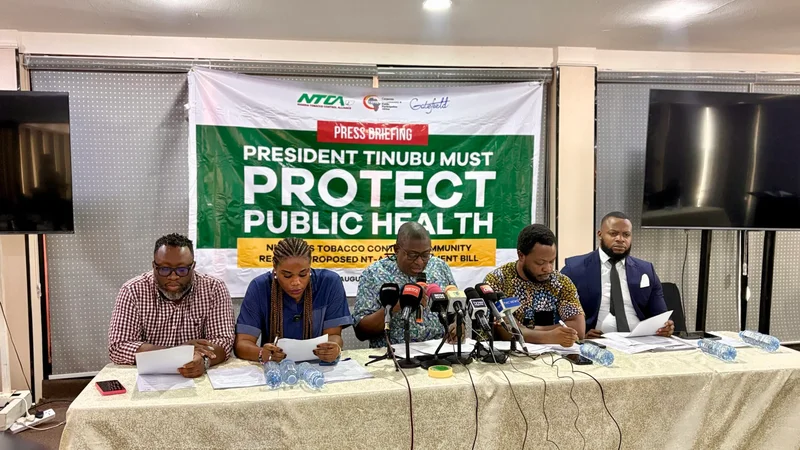
Civil society and public health organisations have urged President Bola Tinubu to withhold assent to a proposed amendment to Nigeria’s tobacco control law, warning that some provisions could weaken existing safeguards against tobacco and nicotine addiction, particularly among young people.
The groups made the call at a press conference in Abuja on Monday, titled “Why Nigeria Must Reject Harmful Amendments to the National Tobacco Control Act.”
The event was organised by the Nigeria Tobacco Control Alliance (NTCA), in collaboration with Corporate Accountability and Public Participation Africa (CAPPA) and other tobacco control organisations.
Beyond asking Mr Tinubu to withhold assent, the coalition called on the National Assembly to recall the consolidated National Tobacco Control (Amendment) Bill, 2025, and subject it to what it described as a transparent, public health-led review.
| | |
|---|
The demand followed the Senate’s approval of the bill after its earlier passage by the House of Representatives, bringing the proposed legislation closer to presidential consideration.
‘Reject the bill’
Reading the coalition’s statement, CAPPA Executive Director Akinbode Oluwafemi said the organisations supported updating the National Tobacco Control Act, 2015, and its 2019 regulations to reflect changes in the tobacco and nicotine markets.
He, however, said such changes should not come at the expense of existing public health safeguards.
Mr Oluwafemi acknowledged provisions the coalition considered positive, including the proposed extension of smoke-free zones to within 30 metres of schools and health facilities, and the inclusion of the Nigeria Police Force and the ministry responsible for youth development in the National Tobacco Control Committee.
He argued, however, that these provisions did not outweigh other changes the coalition considered potentially harmful.
The coalition, therefore, urged Mr Tinubu to withhold assent if the bill reaches his desk.
It also asked the National Assembly to publish the committee reports, voting records and stakeholder submissions that informed the consolidated version of the bill.
The groups further called on the Federal Ministry of Health and Social Welfare to clarify its position on the legislation and demand its recall if it was not adequately consulted during the legislative process.
Questions over consolidated bill
The Country Coordinator of the Campaign for Tobacco-Free Kids (CTFK), Michael Olaniyan, questioned how the consolidated version of the bill was produced, claiming it contained provisions not included in documents presented at the House of Representatives’ public hearing in November 2024.
According to him, the earlier documents totalled four pages, while the consolidated version runs to 31 pages.
“What we have now is a 31-page new document that suddenly emanated from a four-page combined document,” he said.
Mr Olaniyan questioned how the additional provisions were introduced and which public health institutions were consulted before they were incorporated.
Advertising loopholes
Mr Oluwafemi also raised concerns about provisions the coalition said would relax existing restrictions on tobacco advertising, promotion and sponsorship.
He said the bill would permit the promotion of non-combustible products through adult publications, point-of-sale materials, and online platforms, as well as the sponsorship of cultural, social, and recreational events targeted at adults.
He particularly criticised the proposed definition of an “adult publication” as one with a readership of at least 50 per cent adults.
According to him, such a threshold could allow publications with substantial numbers of younger readers to carry advertisements for tobacco and nicotine products.
Smaller packs, weaker enforcement
The Executive Director of A New Thing International Foundation, Kenneth Anetot, said provisions allowing tobacco and nicotine products to be displayed at points of sale and sold in smaller packs could increase their visibility and accessibility among young people.
Mr Anetot said adolescents were particularly vulnerable to addictive substances because their brains were still developing, including areas involved in decision-making and impulse control.
He urged the National Assembly to recall the bill and allow wider stakeholder participation in its review.
READ ALSO: Group warns against tobacco industry still targeting Nigerian youths despite control laws
Nigeria’s tobacco burden
The coalition’s concerns come as tobacco control advocates warn that tobacco use and nicotine addiction continue to impose a significant health and economic burden on Nigeria.
The WHO describes tobacco as a major risk factor for cardiovascular and respiratory diseases, more than 20 types of cancer and other debilitating health conditions. It also states that tobacco kills more than seven million people globally each year.
In Nigeria, the NTCA has previously cited estimates that tobacco-related illnesses cost the country more than N211 billion annually, including healthcare expenses and productivity losses, while nearly 30,000 people died from tobacco-related causes in 2021.
The alliance said young Nigerians were being exposed to smoking, vaping and shisha imagery through music videos, fashion and digital platforms.
A recent study also raised concerns about tobacco marketing targeting women and girls in Nigeria, suggesting that the industry is expanding its marketing strategies to reach new groups of potential consumers.
The health and economic burden of tobacco has also heightened concerns about weakening the safeguards Nigeria has built over the years.
Speaking at Monday’s event, NTCA Coordinator Olawale Makanjuola said Nigeria had made significant progress in tobacco control and argued that some of its regulatory approaches had become reference points for other African countries.
He cited efforts to regulate tobacco imagery in entertainment as one area in which Nigeria had made progress.
Mr Makanjuola warned that provisions in the proposed amendment could reverse some of those gains.
He urged the government and lawmakers to ensure that any changes to the National Tobacco Control Act strengthen, rather than weaken, protections against tobacco and nicotine-related harm.