Iran says regional defense pact signals shift toward indigenous security
TEHRAN — Iran has welcomed the emerging defense understanding among Saudi Arabia, Pakistan and Turkey as evidence of a broader shift in regional thinking about security, arguing that countries in the region are increasingly recognizing the limits of relying on external powers for protection.
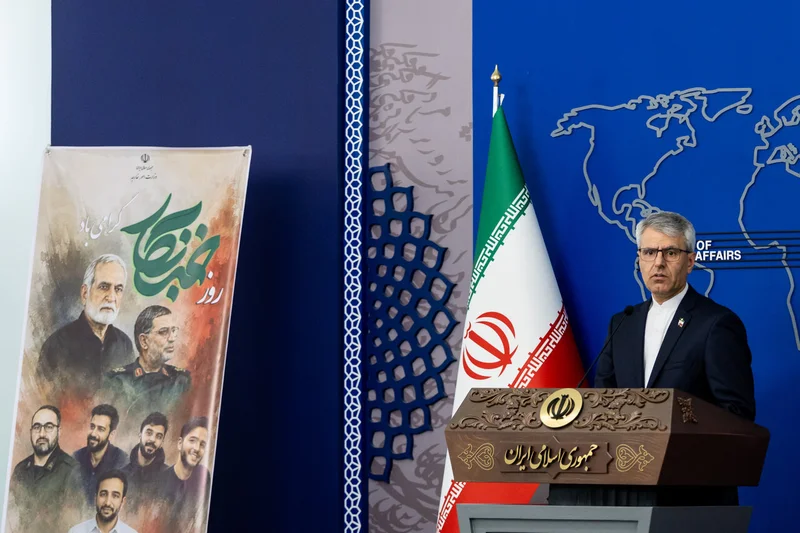
Iranian Foreign Ministry spokesman Esmaeil Baqaei made the remarks at his weekly press conference on Monday, saying Tehran has long advocated regional cooperation, mutual trust and security arrangements that do not depend on foreign actors.
He said developments in recent years, particularly the war in Gaza and Israeli military operations in Lebanon, Palestine and Syria, had reinforced the perception among regional states that the main threats to regional stability must be addressed through regional mechanisms.
Baqaei also criticized US support for Israel, arguing that Washington has contributed directly to insecurity in the region and that Israel could not have carried out its military actions without American backing.
Iran, he said, considers regional security indivisible and believes initiatives that accurately identify the sources of threats and reflect regional realities could contribute to greater stability.
Caspian Sea convention awaits Parliament's decision
Turning to the Convention on the Legal Status of the Caspian Sea, Baqaei stressed that Iran independently determines its position on international agreements according to its national interests and that the final decision on the convention rests with parliament.
The convention, signed by the five Caspian littoral states in August 2018, had been reviewed for years by the Foreign Ministry and other relevant institutions before being submitted to the Iranian parliament, he said.
Baqaei rejected suggestions that the timing of the convention's referral was linked to the recent war or pressure from another country, stressing that Iran's decisions on international instruments are based solely on national interests.
He noted that the convention cannot enter into force until all five signatories have approved it, making it natural for the other Caspian states to favor its early implementation. The Foreign Ministry, he added, would continue to explain the agreement and consider different views, while
parliament would ultimately determine its fate under Iran's Constitution.
Hormuz talks continue as Tehran rejects US demand for reopening
A major part of the briefing focused on the Strait of Hormuz, where Iran and Oman are continuing talks on establishing a mechanism for the safe passage of commercial vessels.
Baqaei said the two sides had reached an understanding on the navigation route, although technical details remained under discussion before a joint statement could be finalized. The proposed arrangements would include monitoring the safe passage of ships, maritime services, environmental cooperation and measures to combat maritime crime.
He dismissed reports that Iran and Oman were negotiating transit fees at this stage, saying such details were not currently under discussion. He added, however, that maritime services would naturally involve compensation.
Baqaei rejected the suggestion that the Strait had been closed because of a disagreement between Tehran and Muscat, attributing the situation instead to US-Israeli military aggression against Iran and the use of military bases along the southern shores of the Persian Gulf to attack the country.
He said the discussions between Iran and Oman were specifically focused on determining a safe maritime route and were therefore a bilateral matter between the two coastal states, although any agreement would inevitably affect international shipping.
The spokesman also rejected the idea that Washington had the moral or legal standing to demand the reopening of the waterway, arguing that the current situation was the result of US actions.
Iran, he said, had never obstructed the passage of vessels carrying a significant share of the world's energy through the Strait despite decades of Western sanctions.
Baqaei said Tehran's diplomatic efforts were aimed at protecting national interests but maintained that a maritime blockade could not be resolved through diplomacy alone. He argued that the continuation of the US maritime blockade and other violations meant the conditions for declaring the Strait a secure waterway had not yet been restored.
He also said Iran's Foreign Ministry, the Supreme National Security Council and parliament were coordinating closely on the issue, rejecting suggestions of divisions within the country's decision-making institutions.
Tehran rejects nuclear allegations, seeks accountability for attacks
Baqaei separately dismissed Israeli Prime Minister Benjamin Netanyahu's claims concerning Iran's nuclear program as fabricated, accusing Israel of 'repeating allegations about an Iranian nuclear bomb that have been propagated for decades.'
He said a recent claim attributed to IRGC Commander Ahmad Vahidi had originated from a false report posted on an Indian social media account and was subsequently repeated by Israeli media before being cited by Netanyahu.
The spokesman also rejected Ukraine's assertion that an attack on an Iranian commercial vessel was unintentional, saying Tehran was not convinced by the explanation and warning that Iran would pursue compensation if Ukraine did not provide it.
On the United States, Baqaei said there had been no negotiations between Tehran and Washington, although messages could be exchanged through intermediaries on specific issues. He said Iran's immediate diplomatic focus was its discussions with Oman over safe maritime navigation through the Strait of Hormuz.
He also said Iran was documenting US and Israeli crimes and pursuing legal action through a joint Foreign Ministry-Judiciary mechanism. Domestic legal proceedings, he explained, would precede efforts to take the cases before international courts and institutions.
On Iraq, Baqaei said Tehran expected Baghdad and the Kurdistan Region to prevent terrorist groups and extra-regional actors from using Iraqi territory against Iran's security. He described bilateral cooperation as positive and said Tehran hoped security cooperation would continue under the existing security memorandum.
He also confirmed that Pakistan had invited Foreign Minister Abbas Araghchi and Parliament Speaker Mohammad-Baqer Qalibaf to visit the country, saying the trips would take place when circumstances were appropriate.
Baqaei said no final decision had been made on whether President Masoud Pezeshkian would attend the upcoming UN General Assembly session in New York, adding that Iran intended to use the annual gathering to present its positions if the circumstances allowed.
Asked about his recent sharp language toward US President Donald Trump, Baqaei invoked Iran's literary and cultural heritage, citing George Bernard Shaw's observation that when one wrestles with pigs, it is impossible to avoid getting dirty.
“Sometimes, getting muddy is part of the wrestling that has been imposed on you,” he said.