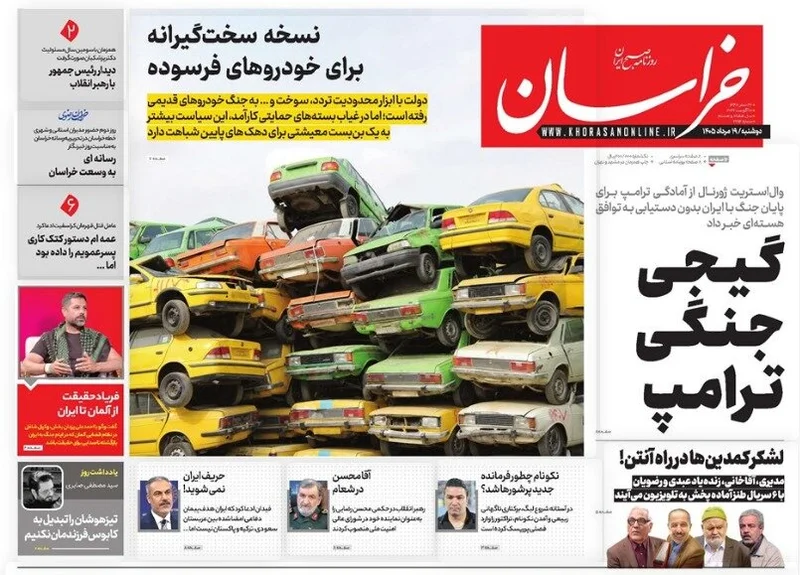
The document of America’s defeat
Khorasan analyzed the United States’ failure regarding Iran. According to Khorasan, the dispute over the Islamabad understanding is less about its clauses and more about differing definitions of victory and defeat. Critics call it a weak agreement, while supporters consider it a significant achievement.
Describing the Islamabad memorandum as a “document of America’s defeat” is not an exaggeration, but rather a logical conclusion to the conflict. Trump and Netanyahu entered the war aiming to collapse the Islamic Republic, strip Iran of decision‑making power, and impose nuclear and regional conditions. Yet in the end, they achieved none of these goals. Instead, to reopen a strait that had already been open before the war, they were forced to negotiate with Tehran on Lebanon, frozen funds, and sanctions. This is what defeat looks like: the enemy imposes costs but fails to achieve the political objective of the war, and ultimately must accept the other side’s terms just to return to the previous status quo. The Islamabad understanding is not a document proving Iran’s resistance was cost‑free; it is a document showing the war launched by Trump and Netanyahu produced no results.
**Arman‑e-Emrooz: Who is the Mecca Pact against? **
Arman‑e-Emrooz examined the pact signed in Mecca between Pakistan, Saudi Arabia, and Turkey. From the paper’s perspective, a new regional balance appears to be forming in which Turkey, Arab states, and Pakistan — each driven by different motives — are moving toward closer cooperation in response to Iran’s growing influence and Israel’s regional power. The consequences of the recent war and the perception among some regional states that previous security arrangements were ineffective have contributed to this new situation. However, the final trajectory of the pact will be determined by fluid regional geopolitical dynamics, the reactions of other actors, and the degree to which members uphold their commitments. Today’s world differs fundamentally from past eras, and regional powers have gained greater agency. Still, it is difficult to imagine the Mecca Pact becoming a decisive variable in Middle East security architecture without some level of alignment or cooperation with Washington.
Hamshahri: Iran’s new arrangements
Hamshahri discussed the features of a new era in the Strait of Hormuz. Contrary to recent speculation suggesting Iran might overlook its “new Iranian arrangements” for the strait, senior Iranian officials have repeatedly emphasized in recent days that reopening this international waterway will occur solely according to Iran’s specific mechanisms and conditions. This strategic waterway is entering a new phase of security, political, and even economic dynamics. Iran insists on redefining the security and political frameworks governing the Strait of Hormuz at a time when recent regional conflicts have created conditions for revising previous arrangements and establishing new ones. Within this reconfiguration of roles in the Persian Gulf, Iran is stressing the need to move away from the traditional model of foreign powers’ presence and intervention in securing the strait, and is working to institutionalize indigenous regional participation in the new arrangements.
Javan: Why is the Strait of Hormuz important for global food security?
Javan analyzed the Strait of Hormuz’s importance in the global food market, quoting agricultural analyst Hossein Shirzad. Recent evidence, he says, shows that sudden increases in energy and fertilizer prices can have a deeper impact on global food prices than grain‑export restrictions alone. Escalating hostilities with Iran and the effective closure of the Strait of Hormuz are rapidly altering risk‑pricing in shipping, insurance, and energy sectors. This raises the cost of delivered grains, limits access to fertilizers, and creates concerns about food security in import‑dependent markets across the Persian Gulf and beyond. Disruptions in Persian Gulf logistics and rising war‑risk premiums push grain prices upward even when futures indices remain stable. Since roughly 80% of global goods are traded by sea, disruptions in maritime transport quickly affect supply chains.
Shargh: Iran is more prepared for Hormuz
Shargh examined why the United States’ maritime strategy today differs from that of previous decades. Forty years ago, during the Iran‑Iraq war, the US kept Persian Gulf shipping lanes open by escorting tankers. But repeating that strategy in today’s Strait of Hormuz would be far more costly. Iran is no longer the military power it was at the end of the Iran‑Iraq war. Over the past decades, Iran’s armed forces have studied the US as their primary potential adversary. Iran adjusted its capabilities accordingly: it built a large missile arsenal, expanded drone technology into a central component of its strategy, and partially decentralized its command structure, granting local commanders authority to fire. Crucially, Iran does not need to sink many tankers to disrupt Hormuz. A few successful attacks — or even a few credible threats — could prompt shipowners and insurers to reconsider transiting the strait. If commercial risk becomes unacceptable, vessels will withdraw on their own.