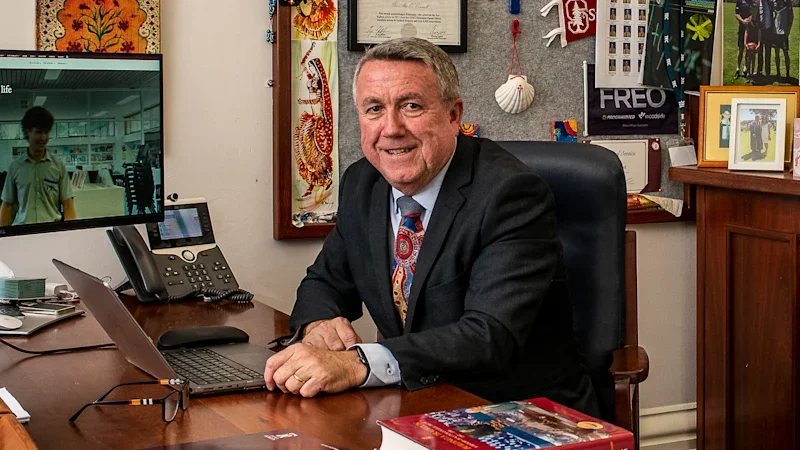
One of Western Australia’s biggest and most expensive private schools has a new way of combatting poor behaviour – but not from its students.
And it is not alone, with the state’s peak independent schools body reporting behaviour from parents as a growing topic of conversation that schools are looking to address.
Scotch College, in Perth’s western suburbs, requires parents to sign a charter when enrolling their children at the school, setting out the expected standards of respect, decency and courtesy.
“To ensure the safety and wellbeing of all, and to protect the reputation of the college, the failure to operate within the intended spirit of the charter may lead to the headmaster or the Scotch College Council taking steps to address unacceptable behaviour, including terminating an enrolment contract,” it reads.
Principal Alec O’Connell said while families formally acknowledged the charter through the enrolment process, its principles applied to everyone who engaged with the college community – including students and visitors.
He said while the majority already did the right thing, the charter was used “in conjunction with our conditions of enrolment” to outline clear expectations.
“As headmaster, I have asked a couple of families to leave our community as it reached a point where they were clearly not aligned to our college and values,” he said.
“It had reached a stage where their attitude towards our college was having a direct effect on the ability of us to support their son, and more importantly for our staff to be able to perform their duties.”
O’Connell said the charter was not introduced in response to a particular incident or report, but the school had become “increasingly aware that schools more broadly were having to deal with disrespectful behaviour within their communities”.
“If someone falls short of the expectations outlined in the charter, the first step is usually to remind them of the standards we share and to work towards a respectful resolution,” he said.
“However, if someone repeatedly or deliberately decides they no longer agree with, or are unwilling to uphold, the expectations of the college community, then they may need to consider whether this is the right community for them.”
O’Connell said during his tenure has principal, he didn’t believe expectations had fundamentally changed – but the way people communicated had.
“Communication is now far more immediate and often digital. That can sometimes create a different tone or distance in interactions, particularly when people are communicating by email or online rather than face to face,” O’Connell said.
“Occasionally, this can lead to what people might describe as ‘keyboard warrior’ behaviour, where individuals need to be reminded that respect and courtesy apply just as much in digital communication as they do in person.”
Families sending their children to Scotch College are also earning one of the highest median incomes in WA, and fees sit at almost $36,000 annually for year 7 to 12.
For international students, that climbs to more than $50,000 and, when the cost of boarding is included, comes to $82,522.
O’Connell said he did not believe the amount parents paid factored into the way they behaved.
“High fees do not provide an imprimatur to act outside of any value construct. Paying fees does not alter the shared responsibility we all have to engage respectfully,” he said.
“It is also important to say that the charter is not designed to create an adversarial relationship between the college and families. It is not about punishment or control.
“The charter exists to protect the quality of relationships across the college. It supports a culture where students, staff, families and the wider community can feel respected, supported and safe.”
Association of Independent Schools of WA executive director Chris Massey said Scotch College was not alone, and other schools across the state, and nationally, were coming up with new ways to address the problem.
“These charters help to define, for parents, staff, students and visitors, what respectful behaviour and appropriate communication looks like,” he said.
“This shared reference point means everyone can focus on what matters most – students’ learning, safety and wellbeing.”
Massey said a spotlight had been shone on parent-teacher relationships recently, particularly given changes in technology had made it easier for parents to contact schools and teachers.
“Parents are rightfully passionate about their children’s wellbeing and education. Schools welcome, and share, that passion,” he said.
“Like any community, from time to time, there may be moments where behaviour or communication that falls outside of agreed expectations needs to be addressed.
“The emphasis for many schools is now making sure these are understood by everyone and are available to the entire schooling community so when complex issues arise, everyone is approaching the issue on the same playing field.”
Last week, Catholic schools across the state introduced a new code of conduct which makes clear parents could face consequences, including being banned from the school grounds, as a result of poor behaviour.
Catholic Education WA executive director Annette Morey said the code made it clear that certain behaviours were unacceptable, but that it reflected what most families already do instinctively.
“Most parents will read this and recognise themselves in it, and that is rather the point,” she said.
It outlined unacceptable behaviours such as aggressive language, demanding meetings without notice, entering classrooms uninvited, posting defamatory material online, or harassing staff through social media.
Clear processes are listed for addressing such situations, ranging from reminders to formal warnings, and restrictions on contact.
Catholic School Parents WA executive director Siobhan Allen said families had welcomed the clarity.
“Avoiding conflict in front of children is harder than it sounds, but it matters,” she said.