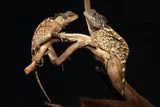
National park records placed Acanthosaura lepidogaster in the high forests of western Thailand. But when Poramad and Krittiya Trivalairat surveyed a site 4,396 feet (1,340 meters) up in Mae Wong National Park, the expected lizard never appeared.
On April 23, 2025, the pair collected three small horned lizards that did not match the species listed for the area. They returned a month later and found five more at the same site.
Those eight specimens became the basis for Acanthosaura syrax, a species new to science described in ZooKeys. It is the 23rd known member of the mountain horned dragon genus and is named for Queen Rhaenyra Targaryen’s dragon in House of the Dragon.
Read More: Are Dragons Real? The Unique History and Origins of Mythical Dragons
How Researchers Identified a New Mountain Horned Dragon
Members of Acanthosaura carry a ridge of enlarged scales from the nape down the spine, earning them the name mountain horned dragons. They live across Southeast Asia, from Myanmar and southern China to the Malay Peninsula.
No known member of the genus has shorter spines along its nape and back than A. syrax. A diamond-shaped marking crosses its neck, while the area around its eyes remains free of the dark coloring found in several relatives.
The researchers recorded 51 physical characteristics and compared the eight specimens with other mountain horned dragons. They then analyzed two mitochondrial genes from all eight lizards.
The results placed the specimens together in their own evolutionary lineage, separate from every other species included in the analysis. That included A. lepidogaster, the known species they most closely resembled.
The Traits Behind the Name Syrax
The scientific name grew out of details the researchers had already recorded. Photos of living lizards captured yellow-green around the males’ lips and necks and pale yellow or cream patterns across the females.
The body measurements supplied another connection. The largest male measured about 2.7 inches (6.9 centimeters) from snout to vent, while the largest female reached about 4 inches (10.1 centimeters). Four of the five females examined also carried eggs, with clutches ranging from 6 to 16.
Together, those observations led the researchers to Syrax. The fictional dragon is portrayed as yellow, relatively small beside the story’s other dragons, and a prolific egg layer.
For English use, the authors recommend “Syrax mountain horned dragon” and offer a corresponding name in Thai.
A Dragon Bound to One Mountain Forest
So far, A. syrax is known only from Mae Wong National Park. Researchers usually encountered it above 4,265 feet (1,300 meters) and did not find it below 3,281 feet (1,000 meters). About 31 miles (50 kilometers) north, they found A. lepidogaster living at lower elevations under warmer conditions.
Field observations show how closely the new species follows the mountain climate. The lizards bask on rocks, logs, shrubs, and cement structures from morning through midday. Some search for earthworms around dawn. Later, they retreat beneath logs and rocks or into tree cavities.
Their activity peaks between the end of the dry season and the beginning of the monsoon, roughly April through mid-June. It drops as the rainy season advances and again during colder months, when temperatures can fall to about 50 degrees Fahrenheit (10 degrees Celsius).
The lizard’s known populations are naturally separated by rugged terrain. The researchers warn that further isolation could reduce contact between groups and create problems for a species adapted to a narrow band of cool forest.
They are calling for stronger protection of Mae Wong’s high-elevation habitat and hope A. syrax can become a symbol of the region alongside the Asian forest tortoise, Oldham’s leaf turtle, and the Indochinese tiger.
A name borrowed from fantasy may now help draw attention to a real mountain dragon known nowhere else.
Read More: This 121-Million-Year-Old “Feathered Dragon” Had Tail Feathers Twice Its Body Length
Article Sources
Our writers at Discovermagazine.com use peer-reviewed studies and high-quality sources for our articles, and our editors review for scientific accuracy and editorial standards. Review the sources used below for this article:
- This article references information from a study published in ZooKeys:Acanthosaura syraxsp. nov., a new species of mountain horned dragon from high-elevation habitats of western Thailand (Squamata, Agamidae)