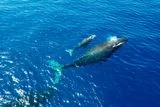
As migrating humpbacks passed the northern coast of New South Wales, drone operator Alexander Forrest noticed an adult female moving much more slowly than the surrounding whales about 2,300 feet off Kingscliff. Forrest thought she might be resting. Then the water around her turned red. Seconds later, a calf emerged and broke the surface, according to the Organisation for the Rescue and Research of Cetaceans in Australia (ORRCA) and ABC News.
ORRCA head of research Annie Post told the Australian Associated Press (AAP) that an initial review of previous accounts found no earlier aerial recording of a humpback birth. ORRCA also believes Forrest’s footage represents only the fourth complete birth captured on film.
Drone Footage Records a Humpback Whale Birth
Forrest was conducting aerial observations for ORRCA. Although he had filmed thousands of humpbacks from above, he had never encountered a birth.
ABC News reported that Forrest kept the drone more than 330 feet from the whales, in accordance with New South Wales regulations. After the delivery, the calf and its mother came together. The team watched the mother tend to her newborn as the calf began submerging for short periods, according to AAP.
The mother appeared to be alone when she gave birth, unlike some previously documented mothers that were accompanied by another whale.
Read More: Humpback Whales Show Strange “Gaping” Behavior — and Social Media Helped Us Understand It
Humpback Whale Births Rarely Appear on Camera
About 40,000 humpbacks pass Australia’s eastern coast during the winter migration, according to figures from the New South Wales environment department cited by AAP. The whales leave Antarctic waters, where they feed on krill, and swim north toward warmer breeding areas off New South Wales and Queensland.
A full journey north and south spans roughly 6,200 miles. Macquarie University whale scientist Vanessa Pirotta told ABC News that humpbacks attract observers around the world each year, yet few births have been documented.
The Birth Raises Questions About Humpback Calving Areas
Researchers once thought humpbacks needed to reach tropical waters before giving birth. A calf arriving near Kingscliff does not fit within that picture.
A study in Frontiers in Marine Science compiled more than 200 records of newborn humpbacks around Australia and New Zealand. Some were found as far south as Port Arthur, Tasmania, about 930 miles beyond the previously reported southern boundary of eastern Australia’s calving range.
The researchers drew on government records, annual migration surveys, and sightings reported by tourism operators and citizen scientists. They classified a calf as a newborn only when its size, physical features, and behavior indicated it was less than a month old. Photographs, video, or an account from an experienced observer were also required. The Port Arthur calf appeared to be the highest-latitude newborn humpback recorded anywhere in the world.
The study also found that mothers often continued migrating after giving birth. All 94 mother-calf pairs in New South Wales with available travel data were heading north, indicating that a calf’s arrival did not necessarily end the journey.
University of New South Wales Ph.D. candidate Jane McPhee-Frew, who led the study, told ABC News that observations such as the Kingscliff birth are changing ideas about where humpbacks may have their calves. Growing whale populations and the wider use of cameras could help explain why more newborns are being documented along the migration route.
The findings could affect how these waters are managed. Some temperate areas where newborns have been recorded are not recognized as calving habitat, even though young calves may pass cities and shipping lanes during their first weeks of life.
One recording cannot determine whether humpbacks are changing their calving areas, but it does add a filmed birth to a larger record showing that calves can arrive before their mothers reach tropical waters.
Forrest set out to film a migration and instead recorded where one whale’s life began.
Read More: These Humpback Whales Rarely Leave Oman — One Just Made a Surprising Trip to India
Article Sources
Our writers at Discovermagazine.com use peer-reviewed studies and high-quality sources for our articles, and our editors review for scientific accuracy and editorial standards. Review the sources used below for this article:
- This article references information from the AAP: Rare humpback birth caught in Australian drone footage
- This article references information from a study published in Frontiers in Marine Science: Humpback whales (Megaptera novaeangliae) continue migration after giving birth in temperate waters in Australia and New Zealand
- This article references information from ABC News: Drone captures 'magical moment' of whale birth off Kingscliff on NSW coast
- This article references information from ORRCA: RARE RECORDING OF HUMPBACK WHALE BIRTH CAPTURED BY ORRCA DRONE PILOT OFF THE NSW NORTH COAST (could embed this video maybe?)