To qualify for the government subsidy for installing rooftop solar panels, households must have a minimum monthly electricity bill of around 3,000 baht, according to the Finance Ministry.
A source from the Finance Ministry, who requested anonymity, said that under the initial criteria being considered, households eligible for the 50,000-baht government subsidy would need to have monthly electricity bills of at least 3,000 baht for the installation of rooftop solar panels to be considered economically worthwhile.
The rooftop solar programme is part of a broader effort to transition away from oil and gas, which Thailand has to import and which contributed to the country's trade deficit during the energy crisis.
The government aims to promote the use of clean energy, such as solar power, and is expected to allocate around 50-60 billion baht for the programme, using funds from an emergency borrowing decree.
The source said the rooftop solar installation programme would also generate employment domestically, as installers would have to be screened and approved by the Metropolitan Electricity Authority (MEA) and the Provincial Electricity Authority (PEA). There are already a number of approved installers, and the authorities are preparing to expand the list further.
The programme is expected to begin as early as September.
The scheme has been designed to encourage households to install rooftop solar panels by providing government subsidies that would shorten the payback period for homeowners. With the subsidy, households could potentially recoup their investment within 3-4 years.
A typical rooftop solar installation under the programme would have a capacity of 5 kilowatts and cost around 150,000 baht per household.
Any installation costs exceeding the government subsidy would have to be covered by homeowners. However, they could apply for low-interest loans from Government Savings Bank or the Government Housing Bank.
For example, if a household previously paid 5,000 baht a month for electricity and the bill fell to 3,000 baht after installing solar panels, the 2,000-baht monthly saving could be used to help cover the loan repayment.
Under one possible arrangement, 1,000 baht of the monthly savings could be allocated towards the monthly loan repayment to the bank.
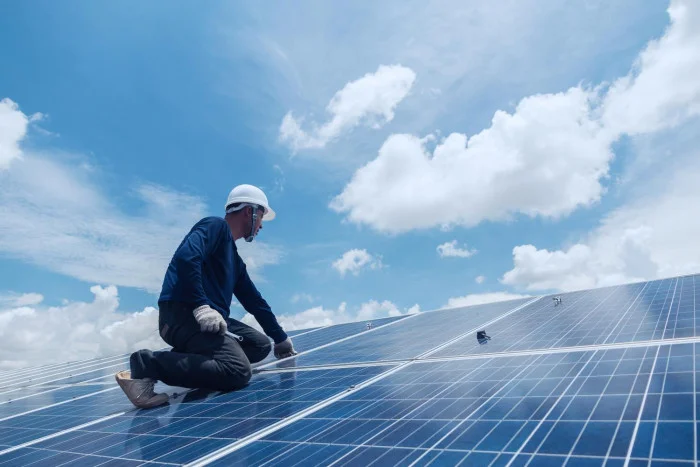
Workers position a solar panel on a rooftop. The government is promoting the use of clean energy, such as solar power, and is expected to allocate around 50-60 billion baht for its rooftop solar programme.