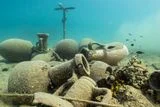
Fisherman Giacomo De Mola was training off the coast of Sicily when he came across an unusual structure on the seabed. Diving down to explore the structure, De Mola saw what he initially thought were stones. However, he soon realized that the scattered objects were amphorae, jars dating back to the ancient Mediterranean world.
Unbeknownst to De Mola, he had stumbled upon the contents of a Roman-era shipwreck that likely sank more than 2,000 years ago, sometime between the 2nd and 1st centuries B.C.E. Investigations into the nearly 70-foot-long wreckage site identified hundreds of amphorae, two lead anchor stocks, and an additional lead structure, revealing a lost chapter of maritime trade in the Mediterranean.
"This is one of the most important underwater archaeological discoveries of recent years," said Italy’s Minister of Culture Alessandro Giuli in a translated press release.
An Unexpected Shipwreck Near Sicily
Giacomo De Mola, who is a spearfishing world champion, first saw signs of the shipwreck on sonar while training off the coast of Mazara del Vallo in western Sicily. According to Cronache Ancona, De Mola described diving at depths of around 151 feet in search of the structure. Then, after seeing the pile of broken amphorae, he immediately went back above water to tell a companion on the boat.
News of the amphorae reached archaeologists not long after the discovery. They confirmed that what De Mola found was indeed the site of a Roman shipwreck. The actual wooden ship, they explained, was likely preserved under sand and mud. They also surmised that the amphorae had been buried under silt for hundreds of years and may have been exposed by currents.
The shipwreck, according to the Italian Ministry of Culture, will be investigated further to learn more about the site’s archaeological context and establish proper protection measures. For now, the shipwreck continues to stir excitement, as people speculate on its role in ancient maritime commerce.
“The sea continues to bring back precious fragments of our history, and the Mazara del Vallo wreck speaks to us of the people, the routes, and the exchanges that made the Mediterranean a crossroads of civilizations,” said Giuli. “Research will continue to uncover its history and deliver it to the community."
Roman Shipwrecks Across Europe
Many Roman shipwrecks have been discovered over the years, submerged in the Mediterranean Sea and Europe’s rivers and lakes. In 2023, a remotely operated robot located and filmed a Roman shipwreck off the port of Civitavecchia, located 50 miles northwest of Rome. This shipwreck, dating to the 1st or 2nd century B.C.E., was similar to the Mazara del Vallo wreck in that it also left hundreds of amphorae on the seabed.
Sometimes, the items of a shipwreck are found underwater without any ship in sight. In 2024, archaeologists spotted pottery, weapons, tools, and wooden and metal chariot wheels on the bed of Lake Neuchâtel in Switzerland. The ship that was carrying this cargo, however, was nowhere to be found. Based on investigations of this shipwreck, called the “Eagles’ Wreck,” archaeologists speculate that the merchant ship was delivering equipment to Roman soldiers stationed at the military camp of Vindonissa, located on the banks of Switzerland’s Aare River.
Transporting Wine and Olive Oil
Roman shipwrecks in the Mediterranean indicate that Roman maritime commerce reached its peak between 100 B.C.E. and 100 C.E., according to the Penn Museum. Beyond the Mediterranean Sea, ships sailed on European rivers like the Rhône, the Po, and the Tiber, and even traversed the Nile.
Trade ships often carried grains, oils, and wines, along with building materials like lumber and marble.
Wine, olive oil, preserved fish, and grains were usually held in clay amphorae, which vary in design. The ones at the Mazara del Vallo wreck, for example, belong to the Dressel 1A type, described as tall and cylindrical with angular shoulders, long straight handles, and a collar rim, according to Potsherd: Atlas of Roman Pottery.
Amphorae are still made today, although they’re not mass transported on ships like they once were. Terracotta jars known as “anfore” or “giare” are largely produced in Tuscany; they take several weeks to produce by hand and are used for wine fermentation and aging of Italian varietals, according to the Wine History Project of San Luis Obispo County.
Meanwhile, ancient amphorae like those at the Mazara del Vallo wreck are helping archaeologists understand how seafaring Romans handled maritime trade.
Read More: Shipwreck Reveals Over 2,350 Pieces of Yuan Dynasty Blue-and-White Porcelain
Article Sources
Our writers at Discovermagazine.com use peer-reviewed studies and high-quality sources for our articles, and our editors review for scientific accuracy and editorial standards. Review the sources used below for this article:
- This article references information from Cronache Ancona, De Mola: "You can't image what's down there!"
- This article references information from Penn Museum: Trade & Industry
- This article references information from Potsherd: Atlas of Roman Pottery: Dressel 1 amphoras
- This article references information from the Wine History Project of San Luis Obispo County: Earliest Pottery Vessels