- See more Daily Mail on Google - save us as a Preferred Source
Long Lost Family: Born Without Trace (ITV1)
Rating: Four out of five stars
At Waterloo station four years after the Second World War, an unmarried mother left a bundle of cloth on a carriage seat and slipped off the train unseen — leaving behind nothing to identify herself.
Minutes later, hearing a whimper, the porter discovered a tiny infant and called the police.
Though doctors thought she must be about five weeks old, the baby girl weighed barely 5lb.
The loving parents who adopted her called her Christine, unaware that her birth mother had given her a different name... a fact that was not uncovered for more than 75 years.
Long Lost Family: Born Without Trace makes fascinating use of current technology to achieve the impossible, winding back time to discover information that seemed lost forever.
With the series now in its seventh year, we've seen this done repeatedly, but it never loses its capacity to astound and move us.
Barry was linked to his half-sister Christine on the show after she was left on a train carriage five weeks after being born
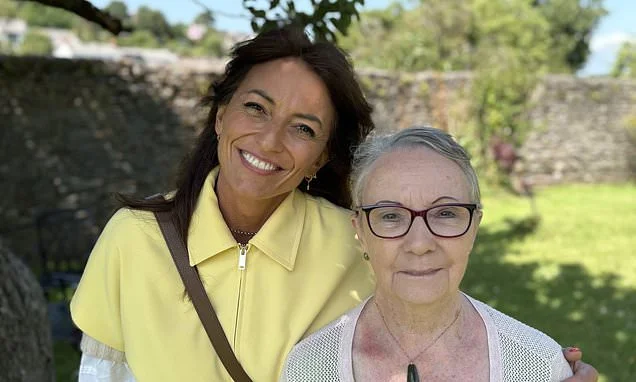
Host Davina McCall with Christine on Monday night's episode of Long Lost Family: Born Without Trace
The show's chief researcher, Ariel Bruce, matched Christine's genetic signature to a half-brother one year older than her, a man in Fleetwood, Lancashire, named Barry.
He too had never known his mum, and endured a tough childhood in foster care. But he did have a birth certificate — and once the TV team knew the mother's name, they were able to find out when and where Christine was born too.
More DNA matching uncovered the identity of her birth father, a merchant seaman from the other side of the Atlantic, who probably never knew of her existence.
The detail that really dates the story for me, emphasising how completely the world has changed in Christine's lifetime, is not the way our genes can be decoded, nor even the absence of CCTV, which wouldn't become commonplace at stations until decades after 1949.
It's the fact that the baby was found by a railway porter. I'd like to think he bicycled home in his uniform, hung his cap on the hatstand, sat down in the parlour to await his tea and told his missus, 'You'll never guess what happened today, love.'
In far less than another lifetime, shows like Long Lost Family will be redundant, I suspect. AI will make genetic analysis as normal as aspirin.
You might think you won't sign up for it, but it will become inescapable, once smartphones become capable of sampling DNA — initially for security and ID purposes, the way they currently recognise our faces and our fingerprints.
Once social media giants can match our genes to everything else they know about us, there will be no secrets.
Genealogy services will bombard us with adverts, offering to reveal instantly where all our blood relatives are scattered around the globe.
You'll click and perhaps see a cluster of dots around your home town, but also a third cousin twice removed in Patagonia or Phnom Penh.
It will be a revelation, bringing the world closer together. It's also going to lead to some very awkward family conversations.