- READ MORE: Drought extended to cover almost three quarters of England
- See more Daily Mail on Google - save us as a Preferred Source
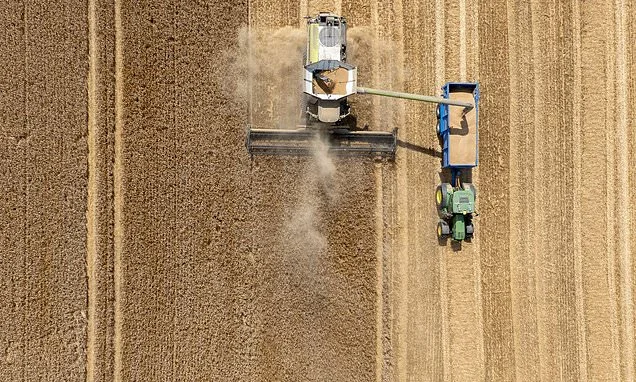
When I look out of the window of my farmhouse in Wiltshire, all I can see is a giant biscuit-coloured dustbowl. In a quarter of a century of working this land, I've never known conditions like it.
There has been no rain since June and there is no grass to be seen anywhere on our 300 acres. The soil is a fine brown powder that hangs in the air whenever it is disturbed by animals or machinery.
We are already having to feed our beef cattle the hay and silage we cut earlier in the year -–winter fodder we wouldn't normally begin to use until November. It's already a major worry what will happen when that runs out. We know we'll have to buy supplies from elsewhere, but who knows what the price will be?
On top of that, the price we agreed for our spring barley last autumn was lower than the previous year. Like many farmers, we were relying on an increased yield to recoup our investment, but this year's drought has meant yields are down by as much as 50 per cent. Taken together, it's the perfect storm for farmers, many of whom will already be considering their seed and fertiliser purchases for next year and pondering whether next year's crop will even cover the fixed costs of fuel, raw materials and labour.
Those costs have increased by more than 30 per cent since 2020, while the prices of milling wheat and malting barley have remained unchanged since last year. That's the brutal arithmetic that has led many farmers to seriously wonder if their businesses can ever again be financially viable. And what's bad for farmers will, sooner or later, hit everyone in the pocket.
For a decade, the mood music from Westminster has been that agriculture doesn't really matter in the grand scheme of things. We only make up 0.6 per cent of the British economy, and Britain is a wealthy nation which can afford to buy its food from elsewhere.
That's the flawed logic that led to England's post-Brexit policy experiment of 'public money for public goods' under which landowners were paid subsidies to protect and restore the environment, rather than the old model of paying farmers a subsidy based on acreage of food production.
This led to some farmers being paid to tend their hedgerows and sow picturesque 'environmental' crops – effectively birdseed –rather than growing food for the national plate.
Britain's drought this year has meant that farmers' yields are down significantly. 'And what's bad for farmers will, sooner or later, hit everyone in the pocket,' warns Minette Batters
Perhaps the great drought of 2026 will force a rethink; particularly when the grim reality of dustbowl Britain feeds through into higher prices in the supermarkets and howls of anguish from already hard-pressed shoppers facing a new and even more fierce cost-of-living crisis.
Sadly this is an inevitable consequence of relying on the global market to feed the nation. Whether we like it or not, Britain's policy choices mean that we are hostage to international events. For example, war in Ukraine has decimated production in one of the world's great breadbaskets, just as the closure of the Strait of Hormuz has hiked energy costs.
It may sound like scaremongering to talk about prospect of empty shelves in supermarkets. But think back only as far as February, when stores were warned of shortages of salad crops and other vegetables because of severe storms in Morocco and Spain. A similar fruit and veg supply crunch happened in 2023, the same year that supermarkets were forced to ration eggs because of a combination of high energy and feed costs and an outbreak of disease.
Nobody can promise that British farmers can solve all these issues, but having robust domestic supply chains so that we grow a lot more of our own tomatoes, say, rather than importing 60 per cent from Spain, is bound to make Britain more resilient and less prone to see-sawing global prices.
Indeed, heatwaves across Europe mean the EU's agricultural sector is even worse affected by drought and wildfires than our own. This inevitably means British retailers will be in competition with continental rivals for dwindling food supplies. And the invariable consequence of demand outstripping supply is higher prices in the shops.
Baroness Batters, former president of the National Farmers Union, says supermarket shelves could be empty – an inevitable consequence of relying on the global market to feed the nation
It's not too late to make the policy choices that will allow farmers to react to the hotter summers brought by climate change – to foster a countryside that will let both crops and livestock thrive
Meanwhile, the new Prime Minister is touring the towns of Britain to push his vision of 'good growth in every postcode'. But we have not heard a whisper from Andy Burnham about the countryside and the rural economy.
He should remember that farming is the only primary manufacturing sector that still exists in every county of Britain. Food production employs far more people than, say, aerospace or the car industry. Why not use the drought to announce a much-needed national plan for farming?
Farmers want to grow food: it is what they have worked for all their lives. But they need the necessary conditions to make the job economically worthwhile.
There are many easy gains to be made – quick policy wins Mr Burnham could announce at little cost.
Water, to take a pressing example. With the trend towards wetter winters and drier summers, the best way for farmers to make their businesses – and Britain's food supply – more resilient is to build reservoirs on their own land so that can store the winter rains.
At the moment, farmers wanting to do this face a red-tape nightmare of planning regulations. Why not allow them to build quickly and easily under permitted development? Properly planned, these small reservoirs may even ameliorate winter flooding. Meanwhile, government subsidies should be targeted at food producers, rather than landowners who choose not to grow food, while still providing environmental benefits.
Farmers by their very nature are entrepreneurs and together we will all benefit from growing, creating and selling more of what we're good at. British-grown wood for house builders, sustainable fuel and wool for insulation. What about bio-refineries to make compostable packaging out of plant waste? Or boosting British horticulture to grow more hedging plants, bulbs and flowers?.
We could plant more orchards, creating beautiful green spaces for everyone, and include food and farming in the national curriculum for schools, which would help restore Britain's native food culture and also go some way to building the start of a career pathway that could create a conveyor belt of trained agricultural workers.
There are innovative ways to finance this transformation. So-called carbon credits – which allow companies to buy and sell rights to emit greenhouse gases – are currently expensive and often ineffective. Targeting a similar system at British agriculture could give farmers a new low-cost source of funding while delivering real environmental benefits.
It makes perfect political sense to boost the security of our food supplies in such a time of escalating climate change and increasing international uncertainty.
But for too long, the focus of Westminster has been the environment rather than agriculture. Food production has been so deprioritised that there is not even a Secretary of State for Agriculture and Food at the Cabinet table.
It's too late for the government to do much to deflect the coming consumer pain. Farming works on a longer timescale than that.
But it's not too late to make the policy choices that will allow farmers to react to the hotter summers and wetter winters brought by climate change – to store water, harvest electricity and foster a countryside that will enable crops, livestock and farmers to thrive.
And the result of that will be better quality, lower-priced food, as well as a country that has intelligently insulated itself against the vagaries of international events.
And come rain or baking heat and drought, far more of our food will be locally grown in Britain.
Baroness Batters is a cross-bench member of the House of Lords and a former president of the National Farmers' Union. She last year led the government-commissioned independent Farm Profitability Review.