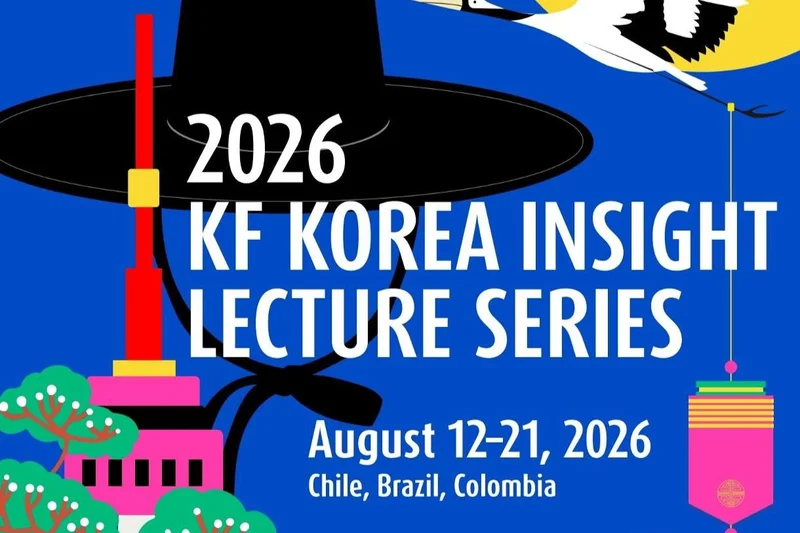
Following a presidential diplomatic tour through South America, the Korea Foundation is moving to translate high-level momentum into academic ties, launching a multicity university lecture series this week across Chile, Brazil and Colombia.
The 2026 KF Korea Insight Lecture Series program will run from Aug. 12-21 across six prominent Latin American institutions. Aimed at cultivating the next generation of Korean studies scholars in the region, the series will cover topics ranging from economic development to the social critiques embedded in globally popular "Squid Game" series.
The lecture tour opens in Chile, where Kim Won-ho, professor emeritus at the Hankuk University of Foreign Studies, will address audiences at the Central University of Chile and the University of Chile. His talks will focus on Korea's rapid postwar economic modernization and the policy lessons it offers for developing economies across Latin America.
In Brazil and Colombia, the focus shifts to how Korean cinema and television reflect broader social transformations. Park Jung-won, a professor of Spanish at Kyung Hee University, will deliver lectures at the University of Sao Paulo, the Federal University of Minas Gerais, the National University of Colombia and the Metropolitan Institute of Technology in Medellin.
Using popular titles such as the historical film "Ode to My Father," the nostalgic period drama "Reply 1988" and the dystopian thriller "Squid Game," Park will trace how rapid industrialization, shifting family structures and globalization have reshaped Korean society.
"We hope these lectures allow future leaders in Latin American to develop a more nuanced understanding of Korea's developmental path and cultural evolution," said a spokesperson for the Korea Foundation, the public diplomacy arm established in 1991 under Korea's Ministry of Foreign Affairs.
Organizers expect the seven-part lecture series to spark expanded academic cooperation between Korean institutions and major universities across Latin America, building a foundation for permanent Korean studies programs in the region.
This article was published with the assistance of generative AI and edited by The Korea Times.