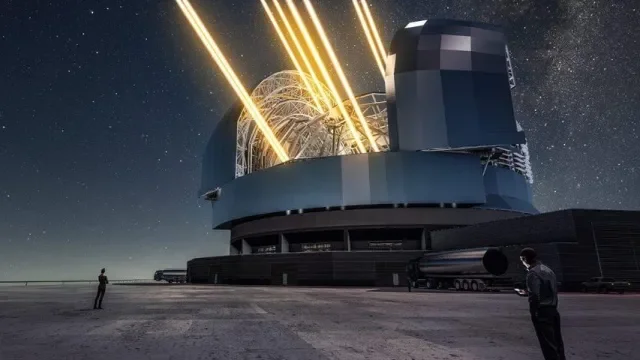
If you want to view the Universe in way that take us past our current frontiers, you only have a few options. You can build a larger telescope: with greater surface area to collect light and a larger diameter to increase your resolution. You can polish your mirror’s surface to be more reflective and smoother: down to nanometer-scale precision. You can keep it clean and pristine: reducing your noise. You can build improved adaptive optics systems: better correcting for the distortion of the atmosphere. And you can build next-generation instruments that make better scientific use of the information encoded in each and every photon collected. When it comes to ground-based optical astronomy — using the same types of light that humans have been using since the invention of the telescope — there are three current planned facilities that seek to do all of these at once. The ELT, or European Extremely Large Telescope, which plans to be the largest of a new generation of telescopes at 39 meters in diameter. The GMT, or Giant Magellan Telescope, whose clever design will provide the best wide-field views and be the most successful at several scientific application despite its smaller, 25 meter size. And the TMT, or Thirty Meter Telescope, which blends many of GMT’s and ELT’s advantages together with an intermediate 30 meter size, but will be located in the northern hemisphere: giving humanity access to parts of the sky that cannot be seen by ELT or GMT. The truth of the matter is, despite the challenges each observatory faces, humanity would truly be better with all three of them functioning: delivering science, together, that no one of them can accomplish on their own. Here’s what the world is waiting for. This photograph shows the Large Magellanic Cloud shining brilliantly in the dark skies provided in the region surrounding Las Campanas Observatory: the future home of the Giant Magellan Telescope. This location is one of the best in the world for ground-based astronomy: with clear skies, high altitudes, dry and still air, excellent seeing, and an astronomy-friendly latitude of 29 degrees south. Credit: Yuri Beletsky The most important thing to recognize is that — while nobody is denying the power of space telescopes — there are plenty of advantages that come with building an observatory on the ground, as opposed to in space. Some of the biggest ones include: No size and weight restrictions. To take a telescope to space, you’re limited by the physical size, dimensions, and payload capacity of the launch vehicle. On the ground, you can build a device that’s as large and heavy as you can design and afford. No launch costs; no risk of a launch failure. Even though launch costs have plummeted since the 20th century, it’s still an expensive proposition, and every rocket launch carries a risk of failure. The Ariane 5 rocket that launched just prior to the one that launched JWST failed; with no launch, there’s no risk of a catastrophic loss. Infinite repairability and easy maintenance. In space, if something goes wrong with your observatory, it’s very difficult — if not entirely prohibitive — to service it with a repair mission. On the ground, your facilities and infrastructure for maintenance and repairs can even be built on the same site as the telescope itself. Upgradeability. Many of today’s greatest ground-based observatories were actually build in the 20th century; the optical hardware is essentially the same. However, advances in instrumentation, including in adaptive optics and CCD/camera technology, have kept those observatories relevant for decades beyond their original planned lifetime. In space, your telescope gets a finite lifetime, and once it runs out of fuel, resources, functioning gyroscopes, functioning antennae, etc., its useful lifetime ends. On the ground, you can extend the life of your telescope for decades; these three 30 meter class telescopes should remain world class observatories for the entirety of the 21st century. This photograph of the under-construction ELT (ESO’s Extremely Large Telescope) atop Cerro Armazones, taken in 2023, shows the all-important roads that connect to the observatory and the summit. Such stable infrastructure is necessary to allow the construction and support of a world-class astronomical observatory. Credit: G. Hüdepohl (atacamaphoto.com)/ESO The biggest aspect of a ground based telescope that cannot be overemphasized enough is size: the size of the primary mirror, both in terms of its light-gathering power, or collecting area, and in terms of resolution, or the number of wavelengths of light that fit across your primary mirror’s diameter. It’s true that size, alone, isn’t everything, but it is the single most important factor in determining the quality of many aspects of your telescope and what it can do. A telescope, at its most basic, is a “light bucket,” with a collecting area that takes incoming light from arbitrarily far away and focuses it, either through mirrors, lenses, or a combination (but most often, in modern times, mirrors), in order to direct that light into the telescope’s instruments: where it can be put to good use. The collecting area of the telescope determines how much light you gather, where a telescope that’s twice the diameter (say, four meters versus two meters) will have four times the collecting area. The more light you gather, the more you can see. That includes: dimmer and fainter objects, faint, extended structures around objects that are bigger than a point source, greater numbers of objects in the same field of view, and more distant objects, whose light has spread out over a greater area by the time it reaches your observatory’s eyes. This simulated view of a dense star cluster shows how JWST would see it (left) and how GMT would see it (right). Owing to GMT’s unique architecture, there are no diffraction spikes present: just a faint series of concentric circles around the brightest stars in the field. However, the increase in sharpness comes from the higher resolutions that are achievable with larger primary mirrors, enabling greater numbers of wavelengths of light to fit across the larger diameters. Credit: Giant Magellan Telescope – GMTO Corporation The largest optical telescope today, the Gran Telescopio Canarias, is 10.4 meters in diameter. If you took a circle that was 10.4 meters in diameter and asked what its area is, you’d get a number that was just about 85 square meters (85 m²), but that doesn’t quite correspond to the amount of light that gets collected and put to use. Because telescopes: typically have holes in the centers of the mirrors in order for the collected light to reach the instruments, are usually segmented, with gaps between the various mirror segments, sometimes have support struts and secondary mirrors that block a portion of the incoming light, and lose some of that collected light before it reaches the instruments due to imperfect reflectivity of the mirrors (some due to the mirror material itself, some due to the coatings, and some due to the imperfect cleanliness of the mirror, which naturally worsens over time), the Gran Telescopio Canarias “only” has a true primary mirror area of 78.54 m², and an effective collecting area (when all of the losses are accounted for) of 73 m². By all metrics, however, that still makes the Gran Telescopio Canarias the current record-holder for largest optical telescope in the world. It can fit greater numbers of wavelengths of light across its primary mirror than any other optical telescope, giving it the highest resolution as well. However, it’s only the largest of the current generation of telescopes. The three next-generation ground-based telescopes — the ELT, the GMT, and the TMT — all will far surpass the capabilities of every currently existing telescope. The three largest telescopes in this image, located along the right, are the TMT, ELT, and GMT, and represent a new 30 meter class, from 25.4 to 39 meters in diameter. For comparison, today’s cutting-edge modern day telescopes range from 6.5 to 10.4 meters in diameter, and are represented by the majority of ground-based telescopes shown in the two middle columns. The leap from the current to the next generation will be transformative, but even the largest of the proposed optical telescopes cannot compare with the resolutions achievable by VLBI. Credit: Cmglee/Wikimedia Commons Scaling up in size has significant implications for the type of science that can be conducted, and the types of things we can learn from doing it. Expected improvements include: the ability to study galactic substructures, even in faint, low-mass dwarf galaxies, to the highest-resolution ever, creating a new probe of the structure of dark matter halos, the ability to probe the feedback from supermassive black holes on star-formation within the host galaxy as never before, teaching us about the growth and activity of the black holes as well as their influence on cosmic evolution and star-formation, the ability to probe fainter, lower-mass stars than ever before, including across our Milky Way, granting us the ability to reconstruct our own galactic assembly history in superior fashion, the ability to resolve individual young stars, including substructures and the presence and abundance of complex molecules within their protoplanetary disks, the ability to map out the distribution of various heavy elements in the interstellar medium and in the remnants of exploded stars and stellar remnants, such as supernovae and kilonovae, the ability to find, measure, and characterize exoplanets down to lower masses and smaller radii around all classes of stars than ever before, and much, much more. This applies to every one of the three next-generation telescopes that are currently being planned, designed, and built, but each one has their own special properties that make them important in their own right. This diagram shows the novel 5-mirror optical system of ESO’s Extremely Large Telescope (ELT). Before reaching the science instruments the light is first reflected from the telescope’s giant concave 39-meter segmented primary mirror (M1), it then bounces off two further 4-meter-class mirrors, one convex (M2) and one concave (M3). The final two mirrors (M4 and M5) form a built-in adaptive optics system to allow extremely sharp images to be formed at the final focal plane. The primary mirror consists of 798 segments to form the 39-meter mirror, but the light that matters most isn’t just the light that’s collected, but rather the light that reaches the instruments. Credit: ESO ELT (formerly the “E-ELT”), the European Extremely Large Telescope. While the United States was busy building JWST — humanity’s most up-to-date flagship space telescope — Europe decided to invest in a different direction: building the most up-to-date flagship ground-based telescope. The ELT will the largest and most expensive of the new telescopes, with the most reflective coatings and the greatest number of mirror segments of them all. They will also have the smallest surface errors, down to 6 nanometers on average (what we call root-mean-squared errors), which is around a factor of four smaller than its competitors. Because it has a larger primary mirror diameter (39 m), a greater overall collecting area (978 m²) and a larger effective collecting area (929 m²) than all the other telescopes, it’s going to be far and away the best of the next-generation telescopes for all applications involving point-sources. That means, for: faint, low-mass stars, including within nebulae, star clusters, and the halo of the Milky Way, identifying and viewing exoplanets, including Earth-sized exoplanets, or taking spectroscopic measurements, including follow-ups of candidate galaxies identified by JWST, of galaxies at the highest redshifts and greatest distances of all, the ELT will be unrivaled, even by the other telescopes in the 30 meter class. In these regards, from its location on the summit of Cerro Armazones in Chile, the ELT truly stands alone at the top of its class. Other ELTs need to take as many as 13x more images to capture the same view of the Universe. With the Many Instrument Fiber System, or MANIFEST, the Giant Magellan Telescope will be able to concurrently observe 100’s of objects and increase the number of targets that can be studied at once. MANIFEST is a multi-object fiber positioning system that allows the telescope to feed light from 100’s of celestial objects simultaneously to its spectrographs. Credit: Damien Jemison, Giant Magellan Telescope – GMTO Corporation GMT, the Giant Magellan Telescope. It’s true: there’s no making up for the fact that GMT is smaller than ELT, and is in fact the smallest of all of the three next-generation, 30 meter class telescopes proposed. Although it has a 25.4 meter diameter primary mirror, there are significant blank spaces between the mirrors, meaning that it has a much smaller overall collecting area for light (368 m²) and an even smaller effective collecting area (326 m²). However, it has its benefits, too. Its field of view is several times larger than the ELT field of view, meaning it will be superior for wide-field studies. Its optimized for shorter wavelengths, making it superior for bluer optical studies and capable of ultraviolet studies, which ELT cannot do. Since resolution equates to the number of wavelengths of light that fit across your telescope’s primary mirror’s diameter, it can potentially equal or exceed ELT’s resolution for the same object by observing at significantly shorter wavelengths. And because of its optical design, it will have the smallest instruments of any of the three telescopes, meaning it should be more easily upgradeable (and for lower costs) with new instruments in the future. Located just a little bit further south in Chile (at 29 °S latitude, rather than 24 °S latitude) than the ELT, the GMT will be able to observe nearly the same set of objects that the ELT will: at slightly lower resolution and with slightly less sensitivity, but with a much larger field-of-view. While it’s less ideal for viewing point sources, it’s much better optimized for conducting large-area, survey-related studies, and for operating at short wavelengths. These renderings compare similar science instruments that the ELT, TMT, and GMT are all planned to be outfitted with. Compared with the largest telescope’s (the ELT’s) instruments, GMT’s comparable instruments are three times smaller in each of three dimensions: a factor of 27 different in volume, mass, and likely cost and time to complete construction as well. Despite this size reduction, there is no compromise in the instrument’s performance. TMT’s instrument size, much like its collecting area size, are in between GMT’s and ELT’s. Credit: Damien Jemison, Giant Magellan Telescope – GMTO Corporation TMT, the Thirty Meter Telescope. The TMT has its own unique architecture, and for most science cases, falls somewhere in between the other two telescopes. It’s larger than GMT but smaller than ELT at 30 meters in diameter, it has a filled aperture and an intermediate collecting area (655 m²) and effective collecting area (524 m²), it has 492 hexagonal segments tiled together, and its instruments are larger than GMT’s but smaller than ELT’s. However, unlike either GMT or ELT, the TMT can do one thing that neither of its rivals can do: observe objects that are very far north in the northern celestial hemisphere. Because of the latitude at which GMT and ELT are located, they can observe the entire southern and equatorial skies over the course of a year, but will be severely limited when it comes to viewing objects north of about 53-55 °N latitude: or about 9-10% of the entire sky. While the initial plan was to construct the TMT atop the summit of Mauna Kea, a combination of factors — particularly in the form of active resistance from the local community, as well as the loss of major federal construction funding support from the National Science Foundation — have made the alternate site, the Roque de los Muchachos summit of La Palma in the Canary Islands, arguably the leading choice for a construction site. A recent pledge from the government of Spain for up to €1B in funding support for the TMT’s construction on that site makes it a more attractive option than ever. The Thirty Meter Telescope is shown at a very low elevation angle in this digital rendering. The segmented primary mirror reflects the convex secondary mirror. The tertiary mirror in the center of the primary mirror is oriented to send light to the Wide Field Optical Spectrograph, the gray structure located on the right side of the image: one of the observatory’s main instruments. The left and right instrument platforms are seen and the dark blue adaptive optics enclosure is seen on the upper left on the instrument support structure. Credit: TMT International Observatory There’s a saying in astronomy that normally comes up when skywatchers first think about getting into amateur astronomy as a hobby and wonder which telescope they should get: “the best telescope to get is the one you’ll use and look through.” In amateur astronomy, this is usually a warning to new hobbyists not to get a large, complex telescope at first, but rather one that’s easy to set up and that you’ll want to use frequently. In the world of flagship-class professional telescopes, however, it could just as easily serve as a warning to TMT leadership: that if they cling to the small advantages in conditions that the Mauna Kea site has over the La Palma site, they’ll be even farther behind the other two telescopes than they already are. The local opposition in Hawaii to TMT was clear and significant in 2015, intensified further in 2019, and has only solidified in all the time since. There is still time to make the right decision — a decision that will result in a ground-based flagship optical telescope for the northern hemisphere — and to assemble the funding consortium that will bring that telescope to fruition. There is still a very bright long-term future to be built as far as astronomy on the summit of Mauna Kea is concerned, but for 21st century science, the northern hemisphere needs a 30 meter class telescope, and opportunities for colleges, universities, research consortia, and nations to be a part of the TMT on La Palma is as bright as it’s ever been. This photograph, outside the Gran Telescopio Canarias, showcases an outside view of the world’s largest optical telescope as of 2026. Atop the summit of La Palma, it’s one of Earth’s three great astronomical sites. Although the ELT and the GMT, both in the Chilean Andes, will someday surpass it as the world’s largest optical telescope, there is a fascinating opportunity for La Palma to host the TMT: providing the northern hemisphere with a new flagship optical astronomy facility fit for the 21st century. Credit: Pedro José Luengo Rarmírez/flickr What’s important to remember is that Earth’s flagship observatories, both on the ground and in space, are both: the most oversubscribed observatories in the whole world, with far more meritorious research proposals submitted than there are available observing slots to accommodate them, and also the most scientifically productive facilities in all of astronomy and astrophysics, with the current ground-based 6.5 meter Magellan Telescope, the 8 meter Subaru and Gemini Telescopes, the 10 meter Keck Telescopes, and the 10.4 meter Gran Telescopio Canarias all leading to comparable scientific outputs on a year-over-year basis. The truth is that all three of these new facilities should be built; all of them offer incredible scientific potential; all of them can benefit researchers, human knowledge, and investing countries and funding partners in ways that no other endeavor is capable of. The loss of funding from the US federal government doesn’t need to be a catastrophe for the GMT and TMT; rather, they could be an opportunity for other nations, as Spain is attempting to prove, to become leaders in astronomy here in 2026 and well beyond. This article Why the world needs all three 30-meter class telescopes is featured on Big Think.
Why the world needs all three 30-meter class telescopes