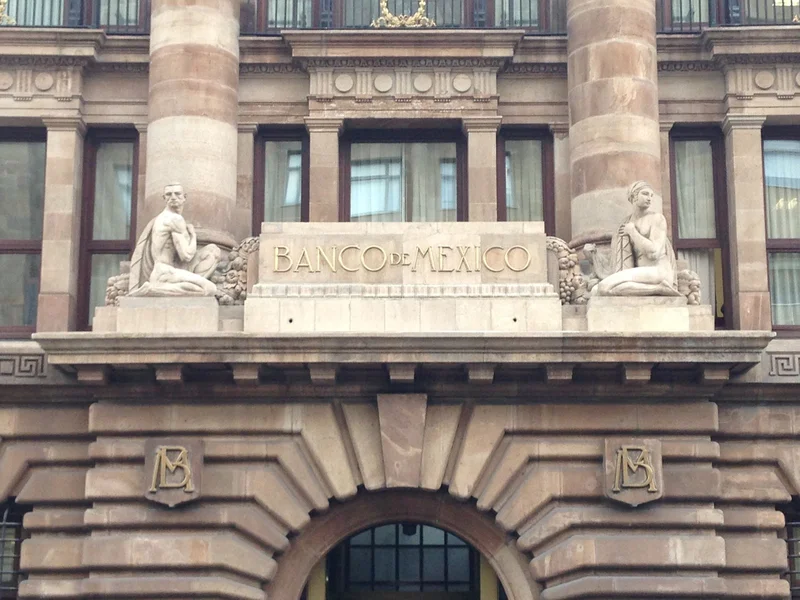
Why Banxico’s New Bond Tool Is Testing Its Autonomy
Mexico · Economy
Key Facts
- Rate heldBanxico kept its benchmark at 6.50% on Aug 6, 2026, in a unanimous vote.
- Inflation lowJuly 2026 inflation fell to a six-year low, though the bank sees the next declines coming more slowly.
- New powerFrom Aug 17, Banxico can buy up to 100 billion pesos (about US$5.8 billion) of Cetes and Bondes F per quarter.
- Secondary onlyThe purchases happen in the secondary market to ease temporary liquidity shortages — not to finance the government.
- Legal firewallArticle 28 of the Constitution and Articles 11 and 12 of the Banxico Law still bar direct government financing.
- Board intactGovernor Victoria Rodríguez Ceja led the five-member board, with no dissent and no political pressure.
A new emergency tool tests how the market reads Mexico’s central bank independence — but the legal guardrails, specialists say, are still firmly in place.
You may have seen headlines suggesting Mexico’s central bank just cracked open the door to government meddling. That is not what happened. This is a new liquidity tool, and it helps to understand why it does not erode Banxico autonomy. Since 1994, the bank has run independently, and a constitutional ban on directly financing the government still holds. The new power, effective Aug 17, 2026, lets the bank buy up to 100 billion pesos (about US$5.8 billion) of Cetes and Bondes F each quarter — but only on the secondary market, and only to relieve temporary cash shortages. That is a long way from printing money to cover the budget.
What the new tool means for Banxico autonomy
Here is the short version: Banxico autonomy is not being eroded, according to most specialists who have read the measure. The tool works like the exchange commission’s dollar auctions — used only in specific, stressed moments, not as a daily habit. Luis Gonzalí drew that comparison, noting that months can pass between uses. Barclays analysts stress the bank “cannot flood the system with liquidity,” because the constitutional limits still bind. The market’s nervous reaction, economist Gabriela Siller notes, simply shows that investors pay close attention to what the central bank does — which is healthy, not alarming.
Skeptics exist. Guillermo Barba has argued that once a central bank grants itself a power this large, the real question is no longer whether it will use it, but when. It is a fair point about precedent. But note the context: there is no statement from President Claudia Sheinbaum or the Finance Ministry attacking the bank’s independence — no political pressure, no attempted takeover. The worry is about perception, in a market already watchful after Mexico’s judicial reform. For now, there is no concrete spillover into Banxico’s governance.
How the intervention actually works
Picture a bank that holds government bonds and suddenly needs cash. Normally it sells them. But in a panic, buyers vanish. Banxico can step in, buy the securities, hand over temporary cash, and sell them back later. That is a classic liquidity operation — not financing, because the government gets no new money. The trade sits between the central bank and market players such as banks, brokerages and pension funds, never with the Treasury. The 100 billion peso (about US$5.8 billion) quarterly cap — up to roughly 400 billion pesos (about US$23 billion) a year — is generous but bounded, and the prohibitions in Article 28 and Articles 11 and 12 stay untouched.
The timing helps explain the caution. July inflation hit a six-year low, yet Banxico expects the decline to slow, which is why it held rates at 6.50%. The new tool simply gives the bank another way to handle short-term market stress without touching rates — a technical upgrade, not a political one.
Why Latin American readers and investors should care
This is bigger than Mexico. Across the region, central banks live or die by credibility. If markets ever decided Banxico had been captured, the peso would weaken, bond yields would jump, and money would leave — and not only from Mexico, as investors re-rate the whole region. So this is a test of whether an independent bank can adopt a new tool without denting its mandate. Peers in Brazil, Colombia and Chile will be watching. If you hold pesos, reais or Chilean pesos, your returns rest on trust in these institutions.
The reassuring part: the safeguards are strong, and the people who follow this daily say autonomy holds. The signal to watch is simple — how often the tool is actually used. Rare, emergency-only use supports independence; frequent use would be the red flag.
Frequently Asked Questions
Does this let the government borrow money from Banxico?
No. The law bars direct financing of the government. Purchases happen only in the secondary market, so Banxico buys securities from banks and funds, not from the Treasury, and the government receives no new money.
Why is the market concerned if the rules are clear?
Investors focus on perception and precedent. They worry that a large new power, even a well-guarded one, could be widened later. Analysts counter that the secondary-market-only scope and the constitutional limits keep that risk small.
What should an investor watch to judge Banxico independence?
Watch how often and how heavily the tool is used, and whether anyone moves to change Article 28 or the Banxico Law. Occasional use in genuine liquidity emergencies supports autonomy. Sustained or growing use would raise real concerns.
Connected Coverage
Sources: El Universal; Banco de México; Reuters; Bloomberg; Barclays; INEGI.
This article was produced by The Rio Times’ automated newsroom system. How we use AI · Report an error