Generative artificial intelligence (AI) is becoming a routine part of television production in Korea. Moving beyond its previous limits as a preproduction and postproduction tool, the technology has rapidly emerged as a core creative element, whether by replacing expensive filming entirely or by serving as the central premise of entire programs.
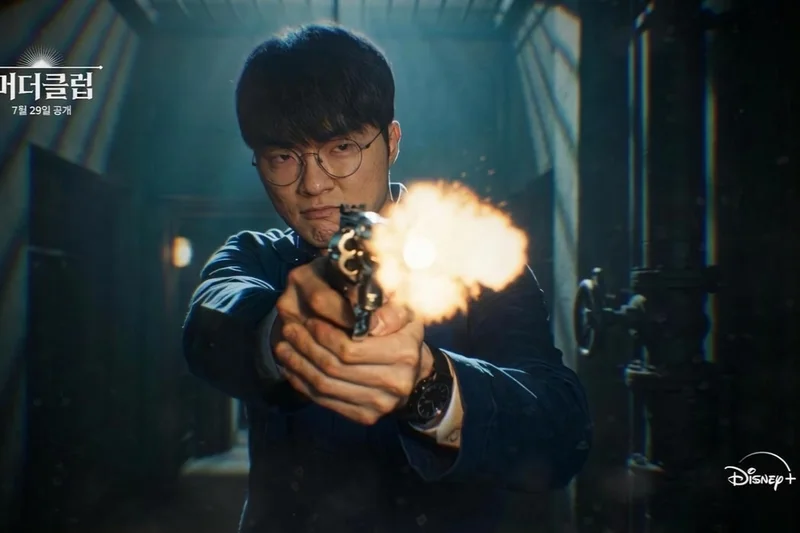
Disney+ released murder-mystery game show "Murder Club: Liar's Table" on July 29. The series assigns cast members unique characters and backgrounds to outmaneuver one another and identify a murder suspect. While resembling "Crime Scene," widely regarded in Korea as an early interactive murder mystery, the new program sets itself apart by using generative AI.
It turns the cast members' alibis and crime scenes into video sequences to add a new visual dimension to the game, such as professional gamer Faker firing a gun in a prison uniform and travel YouTuber Pani Bottle exiled as a Joseon-era nobleman.
AI is also becoming the premise of entertainment formats. SBS will premiere "My AI Partner: Giian Romance" on Aug. 20. In this dating reality show, broadcaster Kian84, comedian Jang Do-yeon and actor Lee Yu-bi interact with AI partners on tablet PCs, experiencing reactions that include excitement, jealousy, confusion and regret.
The production team behind the program, billed by SBS as Korea's first AI dating competition show, said, "As AI rapidly catches up with human capabilities, we wanted to ask the question of whether love with an AI is possible."
Producers are also using AI more extensively in drama production. KBS will use AI technology for large-scale battle scenes in its historical epic "Munmu," scheduled to air in November. The network said the move will improve on-set safety, boost efficiency and create convincing scenes that would be difficult or impossible to shoot practically.
The SBS drama "Agent Kim Reactivated," which recently finished its successful run, also generated an entire three-minute action sequence with AI. Lead actor So Ji-sub voiced support for the move in a post-series interview.
"Now we have to adapt to working with AI," So said. "I think it was a good attempt."
AI was once used mainly to create storyboards to test ideas before filming or to add visual elements in postproduction, but industry professionals say it has now moved into core creative work and is changing how stories are conceived and told.
A survey by the Korea Creative Content Agency found that generative AI adoption among content producers reached 20 percent in the first half of last year, jumping 7.1 percentage points over a six-month period. The most common uses were content production at 63 percent and content creation at 43 percent.
While the commercial and production benefits of AI are clear, it remains uncertain whether the technology can win over viewers. Pop culture critic Kim Hern-sik pointed out that audiences place a premium on human authorship.
"The more cultural and artistic a work is, the stronger the public’s desire to see human-made creations and seek uniqueness. That is why people go wild over director Christopher Nolan’s films made in an analog fashion," Kim said. "If creators are swayed solely by industrial logic without reflecting on why users consume content and enjoy culture and arts, they will not be able to succeed."
"The more cultural and artistic a work is, the stronger the public’s desire to see human-made creations and seek uniqueness. That is why people revere and find meaning in director Christopher Nolan’s films, which are made using practical methods," Kim said. "If creators are swayed solely by industrial logic without reflecting on why users consume content and enjoy culture and arts, they will not be able to succeed."
This article from the Hankook Ilbo, the sister publication of The Korea Times, is translated by a generative AI system and edited by The Korea Times.