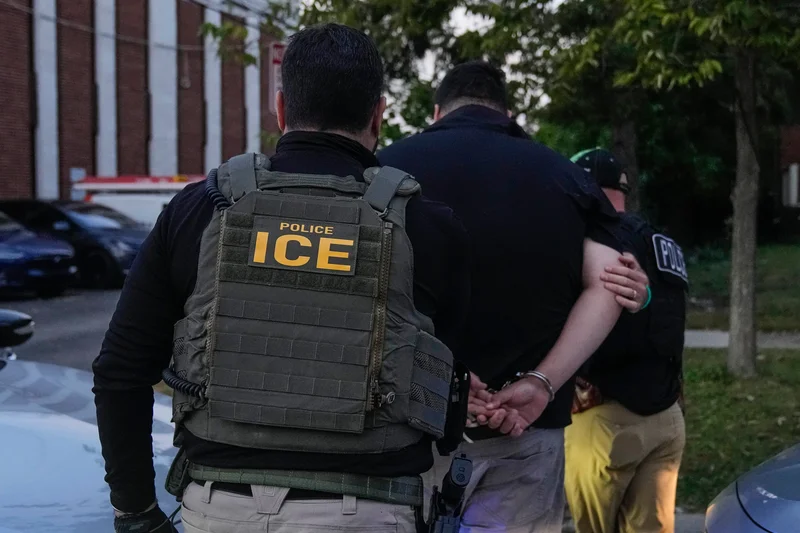
Immigration agents receive regular training on use of force and clearly identify themselves during detention operations, according to a Department of Homeland Security (DHS) spokesman who recently spoke with EL PAÍS on the subject of Immigration and Customs Enforcement’s (ICE) policies. However, the July operations that resulted in the deaths of the Mexican national Lorenzo Salgado Araujo in Houston, Texas, and the Colombian man Johan Sebastián Durán Guerrero in Biddeford, Maine, show a different reality.
In an e-mail statement, the spokesperson said that ICE agents are trained to use the minimum amount of force necessary to resolve dangerous situations, prioritizing the safety of the public and officers, and that they receive extensive training in de-escalation tactics and ongoing instruction on use of force.
The names of the officers who took part in the operation in which 52-year-old Salgado Araujo died on July 7 are unknown, as ICE has kept their identities under wraps, and it is unclear whether they followed those guidelines. The available information comes from two sources: the three witnesses who were passengers in the van—one of them was his brother Víctor Salgado—and from Texas congresswoman Sylvia García, who said at a news conference shortly afterward that the official who fired the gun was removed from Houston that same day.
The three witnesses have been interviewed by different authorities as part of the investigation. They all say that after the van stopped on a Houston street, one of the agents ran from the back of the van to the passenger-side window, shouted “alto” (stop) and almost immediately fired the bullet that killed Salgado.
In two statements sent to EL PAÍS by DHS, the department said the agent who fired did so in response to an alleged attempt by the migrant to ram officials with his van, but all three witnesses denied that claim. They agree that there were never any ICE vehicles or officers in front of Salgado’s car. The pursuit had ended and the car was parked.
In Durán Guerrero’s case, DHS said that on July 13 officials were looking for a migrant with a deportation order, that an individual left the residence in a vehicle and, when agents tried to intercept him, he attempted to flee. “Fearing for public safety, an agent discharged his weapon,” the statement read.
Biddeford residents said the driver had already been wounded when agents chased the car as it spun out of control and, according to DHS’s account, tried to ram them. Some witnesses saw blood on his head.
ICE’s use-of-force standard states that an immigration officer “may use force only when no reasonably effective, safe and feasible alternative appears to exist, and may use only the level of force that is objectively reasonable in light of the totality of the facts and circumstances confronting the officer at the time.”
DHS acknowledged that neither Salgado nor the three passengers were the people that authorities were seeking that morning of July 7. The same was true in Durán’s case: Maine Governor Janet Mills, a Democrat, confirmed that the Colombian man was not the target, and said the tragedy highlighted “the reckless and haphazard manner in which immigration enforcement operations are being conducted” in her state and across the country.
In neither operation did agents exchange words with those being pursued.
ICE policy also states that, whenever possible, agents should use tactics to de-escalate in order to stabilize, slow down or reduce the intensity of a potentially violent situation without resorting to physical force or by using less-than-lethal force.
Beyond the agencies’ claims that officers feared being rammed by the drivers in Houston and Biddeford, DHS has not specified in any of its statements on these operations that any immigration agent involved suffered an injury. In Salgado’s case, the FBI is investigating whether any official was assaulted, the spokesman said.
In both incidents, investigations have proceeded without access to body-camera or in-car footage from the officers. They did not have devices installed to corroborate their accounts, despite DHS’s pledge that all its agents would use such devices following the January deaths of U.S. nationals Renée Good and Alex Pretti. Both were killed by federal agents’ gunfire.
The DHS spokesperson told this newspaper that they have supplied cameras to more than half of field offices, without providing specific numbers. He said the remainder will have them by September.
In Salgado’s case, it adds relevance to the efforts by families and organizations to get the three witnesses to the migrant’s death—one of whom has already been released—moved out of the Houston detention center and allowed to continue their immigration processes without the risk of deportation, so they can help with the investigations without the barriers that federal custody creates.
Identifying the agents
According to the ICE spokesman, “officials on operations clearly identify themselves as such.” Yet in neither Salgado’s nor Durán’s case were the vehicles used by ICE during the pursuits marked with federal agency logos.
Víctor Salgado told his lawyer Ruby L. Powers that he only realized the agency that had chased them was ICE after the agents had already shot his brother. He was in shock at the scene. As he was being dragged out of the car to be detained, he heard his brother shout “They’re killing me!” After he was forced to kneel on the ground, he was able to read one officer’s identification and saw it said ICE.
Meanwhile, the driver, his brother Lorenzo, was handcuffed with his hands behind his back and laid on the ground even though he was bleeding. With the little English he could speak, Powers says Víctor begged the officials, “Call the police to help my brother!”
Amid questions about how these operations unfolded, the families in both cases—Salgado’s and Durán’s—have called for independent investigations. Friday marked one month since Salgado’s death and Thursday will mark one month since Durán’s. So far, no agency has released preliminary results of those investigations.
But in Houston, the office charged with conducting the independent investigation into Salgado’s death, the Harris County district attorney’s office, said it may have to sue federal immigration agencies to review the full evidence on the Mexican man’s death. So far, prosecutor Sean Teare told a news conference, its probe has advanced quickly thanks to evidence and tips provided by private citizens.