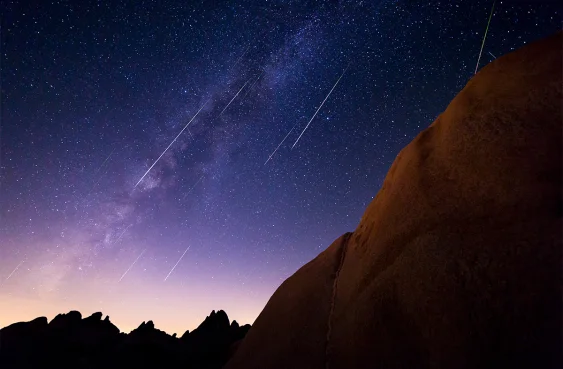
The Perseid meteor showers are beginning to peak, as they usually do around this time (August 10-12) every year. For stargazers in the Northern Hemisphere, the meteor shower is a must-see event, both because of its regularity and its brilliant fireballs and streaks of light—sometimes as many as 50 to 100 per hour.
The Perseids get their modern name from the constellation Perseus, where they appear to originate. But the Romans associated the meteor shower with another mythological figure, Priapus, a minor fertility god usually depicted with one particular organ comically enlarged (to give you a hint, he also lends his name to “priapism,” which requires medical attention when it persists for four hours or more). To the Romans, the Perseids represented Priapus blessing the fields with his cosmic seed. With the spread of Catholicism, the event became rebranded as “St. Lawrence’s Tears,” in honor of the August 10 feast of St. Lawrence, who was roasted alive by the Roman emperor Valerian (so still not exactly G-rated).
Why are they so regular?
Read more: “How to Find and Keep a Space Rock”
You can thank the comet Swift-Tuttle. It has a 133-year orbit that crosses Earth’s on its oblong loop around the sun before zooming into space, past Uranus. Every year around mid-August our planet passes through the massive cloud of dust from Swift-Tuttle’s tail. As this cosmic debris—metal, rocks, and other material—enters our atmosphere, it burns up, producing dazzling displays of light in Perseus’ region of the sky.
You may be old enough to remember when Swift-Tuttle made its most recent pass by Earth in 1992, producing a particularly impressive Perseid meteor shower in its wake. Unfortunately, that means it’s not due to enter our orbit again until 2126. That may be for the best, though. Of all the known near-Earth objects, Swift-Tuttle might be the best candidate to collide with our planet in a cataclysmic event that would dwarf the extinction of the dinosaurs.
But there’s no reason to worry about that now. In the meantime, at least one astronomer has calculated that Swift-Tuttle’s debris densities could make the 2028 Perseids the most dramatic for quite some time. So if you can’t make this year’s show, pencil in mid-August 2028 and start your planning now.
Lead image: Emeric's Timelapse / Adobe Stock