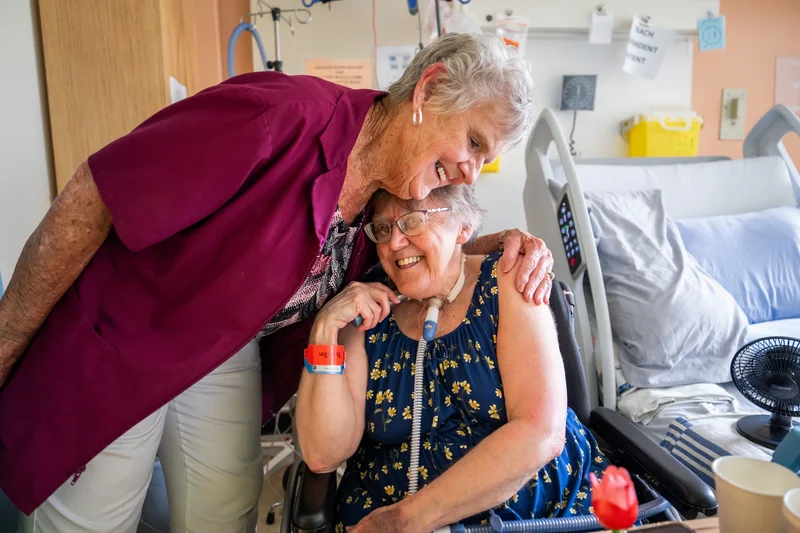
Patients’ eyes light up when they spot her coming – with coiffed blonde hair and a buoyant smile, she rolls a cart filled with a jumble of hairdressing supplies down the corridors of the hospital in Charlottetown.
Gayle MacDonald, the longest-serving volunteer at the Queen Elizabeth Hospital, first started washing and styling patients hair 53 years ago. Today, she runs a team of six volunteers, filling a much-needed gap for long-term inpatients and offering something that goes beyond the physical healing: a sense of well-being.
On a recent Thursday – her usual day at the hospital – she squeezes patient Tony MacKinnon’s hand and rubs his head as she greets him in his hospital room. It’s a gesture of kindness and familiarity, one that she’s clearly earned over the last few months since he moved to her unit from intensive care.
“They’ve done an excellent job,” he says, gazing up at her and congratulating her on 53 years of volunteering.
Lifelong volunteers such as Mrs. MacDonald are a rarity these days. As a young mother more than half a century ago, Mrs. MacDonald watched her husband take his lunch and go off to work every day, while her children hopped on the school bus with their lunch at the end of the driveway. Living in Covehead, a rural community on the north shore, about 25 minutes from Charlottetown, she realized she also needed something of her own, something that would still allow her to be home by mid-afternoon when the kids got home from school.
Back then she started out delivering flowers and mail to patients in the hospital, until one day a woman asked if there was any way she could get her hair washed. Mrs. MacDonald and another volunteer wiggled a rubber sheet under her head and used a second one to funnel water into a bucket.
“I said ‘Maybe there’s a need for something like this,’” Mrs. MacDonald said during an interview. “That’s where it all started and still is.”
Now, instead of a rubber sheet, volunteers use a special hair-washing tray that has a head rest and a funnel. The supplies, paid for by the ladies auxiliary, have also increased to nearly a full salon: hairspray, gel, blue rinses, curling irons, blow dryers, round brushes and a melange of combs in a jar of blue Barbicide.
Hospital volunteer services department manager Janice Morrison said Mrs. MacDonald and her volunteers have repeatedly demonstrated that patient wellness involves more than treating someone’s physical ailments.
“They bring that extra bit of healing,” she said. “It’s the patient being able to feel good about themselves having their hair washed.”
Today Mrs. MacDonald has scaled back from three days a week to one, but over the years, she has accumulated 10,500 volunteer hours – a record that she seems destined to indefinitely hold.
“In my career – what’s left of it – I will never see a volunteer reach that and I don’t think this hospital will ever see another volunteer reach that milestone,” Ms. Morrison said.
“For someone to get to that level now, you would have to be starting to volunteer at the age of 16 and stay with it for as long as she has, and we know that’s not realistic for people in their lives as they grow up. So to think back to what she’s given to the hospital, it is wonderful.”
During an interview, Mrs. MacDonald recalled how that morning, her list of patients who wanted their hair washed included a man who had none. At first, when she poked her head in his room, she thought someone was trying to pull a prank on her, she said. But then the man laughed and told her his head was so itchy, he just wanted a scalp wash. “So, we put the tray under him and lathered him up and he said, ‘Oh that feels so good.’”
She tells the story of an elderly lady who was used to going to get her hair done every week. “‘I know I’m dying, but I don’t want to look it,’” Mrs. MacDonald recalled her saying. PEI, being the small province that it is, the woman was a distant relative of Mrs. MacDonald – which made it more emotional than usual when she died earlier this summer.
And while it’s not always easy handling the odd prickly person or the inevitable losses of patients she’s befriended, the key to doing this work she says is to remind herself of what she is able to do for patients.
“Even if somebody is really sick, you’ve made them feel a little bit better,” Mrs. MacDonald said.
“Today, bless their hearts – every single one of them were so appreciative of getting it done and one lady said ‘I’ve been in here for almost a month and didn’t get my hair washed.’”
There’s perhaps no patient at the hospital right now who’s more appreciative of Mrs. MacDonald’s efforts than Laura Livingston. Over the last 17 months that she’s been in hospital to receive care for chronic lung disease and tracheal stenosis she said she’s developed a closeness with Mrs. MacDonald and two others on her team. Their kindness and compassion when doing her hair and working around her disabilities makes her feel refreshed and ready to take on another day, Ms. Livingston said.
“I just couldn’t believe it – the patience of them, just the time they took to make sure that I was comfortable and if I had any problems with my breathing I could stop and catch my breath,” she said, speaking through an electrolarynx which she held to her neck.
“I just felt like a human being.”
Care Between the Lines is a summer series, which will introduce you to volunteers in health care who fill gaps and provide compassion in a system that can be isolating and scary.