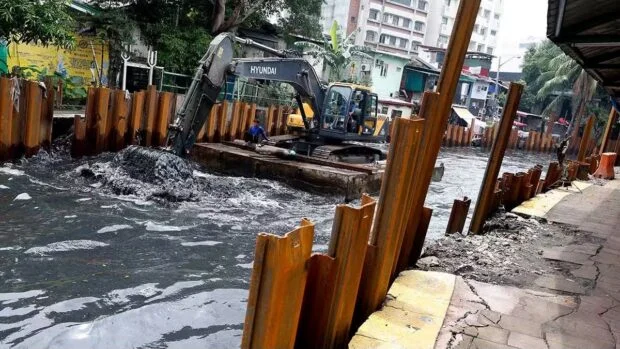
Palace restores flood control funds in proposed 2027 budget
MANILA, Philippines — Flood control funding, which was removed from this year’s budget, is back in the proposed P7.2-trillion national budget for 2027 submitted by the Department of Budget and Management (DBM) to the House of Representatives on Tuesday.
Education continues to receive the biggest share of the proposed budget, with P1.314 trillion allocated to the sector, equivalent to 18% of the 2027 National Expenditure Program (NEP).
The Department of Public Works and Highways (DPWH) received the second-largest allocation at P644 billion, with flood control funding accounting for 16.17 percent of the total.
The Department of Health’s proposed budget stands at P353.8 billion while the Department of the Interior and Local Government is allotted P332.5 billion. Proposed defense spending is at P328.8 billion; transportation at P302.2 billion; agriculture at P261.7 billion; and social welfare at P241.6 billion.
“Our national budget serves as our moral and economic compass. It must always point toward making life better for our people,” President Marcos said in his budget message.
READ: Sona 2026: P800M flood control funds recovered—Marcos
“This reflects our unwavering commitment to building a resilient, inclusive, and prosperous nation… It is a strategic investment in the Filipino people and in our country’s future,” the President added.
Funds for flood control—a corruption flashpoint for the Marcos administration—was included in the proposed budget at P107.4 billion, with P19.6 billion set aside for ongoing foreign-assisted projects, according to acting Budget Secretary Robert Kim de Leon.
Another P3.41 billion was allotted to the Metropolitan Manila Development Authority for upkeep of flood mitigating structures, like pumping stations, he added.
These allocations, De Leon said, emerged after talks that led the government to resume funding to maintain existing flood control works and construct unfinished projects.
Funding for flood control projects in the 2026 national budget was reduced to zero following the multibillion-peso corruption in 2025 which that led to the filing of criminal charges against several former and incumbent lawmakers and DPWH officials.
Last year’s budget deliberations saw not only the funding cuts but also the introduction of sweeping reforms to boost transparency, and following a related controversy over alleged insertions in previous spending plans. The changes included rechanneling P255.5-billion worth of flood control funds to the education, food and healthcare sectors.
‘Intense vetting’
“When we were discussing the formulation of the 2027 National Expenditure Program, this was one of the important considerations,” De Leon said in a briefing after the turnover ceremony at the House. “We cannot simply neglect flood control projects already started… it won’t be of benefit if those projects remain unfinished.”
He said the government subjected proposed flood control funding under “intense vetting’ to ensure they are not “ghost” projects. “Also included in what we will scrutinize and examine is the implementation of these flood control projects, from appropriations to release,” he added.
The government won’t rely solely on contractors’ progress reports for flood control projects, he said, adding that authorities will use satellites to verify the status of each work.
“Congress will likely not only scrutinize the budget more closely but exercise greater caution, especially given the alleged involvement of some of its own members in the flood control controversy,” Ederson Tapia, a political science professor at the University of Makati, said in a text message on Tuesday.
The House will perform “another round” of vetting to examine the flood control projects proposed under next year’s spending plan, according to Nueva Ecija Rep. Mikaela Angela Suansing, who heads the House appropriations committee.
Lawmakers would also use provisions from the 2026 General Appropriations Act (GAA) to scrutinize flood control projects, she added. The House will start budget deliberations on Aug. 17 and hopes to give its final approval on Oct. 9.
Confidential, intel funds
Confidential and intelligence funds are not exempt from government budgeting and auditing rules, De Leon said, as he disclosed that P10.77 billion was allotted to agencies. Of that, P6.40 billion went to law enforcement agencies, while P4.37 billion was set aside as confidential funds for civilian offices.
“The use of confidential and intelligence funds remains subject to existing budgeting, utilization, liquidation and auditing rules to ensure accountability, and that the funds are used solely for their intended purposes,” he said.
While the DBM did not heed the call of budget watchdogs to remove unprogrammed appropriation (UA), the DBM said it kept the UA at “historic low” in the 2027 NEP.
At only P111.984 billion, the proposed UA is the lowest at the NEP level since 2019.
It represents just 1.6 percent of the Total Expenditure Program (TEP)—the lowest UA-to-TEP ratio since 1991, according to the DBM.
The DBM said the move to cut the UA for next year “marks a significant move toward more programmed, predictable, and transparent government spending.”
Budget watchdogs consider UA as “shadow” pork funds, as these sit outside the regular budget framework and can be released with minimal transparency. They have been calling UA as unconstitutional, and should be eliminated from the GAA.
Next year’s spending plan will be crucial for the Marcos administration, serving as a key vehicle to advance his agenda under a budget that will be the last fully implemented under his term, according to De Leon. —WITH A REPORT FROM INQUIRER RESEARCH
Disclaimer: The comments uploaded on this site do not necessarily represent or reflect the views of management and owner of Cebudailynews. We reserve the right to exclude comments that we deem to be inconsistent with our editorial standards.