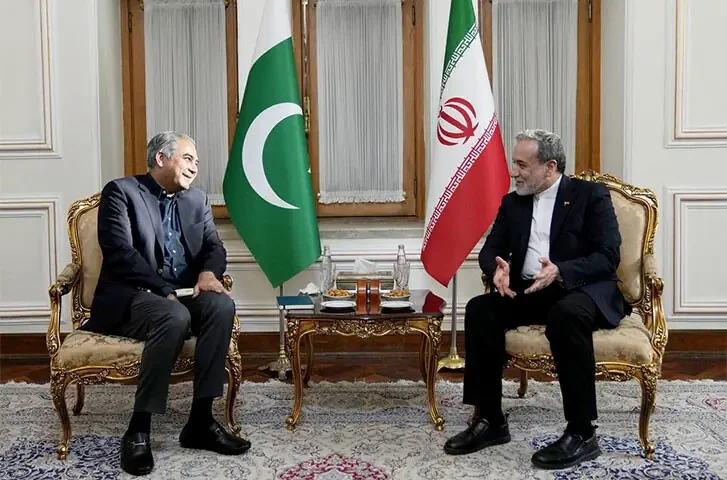
• Mohsin Naqvi meets Pezeshkian and Araghchi in Tehran• Khawaja Asif says warring sides nearing ‘some sort of an arrangement’• Tehran sees Islamabad MoU as ‘only legitimate framework’ for resolution of wider war• Trump rails against ‘devious Iranian negotiators’ ISLAMABAD: Interior Minister Mohsin Naqvi met Iranian Foreign Minister Abbas Araghchi and President Masoud Pezeshkian in Tehran on Tuesday to follow up on the stalled Islamabad Memorandum of Understanding (MoU), as Islamabad seeks to revive its mediation efforts between Iran and the United States. Naqvi, who arrived in Tehran earlier in the day, was received by his Iranian counterpart Eskandar Momeni, and later held talks with Araghchi. The two interior ministers are also expected to hold detailed bilateral discussions during the visit. A diplomatic source told Dawn from Tehran that the principal objective of Naqvi’s visit was to follow up on the Islamabad MoU and Pakistan’s mediation between Iran and the US, which has remained largely dormant as Oman took the lead in negotiations over arrangements for navigation through the Strait of Hormuz. The reported progress in Oman-Iran dialogue has created an opportunity for Islamabad to move for reviving the broader process that had emerged from the June agreement. Separately, Defence Minister Khawaja Asif told Bloomberg that the United States and Iran are close to “some sort of an arrangement”. “Things are shaping up again in favour of a peace arrangement or a deal. The signals over the last three days are that we are close to some sort of an arrangement,” he added. Diplomatic efforts Pakistan had recently invited Araghchi and Iranian parliament speaker and chief negotiator Bagher Ghalibaf to visit Islamabad at the “earliest possible opportunity”. Iranian foreign ministry spokesman Esmaeil Baghaei, however, said on Monday that the visit of the two Iranian leaders would take place “at an appropriate time”. Naqvi’s visit assumes significance as an effort to keep Pakistan’s mediation channel active rather than wait for the Iranian leadership to visit Islamabad. The Persian Gulf, particularly the Strait of Hormuz, remains locked in a fragile “no war, no peace” situation following the collapse of Islamabad MoU reached between Iran and the US in June. In his meeting with the Iranian president, Naqvi described the relationship between the neighbours as “strong, long-standing and unbreakable” and conveyed Islamabad’s “serious determination and will” to pursue the comprehensive development of ties with Tehran. President Pezeshkian also noted that Iran-Pakistan relations would serve the two countries’ national interests as well as contribute to regional stability and security. The emphasis on bilateral ties came days after Pakistan signed a trilateral defence agreement with Saudi Arabia and Turkiye, an arrangement Islamabad has repeatedly stressed is defensive in nature and not directed against any country. On Monday, Deputy Prime Minister and Foreign Minister Ishaq Dar spoke with his Iranian counterpart Abbas Araghchi and shared the contours of the agreement, underscoring its objectives of strengthening strategic cooperation and contributing to regional peace and security. Hormuz future The disagreement over the future management of the waterway had emerged as one of the principal fault lines in the implementation of the agreement and contributed to the subsequent escalation. Iran and Oman have since been negotiating a new arrangement for safe passage through the strait, with the talks focused on a possible new shipping route and mechanisms for its management. Tehran, however, has maintained that an understanding with Oman would constitute only a technical or first stage arrangement and would not by itself amount to a full reopening of the waterway. Iran is adamant that it will reopen the strait only after US has redressed all alleged violations of Islamabad MoU. According to the diplomatic source, Iran’s position conveyed to foreign capitals remains that full reopening of Hormuz is linked to implementation of the Islamabad MoU by US. Iran, the source said, has insisted that the MoU, having been concluded at the presidential level, remains the only legitimate framework for resolving the wider dispute and should be implemented in the form in which it was signed rather than renegotiated through selective reinterpretation. The source said Tehran was also seeking evidence of US political willingness to restore the process before moving towards what he described as the next phase leading to reopening of Hormuz. Iran, he said, wants concrete and verifiable assurances rather than verbal commitments, particularly on whether Washington is prepared to return to its obligations under the MoU. Trump rails against ‘devious negotiators’ Meanwhile, US President Donald Trump on Tuesday described Iran’s negotiators as “devious” and “dishonest”. “They’re very devious negotiators because they’ll agree to something, then they’ll go out and tell the press that they never agreed to it. They’re very dishonest people,” he said in an interview with US outlet Real America’s Voice. He added that Iran’s economic situation and inflation was unsustainable, suggesting that the US could either wait and “just keep that going”, or “hit them really, really hard”. The third option, he said, was to “beat them economically — but we’re doing that anyway”. He claimed that Iran was economically “a mess”, saying: “They can’t borrow money. We control their money … they had a lot, and we have total control… I’m their banker.” Published in Dawn, August 12th, 2026
Islamabad looking to breathe new life into mediation push