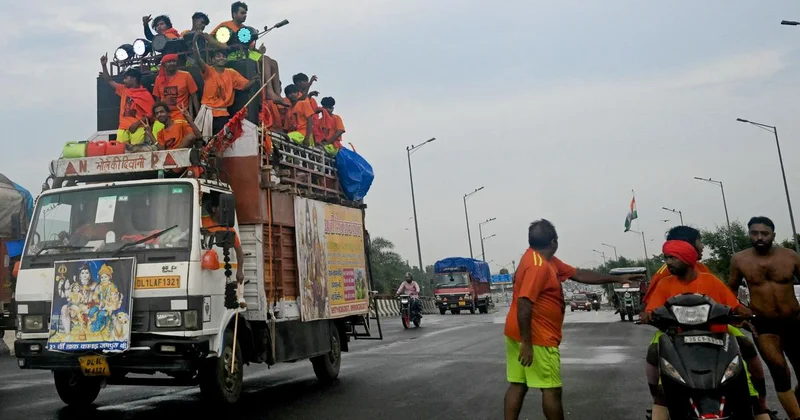
This week, Delhi heard the Kanwar Yatra before seeing it.
Newspapers reported residents describing sleepless nights and rattling windows due to the ear-splitting noise. The * Hindustan Times* said its sound metrers clocked more than 100 decibels as trucks carrying large sound systems moved through residential areas near Kalindi Kunj and Kalkaji. Between passing convoys, readings were between 80 decibels and 88 decibels.
Police officers directed traffic and assisted pilgrims, some drivers were asked to lower the volume, but no FIRs had been registered when the measurements were reported. In fact, in Uttar Pradesh, the Kanwar Yatra pilgrims were welcomes included flower petals showered from helicopters.
Why is noise during religious events sometimes a public health violation, but other times a celebration that the administration must accommodate?
India’s noise rules make no religious distinction. They require written permission for loudspeakers, set residential limits of 55 decibels by day and 45 at night, and prohibit outdoor amplification between 10 pm and 6 am. Limited festival exemptions do not remove the applicable volume limits.
Noise is a public health concern. The World Health Organization and UN agencies say that excessive environmental noise can cause sleep disturbance, hearing impairment and cognitive impairment, and can increase the risk of hypertension and ischaemic heart disease. They recommend limits on nighttime noise exposure.
India’s judiciary is clear about protecting citizens from noise. The Supreme Court in 2005 had held the right to live in freedom from noise pollution as a fundamental right protected by Article 21. “We are not concerned with any religion or religious practices; we are concerned only with the fundamental right of the citizens…and the people to protect themselves against noise pollution and forced audiences,” said the court.
Yet, these rules have paper-thin enforcement and are selectively applied.
In Sambhal in March 2025, the police seized a mosque loudspeaker and registered a case against imam Hafiz Shakeel Shamsi over an allegedly over-amplified azaan. It followed cases against two other imams in January and the removal of speakers from the Shahi Jama Masjid in February.
Ahead of Holi that week, a Sambhal police officer observed that Holi was once a year while Friday prayers were held 52 times a year. Noise regulation became a judgement about whose religious presence was acceptable in public space. A police inquiry into a complaint against the officer’s remarks cleared him.
Journalist Kunal Purohit’s work on Hindutva pop shows why sound deserves closer attention. Purohit has documented music with anti-Muslim verses during religious processions, often played near mosques. Loudness is a way of projecting power and marking territory. Amplified sound is a means of asserting public presence.
There is little evidence that the Kanwar Yatra sound systems in Delhi were blaring hateful songs. Their relevance lies in the official tolerance of them.
A mosque loudspeaker can prompt seizure and criminal proceedings. Yatra sound systems crossing through the national capital’s residential neighbourhoods, with music well above legal limits, have at best prompted cautious requests to turn the volume down.
Mosques in India should, of course, follow the same noise rules as everyone else. Azaan does not deserve immunity from rules intended to protect health and peace. But the principle is legitimate only when applied with the same speed and seriousness to every source of religious sound.
A secular state can make room for all kinds of worship, celebration and silence. But its real test is whether it can hear all violations with the same urgency.
Rishiraj Bhagawati is a public health policy researcher based in Bengaluru.
We welcome your comments at letters@scroll.in.