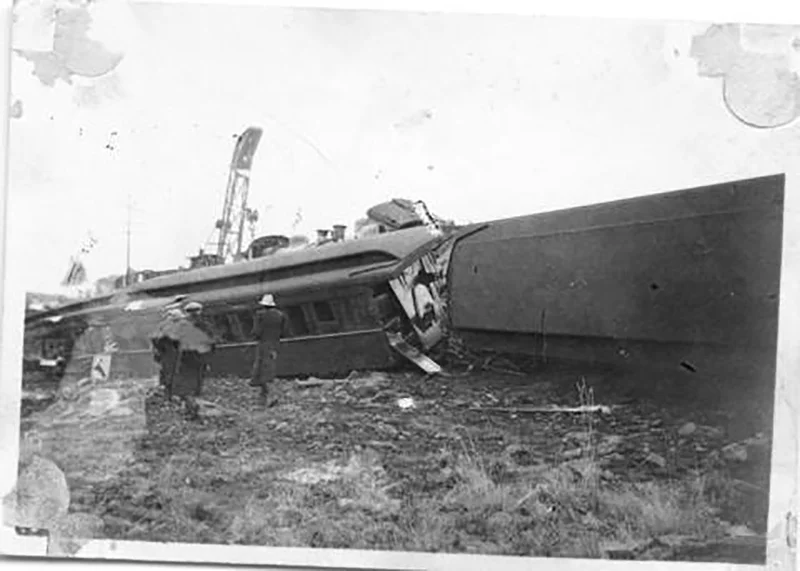
In the quiet, far-flung reaches of the veld approaching Heidelberg there lies a train track that witnessed, and then forgot, one of the largest train accidents in South Africaâs history.
On 27 July 1927, a train carrying migrants from what today are the provinces of the Eastern Cape and KwaZulu-Natal collided with a goods train near the quiet town of Mapleton.
31 people died in the accident and many more were injured.
The way in which the accident was reported plays a significant role in how we understand the story today. The history of the accident, and the accompanying media reporting, provide an interesting case study in the links between history, media and memorialisation.
It is clear, 99 years on, that journalists are âservants of historyâ because their records have given us crucial information about the events of the fateful day.
At around 4.20pm on the day of the accident, a train carrying migrant workers from Natal left Glenroy station. Typically for that time of year, the weather was terribly cold and soft rain, mist and low clouds hung over the veld landscape.
Unbeknown to the travellers on that train, a goods train travelling towards Natal was on the same line and headed towards them. These two trains collided at 4.26pm. Migrant workers were flung out of the carriages. Survivors rushed to look for help.
The scenes of death and destruction were horrible.
Some passengers lay dead beside the railway track, while others suffered lacerated and broken thighs, legs and arms. There was an overwhelming number of injured black passengers, who had been travelling in coaches that were simply ânot built as stronglyâ. These coaches were placed just behind the engine so that, in the event of an accident, no harm would come to white passengers who sat in the safer and more strongly built coaches.
The black migrants who died in the accident were later buried in one large grave at the scene of the accident, whereas the white train staff received individual funerals and memorials.
Those who survived the initial impact had to be innovative, fashioning bandages and splints from pieces of the train seats and smashed carriages. The wait for further relief was long and harsh. Government and railway officials failed to speedily reroute auxiliary trains and deploy personnel.
The first transport for the 60 injured passengers came in the form of large iron disused cattle trucks. On the slow journey to Johannesburg, the cold rain made an already painful journey simply unbearable. The injured migrants were given blankets, but these quickly became wet. By the time the passengers reached the hospital, they had been out in the cold for up to 14 hours.
The shocking experience of the accident was made even worse by the horrendous treatment of the injured on their way to receive medical attention.
The Industrial and Commercial Workersâ Union (ICU), the principal movement for liberation at the time, spoke out against the railway department, arguing that the departmentâs actions constituted a âreproach to civilisationâ. It called for a commission of inquiry into the treatment of the injured.
Instead, two weeks after the accident, the government instituted a commission of inquiry into its causes. The commission stated that the accident âwas due to the negligence of engine driver P de Vries ⦠[who] failed to stop at Mapleton stationâ.
The fireman, a 22-year-old graduate named Norton, was blamed for not reminding the driver that the trainâs âstaff authority only carried them as far as Mapletonâ.
The commission gave little consideration to the poor weather, the excessive workload placed on railway employees, or the fact that Mapleton had recently been upgraded from a railway siding to a station. The driver and the guard were placed on suspension and charges of culpable homicide were considered.
Just over a month after the accident, in September 1927, a memorial service was held at the scene of the crash. It was attended by state and railway dignitaries, political groups and churches. The total number of people at the service came to about 4,000.
People sang the hymns Rock of Ages and Nkosi Sikelelâ iAfrika. Wreaths were placed on the grave by government officials, after which the crowd â swept by emotion â swarmed the grave and sprinkled sand as a final send-off to the dead.
Today, the monument stands as it was left almost 100 years ago. It does not give the names of those killed, nor does it provide the correct number of the deceased. If you manage to find it, there is no mention of the treatment of the injured. It stands alone in a vast expanse of veld, forgotten by most. To those unlikely searchers who have come across the memorial and grave, its occupants remain anonymous, their story buried and forgotten.
Finding the forgotten monument
When we went looking for the monument in 2022, our efforts got lost in the expanse. Where would we even begin to find it?
In the far south of Gauteng, a scarcely used Transnet train track cuts through the small townships of Buhle Park and Roodekop. It winds through the plains of old neglected farmland where subsistence farmers grow mealies, peanuts and beans. As you move south, the plains are more expansive and underused.
Speaking to people gave little evidence of the site of the train accident. Archival records showed that it had happened at the 433 mile post. Although these systems of measurement have been abandoned, luck and a dayâs worth of perseverance took us to a dirt road that leads to the AfriSam Rooikraal Quarry.
As we looked west from this dirt road, a bunch of tall beefwood trees were specks in the distance. They provided the only living signpost of the site. When we found it, we began to understand how important it was that journalists had captured this history.
It was only by riffling through some old newspapers five years ago that we were alerted to this accident. An analysis of the reporting on the accident shows us the benefits of it and the mistakes that were made, and provides fresh perspectives on the role of journalism in preserving history.
Newspapers at the time helped readers to bear witness to the horrors of the disaster. They helped to incite public action by publishing opinion pieces that defied racial division in society.
Not all newspapers ensured this disaster would be remembered equally, however.
Whereas black and working-class newspapers published full lists of the names of those killed and injured, journalists for white liberal newspapers acted as markers of difference through their failure to name the deceased black passengers.
In the reportage of newspapers including The Star, the Rand Daily Mail, Umteteli Wa Bantu and the ICUâs newspaper, The Workers Herald, it is clear that newspapers bore witness to the suffering. This is how we know of the unjust treatment black passengers experienced. The ICUâs newspaper was especially strong in criticising the railway department for its âcallousness and brutalityâ in the treatment of the injured.
Fascinatingly, the accident elicited a degree of nonracial solidarity in the reported speeches of public officials and short letters to the editor. Newspapers foregrounded these letters, further shaping public opinion. At the height of the racist Pact government, a pact between nationalist and labour parties that rose to prominence in 1924, this would have seemed extremely unlikely.
During the period after the Mapleton disaster, newspapers fostered and represented these voices of nonracial solidarity. They spoke of the generosity of white passengers in the treatment of the injured, the heroism of train driver Ernest Milton, and lambasted the government for the treatment of black passengers. Altogether, the voices of the nonracial public took precedence.
Perhaps the most important aspect overlooked at the time of the disaster was the naming of passengers. White liberal newspapers only named the white train staff who died and elaborately described their funerals. Black passengers were, as in their final resting place, an unidentifiable mass.
An ICU article lamented that the final memorial, in the lonely veld, remained without names: âShame on you, really. The stone does not even have the names of its people.â
We have chosen to share the names here to properly acknowledge those who were killed in the disaster.
Memory and the media
As a testament to South Africaâs complex history of migration and segregation, the monument and the history of the disaster deserve attention. The importance of newspapers in excavating this history cannot be overstated.
Reflecting on this research while the country witnessed the horror of the artisanal miners starved underground in Stilfontein revealed that the complexities of bearing witness to suffering through journalism still exist today.
How will we remember those who died in Stilfontein in the future? Will we be able to call them by their names? As it stands, there is no memorial erected â we only have the journalism as a record.
As far as Mapleton is concerned, we hope that, as we approach the centenary, the memorialisation of the disaster will be revitalised and the monument upgraded and cared for. DM
List of people killed in 1927 Mapleton disaster
Note: The list of those killed published in the newspapers does not correspond to that of the South African Railways. The newspapers (The Workers Herald and Umteteli Wa Bantu) had a list of 22 people killed and three dying from injuries (excluding the white train staff). The government numbers put those deceased at 31. Accounting for this discrepancy, it is likely that at least two of the 60 or so injured people died after the newspapers published the list of the injured and dead. (They published their articles on 6 August 1927, whereas the government commission list was published on 8 August 1927.)
Name and place of origin:
Cabane - Umzimkilu
John Mhimnyana - Mount Fletcher
Moses Thomas - Mount Frere
James Nopondo - *Mount Ayliff *
Rbin Nonakasha - Mount Frere
Koloni Ncukana - Matatiele
Jack Manbowe - Masinga
Tili Soldat - Not mentioned
Bekunyana Charile - Johannesburg
Lamane Mbelane - Mount Fletcher
Tweshe Cabane - Umzimkulu
Medilli Jim - Johannesburg
Bonkaliso Nongogo Tabankulu - Not mentioned
Mdede - Mount Frere
Sotwishe - Not mentioned
John Hlanga - Standerton
Fatamposi - Mount Frere
Ncedani - Lusikisiki
Lindani - Mount Frere
George Sokele - General Hospital Johannesburg
Patrick Quinn - Not mentioned
Ben Van As - Not mentioned, later died in hospital
Hermina Modise - Kraal Station
Manungwa Tshabalala - Monet Trichard
Shatane Ratanyele - Quachas Neck
Ernest Milton - Volksrust, buried in Brixton Cemetery, Johannesburg
C Lourens - Standerton, buried in Natal
Laurence Stewart is a PhD candidate at the Wits History Workshop and Dr Thandi Bombi is a lecturer at the Wits Centre for Journalism.
This story first appeared in our weekly DM168 newspaper, available countrywide for R35.