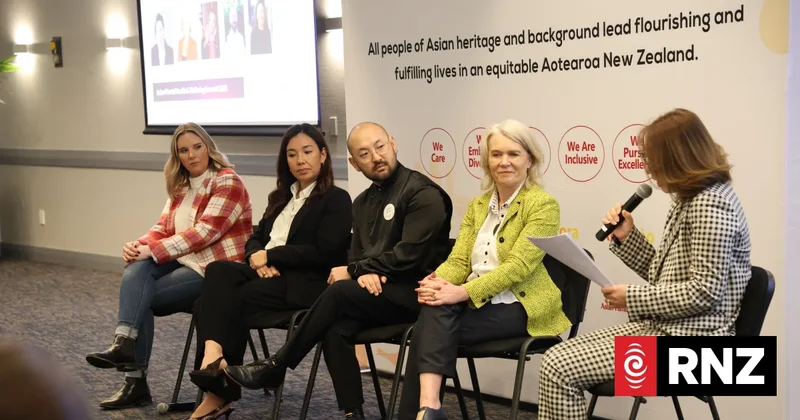
Representatives of all political stripes have vowed to improve Asian mental health if voted into power in the upcoming general election.
Participants at this year's Asian Mental Health and Wellbeing Summit, held by Asian Family Services in Auckland on Wednesday, heard from members of Labour, Green, ACT and Opportunity at a cross-party panel.
National's representatives - Mental Health Minister Matt Doocey and Vanessa Weenink - were absent from the event after embattled Prime Minister Christopher Luxon called an urgent in-person caucus meeting Wednesday morning.
Asian health practitioners at the summit called for increased sustainable funding, a stronger workforce and a raising of awareness.
Ingrid Leary, mental health spokesperson for Labour, highlighted the importance of better data and evidence collection to inform systemic changes.
In recognising equity, the provision of more funding for the health system and the importance of having outcome-based contracts, a capable workforce could help better outcomes for Asians, Leary said.
Lawrence Xu-Nan, ethnic communities spokesperson for the Greens, said getting more Asian voices at the decision-making table and better educational programmes in schools targeting racism could help make an impact.
Xu-Nan said it was important to secure long-term contracts for community providers in the short term.
In the longer term, his party wanted to provide more free services that were culturally appropriate to deal with mental health, gambling harm and domestic violence.
Laura McClure, mental health spokesperson for ACT, agreed that funding was key to success but how such funding could be ring-fenced to achieve results was more important.
She said engaging with the community was also critical.
"I think we do need to do more work as a government around awareness, and around talking to people within their cultural needs, about how they can access services and where to access services," McClure said.
Opportunity leader Qiulae Wong said there was a need for greater funding for primary care and community services, which her party would focus on as a priority.
"Those kinds of broad services that understand the needs of their community, and have the flexibility and the funding to deliver what that community needs could save us enormous amounts in our hospital and emergency departments," Wong said.
"We would like to see more investment and ring-fencing of that funding to be decided on how those communities use it at a sort of individual level."
Leary and McClure also acknowledged the comments New Zealand First leader Winston Peters made to Xu-Nan in July, calling them unacceptable and disappointing.
Mental Health minister Matt Doocey said in an email to RNZ that progress had been made since the inaugural summit in 2024 around wellbeing promotion, telehealth, primary mental health support and specialist services.
He said the latest New Zealand Asian Wellbeing and Mental Health Report highlighted both the progress and the work that remained incomplete.
"The National Party will release all its policies closer to the election," Doocey said.
"However, my focus will continue to be ensuring faster access to support, more frontline workers and creating a better crisis response for all New Zealanders."
Kelly Feng, chief executive at Asian Family Service, said it was encouraging to hear from different political parties about their ambition.
"The matter is how they're going to put [these] into their policy and commit it to those from policy level to implementation and to really addressing Asian well-being in the real world," she said.