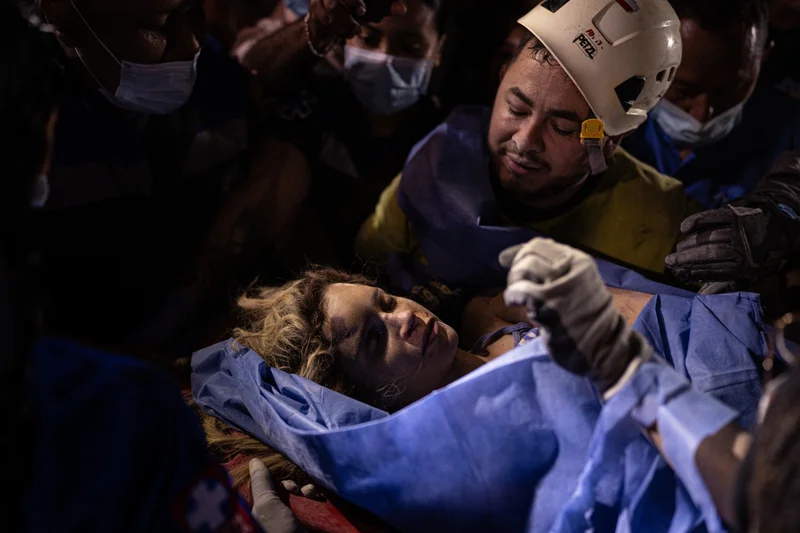
Rescuers keep repeating that the greatest chances of saving an earthquake victim’s life are in the first 72 hours. After that window, the odds fall to as low as 2.5%. Colombia awoke this Wednesday with 48 of those hours gone, and speeding up rescue operations to try to find the roughly 200 people who remain missing, according to figures from the Colombian Association of Capital Cities. So far the quake has left about 200 dead while the physical devastation is still being measured.
President Abelardo de la Espriella has visited Cali, Quibdó, Pereira and Manizales — the cities worst hit by Monday’s magnitude-7.4 earthquake — but he was slow to request international assistance. Facing the tragedy on what was barely his third day in office and before his full team was in place, he insisted that Colombian capacities were sufficient, which is rarely the case. International deployments are common after natural disasters even in countries with strong rescue capabilities: Spain requested help after the floods that hit Valencia province in 2024 and during the summer wildfires that burn hundreds of hectares each year. But De la Espriella resisted. He initially limited his requests to supplies, as El Salvador’s Nayib Bukele explained, and only later agreed to receive brigades and equipment from friendly countries such as the United States and Argentina.
Over recent days the country’s 23 USAR (Urban Search and Rescue) teams, which specialize in these operations, have worked alongside firefighters, residents and other authorities to clear rubble from the more than 100 collapsed buildings in these cities. Unlike the earthquakes in Venezuela less than two months ago, victims and their families have not broadly accused the state of abandonment.
Colombia’s response has been rapid but uneven. Neighbors and relatives, as in any disaster, were the first to arrive on the scene, dropping to the ground and starting to dig. In Quibdó, one of the poorest departmental capitals in the country, there are shortages of heavy machinery and also a lack of public visibility for a tragedy that hit those with the least hardest.
In Pereira, Tuesday showed both faces of the response — or of the lack of it. On a downtown corner an impromptu army of more than 500 people who did not know each other worked together for hours to remove thousands of fragments of rubble searching for survivors. All they had were their hands, their buckets and the help of a handful of firefighters and many volunteers. Meanwhile, on that same street, others were surrounded by dozens of police, firefighters, USAR members and even an Australian rescuer to pull a woman named Daniela out alive. The 32-year-old woman was rescued in apparently good condition after surviving a day and a half under tons of debris. Similar images are being seen in Cali, where other teams are searching for victims such as seven-year-old Violeta and her grandmother Amparo in the Guadalupe residential complex in the southwest of the city.
Miles away from ground zero, the rest of society is mobilizing to provide support that goes beyond rescues. Organizations such as the Red Cross, the Bogotá Food Bank and various foundations and initiatives are collecting money and supplies. Food appears to be sufficient, but items to care for the injured, mattresses, blankets and generators to maintain power where it is still needed remain among the greatest needs.
Providing shelter is also a huge challenge in Quibdó, where shelters were destroyed by the quake, and in Pereira, where the most vulnerable street vendors not only lost their homes but also their livelihoods. At least for now, until they obtain new carts to sell coffee or customers who will buy a phone charger, they have lost both.
“We have to rebuild the city,” Pereira Mayor Mauricio Salazar said, downcast, on the morning of Tuesday. Although the country is still conducting its damage census, the president has said at least 807 schools were affected, including four that collapsed in Quibdó. Three airports remain closed and need repairs. Dozens of water systems, bridges, roadways and hospitals require repairs of varying degrees. Buildings that remain standing but are unusable add to the total. For that reason the United States Geological Survey, which monitors these kinds of disasters worldwide, estimates that reconstruction will probably require between $1 billion and $10 billion, or up to 7% of Colombia’s GDP.
Finance Minister Miguel Gómez Martínez told Congress on Tuesday that the government is considering declaring an economic emergency, like the one the administration of Andrés Pastrana declared when a similar earthquake struck the same area and left more than 1,000 dead in 1999. At that time the decree not only provided extraordinary funds but also created a special institutional framework — the so-called Fund for the Reconstruction of the Coffee Axis, or Forec — specifically aimed at reactivating the regional economy.
The number of businesses that could disappear because they have nowhere to operate or because their inventory capital was lost has not yet been measured. Those bankruptcies produce a chain effect of job losses, strain on the financial sector and difficult family situations. De la Espriella has already mentioned rent subsidies for families that cannot pay for housing, suspension of utility payments and postponement of income tax filings. Longer-term reconstruction remains to be determined.
Meanwhile, thousands of families are looking for a place to spend a second night after losing their homes or because they have not yet been cleared to return amid doubts about structural safety. Under the rubble, the 72-hour clock keeps running.
Sign up for our weekly newsletter to get more English-language news coverage from EL PAÍS USA Edition